

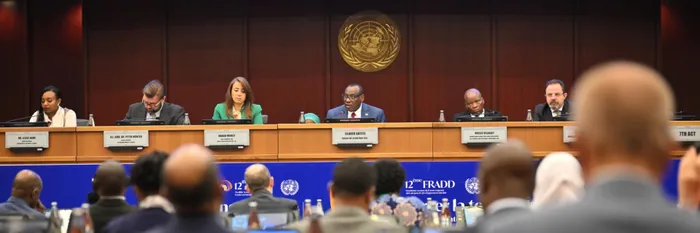
Convened by the United Nations Economic Commission for Africa (UNECA), the forum brought together more than 1,500 participants from 48 countries, including ministers, policymakers, experts and civil society representatives.
Image: Supplied
African leaders have issued a stark warning that the continent is falling behind on global development and climate goals, adopting a new declaration that calls for urgent, coordinated action to reverse slow progress and deliver tangible results.
The declaration, agreed at the close of the Twelfth Africa Regional Forum on Sustainable Development in Addis Ababa on Friday, underscores growing concern that Africa is off track on the United Nations Sustainable Development Goals (SDGs), with progress lagging on most targets and reversing on several.
Convened by the United Nations Economic Commission for Africa (UNECA) alongside partners including the African Union Commission and the African Development Bank, the forum brought together more than 1,500 participants from 48 countries, including ministers, policymakers, experts and civil society representatives.
At the heart of the discussions was the newly adopted Addis Ababa Declaration on “Turning the Tide,” which outlines a roadmap for accelerating implementation of both the 2030 Agenda and the African Union Agenda 2063.
Participants highlighted deep structural challenges, including an SDG financing gap estimated at between $670 billion and $848bn annually, widespread energy poverty affecting around 600 million people, and persistent deficits in water, sanitation and infrastructure.
Closing the forum, Hanan Morsy, deputy executive secretary and chief economist at UNECA, said the continent faces a decisive moment shaped by overlapping crises.
“The message from this Forum is clear: Africa’s trajectory will be determined not by constraints alone, but by how decisively we act,” she said.
Morsy noted that while some progress has been made—particularly in expanding access to water and energy—millions still lack basic services, and structural transformation remains incomplete.
She also warned that rapid urbanisation is outpacing planning and service delivery, while financing pressures are intensifying.
“The conclusion is straightforward: incremental progress will not deliver the SDGs,” she said, urging countries to scale up coordinated action, accelerate digital transformation and reform both domestic and global financing systems.
The declaration places strong emphasis on five priority areas under review in 2026: water and sanitation, energy, industrialisation, sustainable cities and partnerships.
It calls for increased investment in renewable energy, clean cooking solutions and regional power integration, as well as forward-looking industrial strategies aligned with megatrends such as artificial intelligence and the green transition.
Urban development also featured prominently, with ministers urging governments to treat cities as engines of inclusive growth through investments in housing, infrastructure and safer environments for vulnerable populations.
Beyond development goals, climate action emerged as a central theme, particularly as Africa prepares to host a future global climate summit. At the parallel 7th Africa Climate Talks, leaders stressed the need to move beyond pledges to measurable implementation ahead of COP32, which Ethiopia is set to host in 2027.
Addressing the talks, Claver Gatete, executive secretary of UNECA, said the upcoming summit must restore credibility to the global climate system.
“COP32 will be a defining test of credibility,” he said. “A test of whether we can move from commitments to results. A test of whether trust in the multilateral system can be restored through delivery. And a test of whether Africa’s priorities will finally be matched with action at scale.”
Gatete highlighted the disproportionate burden Africa faces despite contributing less than 4% of global emissions, noting that climate impacts—from droughts to floods—are already undermining food security, infrastructure and economic stability.
He also pointed to a massive financing shortfall, with African countries requiring an estimated $277bn annually to meet their climate targets but receiving only a fraction of that amount.
“This is where the narrative must change,” Gatete said. “To define Africa solely by vulnerability would be to miss the full picture. The continent also offers significant solutions.”
These include abundant renewable energy resources, rich biodiversity and a rapidly growing young population capable of driving innovation and green growth.
The Addis Ababa Declaration will serve as Africa’s unified position at upcoming global forums, including the High-Level Political Forum on Sustainable Development and future climate negotiations.
It also calls for reforms to the international financial architecture, greater domestic resource mobilisation and stronger participation of youth and women in shaping development outcomes.
As the continent looks beyond 2030, leaders emphasised the need for a new global framework that reflects Africa’s priorities and moves beyond traditional measures of economic progress.
“The challenge is not diagnosis, it is delivery,” Morsy said. “Let us move from dialogue to action, from commitments to results, and from fragmentation to scale.”
BUSINESS REPORT