

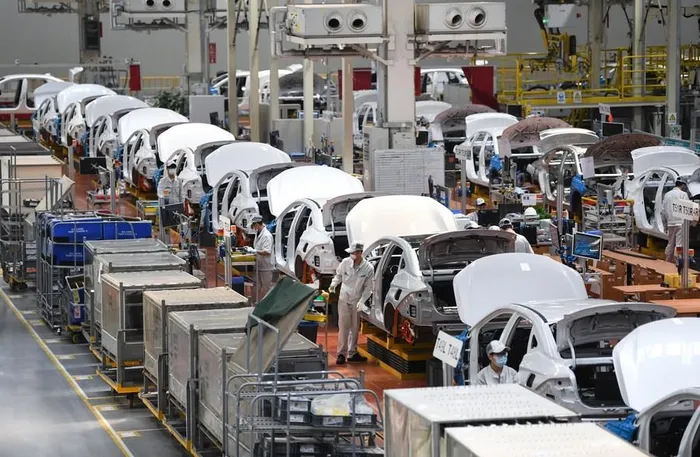
This photo shows the assembly line of GAC Aion, an NEV subsidiary of Guangzhou Automobile Group Co., Ltd. (GAC Group), in Guangzhou, Guangdong, China. Despite the growing presence of new entrants, NADA chairperson Brandon Cohen said the industry's transformation should be viewed as an opportunity rather than a disruption.
Image: Xinhua
South Africa's strong new vehicle sales are being driven by far more than the rapid rise of Chinese car brands, with established manufacturers continuing to dominate the market despite growing competition, according to the National Automobile Dealers' Association (NADA).
The association on Tuesday said the record June sales figures have created the impression that affordable, technology-rich Asian brands have transformed the country's automotive landscape.
However, NADA chairperson Brandon Cohen argued that the data tells a more balanced story.
"We've just witnessed the strongest June performance in nearly two decades, dating back to 2007," Cohen said.
"In an environment still clawing its way through high interest rates and inflationary pressure, many observers have resolved to attribute this boom entirely to the rapid influx of budget-friendly Chinese brands. But this is not entirely the case."
Cohen said traditional manufacturers continue to account for the bulk of new vehicle sales, demonstrating that South African consumers remain loyal to well-established brands.
Toyota retained its position as the country's best-selling brand in June, recording 12,417 vehicle sales. It was followed by Suzuki with 5,689 units and Volkswagen with 5,613, while Hyundai and Ford rounded out the top five with 2,986 and 2,961 sales respectively.
"Newer entrants are expanding their footprints at a breakneck pace and scoring highly impressive volumes. But they are not replacing the traditional brands," Cohen said.
He added that the current market recovery extends beyond passenger vehicles to include light commercial vehicles, heavy trucks and buses.
According to Cohen, improved consumer confidence has played a significant role in the market's recovery, supported by a more stable political environment and measures that helped cushion motorists from global oil price volatility.
NADA also dismissed concerns that the growing number of vehicle brands and the rise of multi-franchise dealerships threaten jobs in the retail motor sector.
Instead, Cohen described the shift as an evolution of the dealership model rather than a decline.
"Sharing real estate and overhead costs optimises dealership functionality," he said, adding that dealerships selling multiple brands were benefiting from increased customer traffic, particularly in the sub-R400,000 price segment.
However, he cautioned that long-term dealership success depends on more than selling new vehicles.
"A dealership cannot survive on the margin of a new-car invoice alone," Cohen said, stressing the importance of after-sales services, workshops, parts availability, technical expertise and customer support.
The changing new vehicle market is also reshaping the used car sector.
Cohen said increased competition from competitively priced new vehicles is placing downward pressure on prices in the R350,000 to R500,000 pre-owned market as dealers adjust values to remain competitive.
He also expects a shortage of premium used vehicles over the medium term as more buyers continue opting for lower-priced vehicles instead of trading into luxury models.
Despite the growing presence of new entrants, Cohen said the industry's transformation should be viewed as an opportunity rather than a disruption.
"Ultimately, the influx of new entrants has not been a complete revolution, but rather an evolution, marked by adaptation and innovation," he said. "The biggest winner is ultimately the South African consumer, who is spoilt for choice."
BUSINESS REPORT