

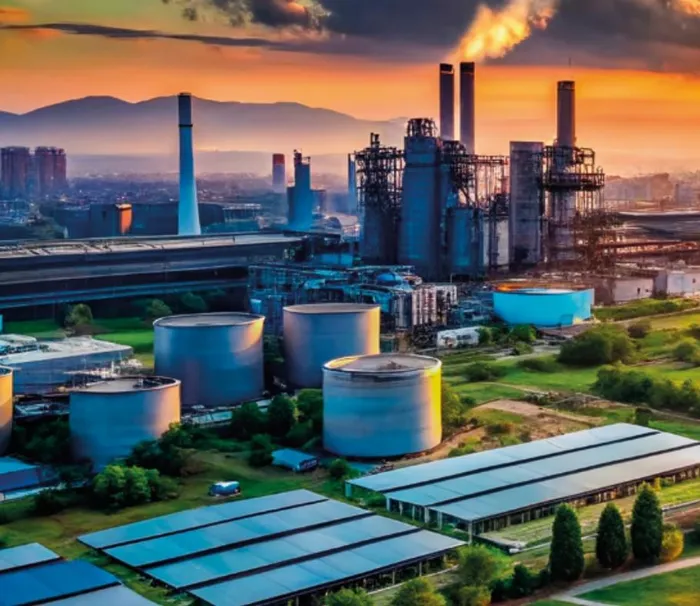
According to the report, Africa's abundant natural resources, youthful population and expanding consumer markets position it to benefit from multinational companies seeking to diversify production away from traditional manufacturing centres.
Image: Supplied
Africa must stop viewing geopolitical tensions and global trade disruptions as threats and instead exploit them to transform the continent into a global manufacturing and industrial powerhouse, according to the African Export-Import Bank's (Afreximbank) African Trade Report 2026.
The report argues that the restructuring of global supply chains, rising protectionism and geopolitical rivalry present Africa with its biggest opportunity in decades to shift away from exporting raw materials towards producing and trading higher-value manufactured goods.
In an exclusive interview with Business Report on Friday, Afreximbank chief economist and managing director of research and trade intelligence, Dr Yemi Kale, said the continent stands at a defining moment.
"The central message is that current geopolitical disruptions should not be seen merely as a risk for Africa to navigate but more as an opportunity to exploit," Kale said.
He said the world economy was undergoing profound restructuring as companies diversify supply chains, governments revive industrial policies and resilience increasingly outweighs cost minimisation in investment decisions.
"Historically, Africa has often been affected by these global shifts without significantly influencing them. The African Trade Report 2026 argues that this moment can be different."
The report found that Africa's real GDP growth accelerated from 3.4% in 2024 to 4.5% in 2025, outperforming global growth despite geopolitical tensions, trade disputes and slowing expansion in advanced economies.
Merchandise trade expanded by 6.1% to approximately $1.5 trillion, while intra-African trade grew 5.5% to $213.8 billion, reflecting stronger regional integration and improving economic resilience.
Kale said the changing composition of African trade was even more significant than the increase in trade volumes.

Afreximbank chief economist and managing director of research and trade intelligence, Dr Yemi Kale, said the continent stands at a defining moment.
Image: Supplied
"The key highlight is not just the growth in trade volumes and values, but also that Africa is trading more with itself."
Unlike exports to overseas markets, which remain dominated by raw commodities, trade within Africa increasingly consists of manufactured and processed products, signalling gradual structural transformation.
The report notes that global disruptions—including conflicts in the Middle East, attacks on shipping through the Red Sea and protectionist trade policies—have exposed the vulnerabilities of long, globally concentrated supply chains.
Rather than seeing these developments purely as risks, Afreximbank argues Africa should position itself as an alternative production and manufacturing hub.
Shipping companies rerouting vessels around the Cape of Good Hope have increased transit times by between 10 and 14 days while driving up freight, fuel and insurance costs.
Although this has disrupted international trade, it has also enhanced the strategic importance of African ports and logistics corridors while strengthening the case for expanding regional manufacturing.
According to the report, Africa's abundant natural resources, youthful population and expanding consumer markets position it to benefit from multinational companies seeking to diversify production away from traditional manufacturing centres.
Kale said investors should increasingly view Africa as a destination for value creation rather than simply a source of raw materials.
"The report sends a fundamentally different message from the traditional narrative. Africa is increasingly becoming a story of industrialisation, supply-chain diversification and regional integration."
He said the biggest opportunities lie in industries where Africa can move further up the value chain.
These include agribusiness, mineral beneficiation, pharmaceuticals, automotive manufacturing, petrochemicals, renewable energy technologies, digital services and creative industries.
"Ultimately, the biggest opportunity is not simply increasing trade volumes but increasing the value added before products leave African borders."
However, the report warns that significant structural obstacles continue to constrain the continent's ambitions.
Africa's trade finance gap remains about $74bn, limiting the ability of businesses—particularly small and medium-sized enterprises—to participate fully in regional and international trade.
Kale said addressing the financing shortfall would require stronger African financial institutions, expanded trade finance products, improved risk-sharing mechanisms and greater use of digital payment platforms such as the Pan-African Payment and Settlement System (PAPSS).
"If Africa is to fully realise the opportunities presented by the African Continental Free Trade Area, expanding access to trade finance must remain a strategic priority," he said.
The report also identifies five priorities for accelerating industrialisation: investing in reliable infrastructure and energy, expanding industrial and trade finance, developing technical skills and technology, fully implementing the African Continental Free Trade Area (AfCFTA), and ensuring long-term policy certainty for investors.
Afreximbank argues that Africa must also deepen regional value chains by processing its own agricultural products, minerals and energy resources rather than exporting raw materials for processing elsewhere.
The bank believes the continent's transition towards manufacturing and value-added production will determine whether it merely adapts to a changing global economy or emerges as one of its principal beneficiaries.
"The countries and companies that position themselves early for this transition will be the primary beneficiaries," Kale said.
BUSINESS REPORT