

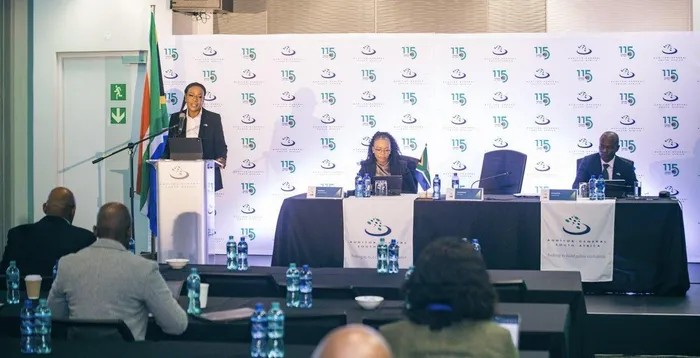
Presenting the 2024/25 municipal audit outcomes to Parliament on Thursday, the Auditor-General Tsakani Maluleke said the late or non-submission of financial statements by municipalities in the Free State, Northern Cape and North West reflected capacity and system challenges that were not addressed timeously by municipal leadership.
Image: Supplied
Five municipalities failed to submit their annual financial statements for audit by the legislated deadline, highlighting persistent governance and capacity weaknesses in local government despite improvements in overall audit compliance.
Presenting the 2024/25 municipal audit outcomes to Parliament on Thursday, the Auditor-General Tsakani Maluleke said the late or non-submission of financial statements by municipalities in the Free State, Northern Cape and North West reflected capacity and system challenges that were not addressed timeously by municipal leadership.
The municipalities were among only five out of 257 municipalities that missed the statutory deadline, as local government achieved a record 98% on-time submission rate, up from 92% in 2021/22.
By the Auditor-General’s reporting cut-off date of 30 April 2026, the audits of Free State municipalities Nala and Maluti-a-Phofung had not been completed because of late submission and non-submission of financial statements respectively.
Nala’s audit was subsequently completed by the end of May, resulting in a qualified audit opinion.
While acknowledging improvements in some areas, Maluleke said the broader state of local government remained deeply concerning.
“In 2024-25, five municipalities did not submit their financial statements for auditing by the legislated date. The main reasons for the non-compliance by municipalities in the Free State, Northern Cape and North West are capacity and system challenges, which have not been appropriately and timeously dealt with by the accounting officer, mayor and council,” she said.
“Over the past four years, mayors and councils of the 6th administration have made limited progress to strengthen governance and improve service delivery, as residents and businesses continue to experience unreliable service delivery, environmental hazards and deteriorating infrastructure.”
She added that municipalities had also overseen worsening financial health in many parts of the country.
The AGSA’s consolidated report found that only 39 municipalities, representing 15% of the total audited municipalities, achieved clean audits during the 2024/25 financial year. Those municipalities collectively managed R52.6 billion, or just 8% of total local government expenditure.
At the same time, 38 municipalities regressed in their audit outcomes compared with 2020/21, including three metropolitan municipalities.
Maluleke noted that significant gains had nevertheless been made in reducing the number of municipalities receiving disclaimer audit opinions, the worst possible audit outcome. The number of disclaimer opinions declined from 29 in 2020/21 to eight in 2024/25, while KwaZulu-Natal, Limpopo and Mpumalanga eliminated disclaimer opinions entirely.
Maluleke described the reduction as one of the most encouraging developments in recent years.
“We have moved since the beginning of this term of administration for local government from 29 disclaimers to now eight disclaimers,” Maluleke said.
“For the very first time, we’ve actually got a very low number of municipalities in this category. In fact, we went back to our records and we couldn’t find any year when we had this low number of disclaimers.”
She attributed the improvement to stronger oversight from national and provincial governments, parliamentary committees and the AGSA’s material irregularity process.
Despite these gains, financial reporting quality remains a major concern. According to the report, 195 municipalities, or 76%, submitted financial statements containing material misstatements, while 99 municipalities received modified audit opinions. Without corrections made during the audit process, only 24% of municipalities would have achieved unqualified opinions compared with the 61% that eventually did.
The AGSA also found that 62 municipalities were in severe financial distress, with 54 disclosing going-concern uncertainties and only 35% assessed as having good financial health. More than half of municipalities lacked sufficient current assets to meet their obligations, while 72% did not have enough cash to pay creditors.
Maluleke warned that poor accountability and weak governance continued to undermine service delivery and financial sustainability.
“The poor responsiveness and disregard for accountability at municipal level have had tangible consequences,” she said, adding that leadership across all spheres of government must act decisively to strengthen institutional capability, enforce consequences for wrongdoing and improve service delivery outcomes.
With local government elections approaching, Maluleke urged incoming councils and mayors to use the audit findings as a roadmap for reform and to build municipalities characterised by accountability, transparency and sustainable performance.
BUSINESS REPORT