

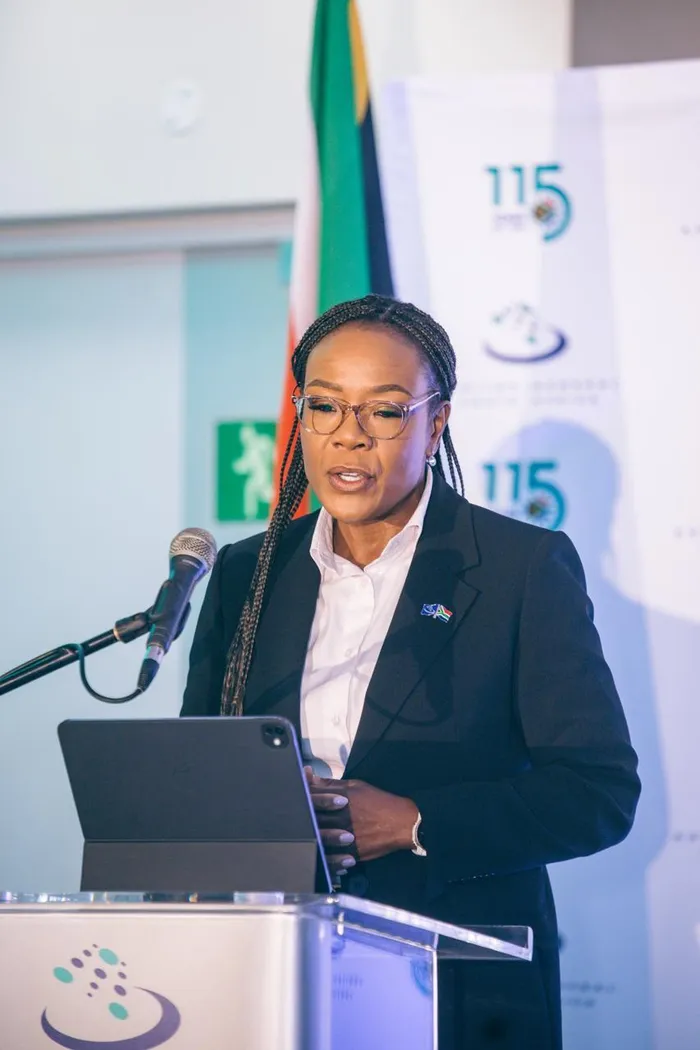
Auditor-General Tsakani Maluleke on Wednesday presenting the consolidated general report on local government audit outcomes for 2024-25.
Image: Supplied
South Africa’s local government sector has recorded some notable audit improvements over the past five years, but Auditor-General Tsakani Maluleke has warned that persistent financial mismanagement, weak accountability and deteriorating performance in major metros continue to pose significant risks to service delivery, economic growth and public confidence.
Presenting the latest local government audit outcomes for the 2024/25 financial year, Maluleke on Wednesday said the overall state of local government remains concerning despite progress in reducing the number of municipalities receiving the worst audit opinions.
“Based on the overall audit outcomes for 2024/25 and the insights from our audit work at metropolitan municipalities and the management of finances, infrastructure, procurement, contracts and consequences, we can only conclude that limited progress has been achieved and that the state of local government remains concerning,” Maluleke said.
The report shows that 57% of municipalities remained unchanged from their audit status in 2020/21, while 15% regressed, including municipalities that previously achieved clean audits and three metropolitan municipalities. These regressions account for 24% of total local government expenditure, highlighting the scale of the challenge.
Only 39 municipalities, representing 15% of the total, achieved clean audits in 2024/25. Together, they administered just R52.6 billion, or about 8% of the total local government expenditure budget of R622.56bn.
While the number of municipalities receiving disclaimed audit opinions has fallen significantly over the term of the sixth administration, Maluleke cautioned that this success should not obscure deeper governance weaknesses.
Maluleke said 23 municipalities improved from disclaimer status, a development she described as worthy of recognition. However, the most common audit outcome remains an unqualified audit opinion with findings, a category that now includes 117 municipalities.
“The most prevalent audit outcome in 2024-25 was an unqualified audit opinion with findings. Although this outcome is frequently perceived as favourable, the municipalities in this category continue to exhibit high levels of non-compliance, together with significant weaknesses in financial and performance management,” the report noted.
A major concern highlighted by the Auditor-General is the deterioration in metropolitan municipalities, which collectively manage R335.97bn, or 54% of the country’s municipal expenditure budget, and serve nearly 8.9 million households.
“The regression in audit outcomes among the metros is particularly concerning,” the report stated, warning that deficiencies in financial and performance management within these municipalities have the potential to negatively affect almost half of South Africa’s households.
The financial implications extend beyond audit outcomes. The Auditor-General found widespread weaknesses in consequence management, with municipalities often failing to investigate unauthorised, irregular and fruitless expenditure or identify officials responsible for financial losses.
Maluleke said accountability remained one of the biggest obstacles to sustainable improvement.
“During the past year, I issued the first-ever certificate of debt, compelling a municipal manager to reimburse the municipality for a financial loss suffered because of his failure to act and remedy the situation,” she said.
“This unprecedented measure underscores the seriousness of the prevailing accountability deficit and affirms that sustained inaction and non-responsiveness will not be tolerated.”
She further warned that there is “insufficient commitment to action recoveries and enforce consequences, which perpetuates a culture characterised by a lack of responsiveness and accountability”.
The consequences are increasingly visible in infrastructure delivery and service provision. The audit identified weaknesses in more than half of the infrastructure projects reviewed, including delays in housing, roads, electricity, water and sanitation projects.
Poor project management and inadequate oversight continue to slow service delivery and undermine development objectives.
Despite these concerns, Maluleke acknowledged that there have been successes. Improvements in audit outcomes were driven by greater stability in key financial management positions, stronger financial reporting and better implementation of prior-year audit recommendations.
Municipalities that sustained clean audits demonstrated the value of stable leadership, effective oversight and strong internal controls.
She said meaningful reform will require all participants in the local government accountability ecosystem to perform their responsibilities diligently.
“Local government requires fundamental and far-reaching reform, driven by capable, collaborative and ethical leaders that are committed to building municipalities characterised by sustained institutional performance, accountable leadership and officials, transparent systems and processes as well as strong institutional integrity,” Maluleke said.
BUSINESS REPORT