

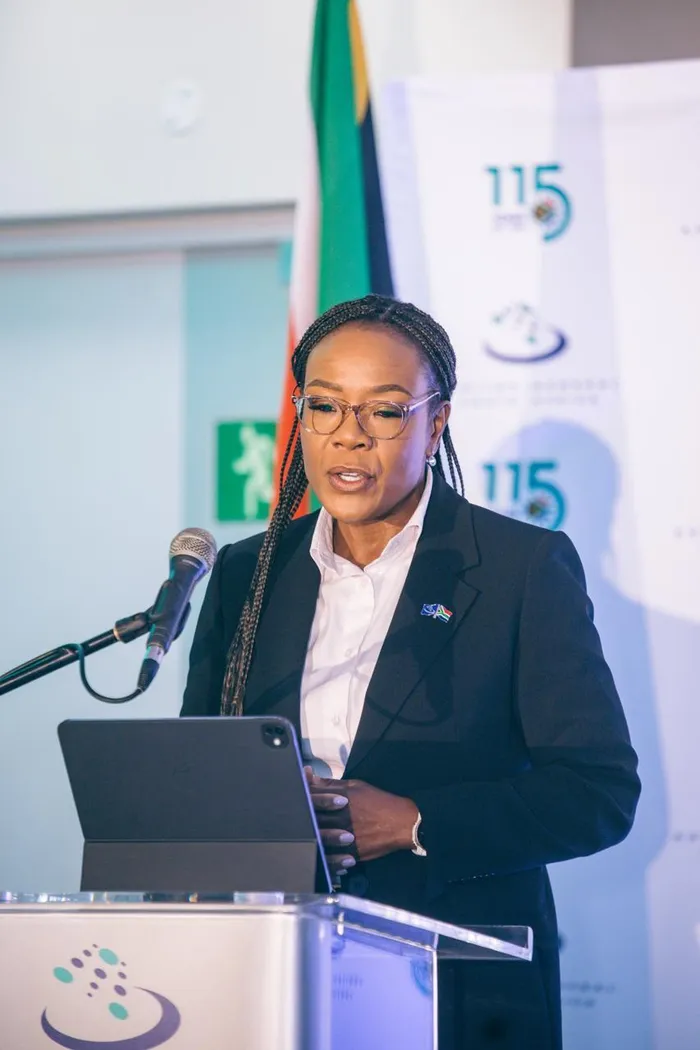
Auditor-General Tsakani Maluleke on Wednesday presenting the consolidated general report on local government audit outcomes for 2024-25.
Image: Supplied
The City of Johannesburg is facing mounting financial, governance and service delivery challenges that threaten its ability to fulfil its role as South Africa’s economic powerhouse, Auditor-General Tsakani Maluleke has warned.
The warning comes in the Auditor-General’s latest report on local government audit outcomes on Wednesday, which paints a troubling picture of deteriorating financial management, weak accountability and declining institutional capacity within the country’s largest metropolitan municipality.
Johannesburg’s standalone audit regressed from an unqualified audit opinion to a qualified audit opinion in the 2024/25 financial year after the city failed to correct material errors identified during the audit process.
While the city’s consolidated audit outcome, which includes its municipal entities, remained unqualified with findings, the regression in the core administration raised concerns about the municipality’s financial governance.
Addressing Parliament on the audit outcomes, Maluleke said Johannesburg requires urgent intervention from both oversight structures and the executive.
“The city itself, outside of the entities, has got a qualified audit opinion this year. It had been unqualified for many years, and this time around they were unable to correct the errors we identified through the audit,” she said.
She noted that many of Johannesburg’s major municipal entities, including City Power, Johannesburg Water, Pikitup and the Johannesburg Roads Agency, have remained in the category of unqualified audits with findings for years.
“Most of those entities have got unqualified audit opinions with findings. Some of them for more than a decade, meaning that they can put the financial statements together for the audit process, but their financial governance is weak,” Maluleke said.
According to the Auditor-General’s report, the metro continues to struggle with procurement non-compliance, weak performance management and ineffective oversight, while investigations into unauthorised, irregular and fruitless expenditure have been delayed or left incomplete.
The report found that instability in both political and administrative leadership weakened accountability during the audit period.
Vacancies in key management positions, including within finance and internal audit functions, further undermined the city’s ability to implement corrective measures and strengthen controls.
Johannesburg’s financial health also remains under significant pressure.
The city has also committed R10.3 billion to the Politically Facilitated agreement (PFA) deal with representatives of its employees to address a long-running salary increase dispute after it was flagged by Finance Minister Enoch Godongwana.
The city's transport department on Tuesday also confirmed that Joburg Roads Agency vehicles cannot operate because refuelling services have been suspended due to insufficient funds, leaving critical service delivery in limbo.
The Auditor-General identified liquidity constraints, high debt levels and an inability to collect revenue efficiently as key concerns. The city incurred unauthorised expenditure of R2.38bn during the year, largely due to overspending.
Infrastructure challenges continue to compound these financial pressures. The report highlights ongoing electricity distribution losses through City Power Johannesburg and persistent water and sanitation challenges at Johannesburg Water.
Delays in infrastructure delivery, weak project management and inadequate maintenance have contributed to high water and electricity losses and negatively affected service delivery. The city’s performance against key service delivery targets was also poor.
The Auditor-General reported that Johannesburg achieved only 36% of its planned targets for infrastructure development and refurbishment. One example cited was the provision of electricity to households in informal settlements, where only 1,059 connections were achieved against a target of 2,000.
Maluleke warned that if governance weaknesses are not addressed, Johannesburg risks further financial deterioration and declining investor confidence.
“It’s crucial that the institutional arrangements within Johannesburg be attended to. If we don’t do that, we’re going to continue on this slide where financial health deteriorates, where service delivery continues to be compromised,” she said.
The Auditor-General has recommended that the city stabilise senior management by filling critical vacancies, implement agreed audit action plans and enforce consequence management.
The report also calls on the mayor to hold officials accountable for longstanding governance failures and ensure measurable progress in addressing financial and operational weaknesses.
Despite its challenges, the report notes that Johannesburg remains central to South Africa’s economy, serving approximately 2.25 million households and acting as a major hub for finance, commerce and manufacturing.
However, the Auditor-General cautioned that without stronger leadership, accountability and financial discipline, the city’s ability to drive economic growth and deliver reliable services will remain at risk.
BUSINESS REPORT