

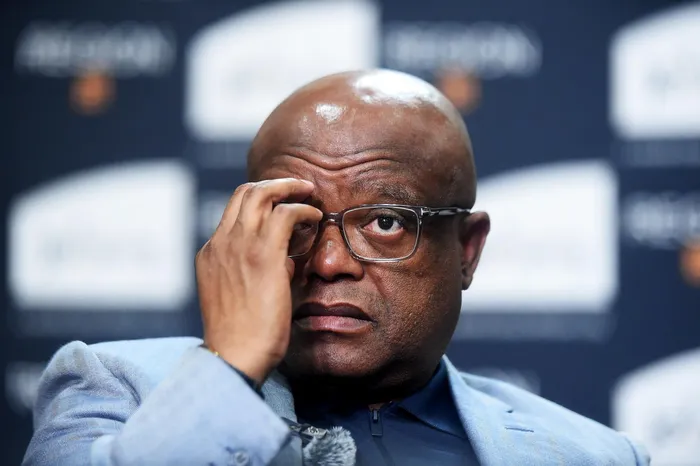
Joburg Mayor Dada Morero traced many of Johannesburg’s current challenges to the city’s operating model established through the Egoli 2002 restructuring programme, which created 14 municipal-owned entities responsible for delivering services on a business footing.
Image: Itumeleng English / Independent Newspapers
The City of Johannesburg has acknowledged serious governance and financial management shortcomings after the Auditor-General (AG) raised serious concerns about governance failures, weak compliance controls, deteriorating infrastructure and poor information technology management.
The AG last week told Parliament that the majority of the city's municipal entities remain trapped in a cycle of poor governance and inadequate accountability.
Appearing on Tuesday before Parliament’s Standing Committee on Public Accounts (Scopa) and the Portfolio Committee on Cooperative Governance and Traditional Affairs to account for its 2024/25 audit outcomes and ongoing investigations by the Special Investigating Unit (SIU), the City's leadership conceded that Johannesburg continues to face deep-rooted structural, financial and governance challenges.
Joburg Mayor Dada Morero said the city received an unqualified audit opinion on its consolidated group annual financial statements for the 2024/25 financial year.
However, he said the core municipality received a qualified audit opinion on its performance information and annual financial statements, highlighting persistent weaknesses in internal controls and financial management.
“Not all the issues of the dispute could be satisfactorily resolved for the period under audit,” Morero said, adding that management was developing a remedial action plan to address the root causes identified by the AG.
Morero traced many of Johannesburg’s current challenges to the city’s operating model established through the Egoli 2002 restructuring programme, which created 14 municipal-owned entities responsible for delivering services on a business footing.
These entities include City Power, Johannesburg Water, Pick it Up, the Johannesburg Roads Agency, City Parks and the Johannesburg Property Company.
While the model helped rescue the city from near insolvency more than two decades ago, Morero acknowledged that several entities are now facing significant operational and financial difficulties.
Johannesburg Water is currently grappling with non-revenue water losses of 44.7%, translating into approximately R3.8 billion in lost revenue. City Power’s total electricity losses stand at around 30%, with non-technical losses amounting to R4bn and technical losses estimated at R1.7bn.
Morero also highlighted financial challenges at the Johannesburg Social Housing Company, which is carrying a deficit of about R559 million.
Despite these difficulties, Morero pointed to several municipal entities that continue to perform well.
The Johannesburg Market achieved a clean audit and recorded a surplus of R170m while maintaining a 43% share of the national fresh produce market.
The Johannesburg Property Company reported a surplus of R140m, while the Johannesburg Tourism Company maintained a clean audit and posted a surplus.
One of the key concerns raised during the presentation was the city’s continued struggle with irregular, unauthorised, fruitless and wasteful expenditure.
According to Morero, Johannesburg has reduced its accumulated unauthorised and irregular expenditure balance by 44%, from R54.23bn to approximately R30.3bn, largely through council-approved write-offs.
However, he admitted that new unauthorised expenditure remains stubbornly high at around R9bn annually.
“New irregular expenditure of about R3.7bn continues to be recognised,” Morero said, adding that investigations into a substantial portion of these expenditures are still underway.
Fruitless and wasteful expenditure has also increased significantly, reaching R938m in the 2024/25 financial year, mainly due to interest and penalty charges incurred across municipal entities.
City Manager Dr Floyd Brink accepted responsibility for the municipality’s qualified audit outcome, describing it as a serious setback that requires urgent intervention.
“One would not want to minimize the outcome of the Auditor General, but we do respect the Office of the Auditor General as well as the audit opinion that we have received. The 2024/2025 audit opinion was a mixed one.
“But I want to make it clear from the outset that the qualification is quite serious. And as the accounting officer, I accept the responsibility relating to those control failures.”
Brink explained that the AG’s findings were primarily linked to weaknesses involving summary data and expenditure cut-off processes. Brink said the city has already begun implementing remedial measures and strengthening oversight structures to improve future audit outcomes.
“We have shifted the city’s focus specifically to address those weaknesses and to ensure that we hold officials accountable where evidence supports such action,” he said.
Brink added that the city had intensified engagement with executive management, finance directors and municipal entities to drive accountability and ensure a comprehensive response to the AG’s findings.
BUSINESS REPORT