

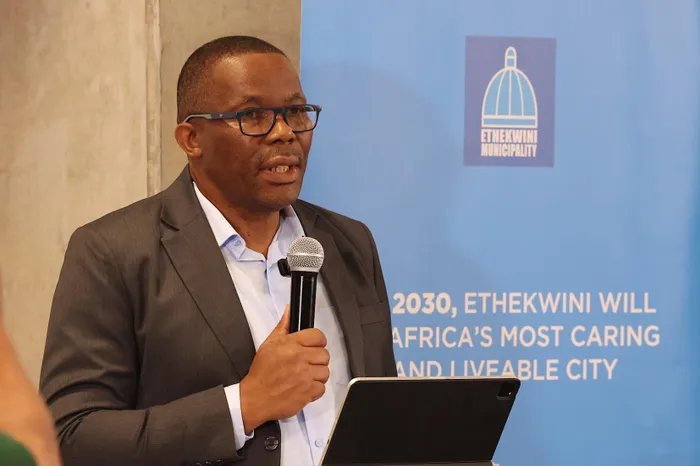
EThekwini mayor Cyril Xaba. With a budget of R71 billion, the metro’s scale and economic significance mean that its governance and service delivery outcomes have a substantial impact on the province’s overall development trajectory.
Image: Siyabulela Duda / GCIS
The eThekwini Metropolitan Municipality has emerged as one of only two metropolitan municipalities to secure an unqualified audit opinion on its financial statements, standing out against a backdrop of deteriorating audit outcomes across the metros, according to the Auditor-General (AG) Tsakani Maluleke.
With a budget of R71 billion, the metro’s scale and economic significance mean that its governance and service delivery outcomes have a substantial impact on the province’s overall development trajectory.
Presenting the 2024-25 local government audit outcomes report, Maluleke on Thursday said the country’s metros continued to regress, despite their critical role in serving nearly 25 million people and managing more than half of local government expenditure.
“The audit outcomes of metros continued to regress in 2024-25, reflecting that these fundamentals are not in place,” Maluleke said in the report.
She noted that none of the eight metros achieved a clean audit, while the number of metros receiving qualified audit opinions increased from two to five during the current local government administration.
However, eThekwini distinguished itself by being one of only two metros whose financial statements received an unqualified audit opinion.
“The financial statements of only City of Cape Town and eThekwini and the consolidated financial statements of only City of Johannesburg received unqualified audit opinions,” the report stated.
“The separate financial statements of the City of Johannesburg, without its municipal entities, regressed to a qualified audit opinion.”
The municipality also performed comparatively well on financial health indicators.
Malukele said the qualified audit opinions on the financial statements of the other five metros were due to weaknesses in their in-year and year-end reporting, poor record-keeping, weak internal review and reconciliation processes as well as over-reliance on the audit process to identify material misstatements.
According to the AG, “only City of Cape Town and eThekwini had good financial health indicators”, while the remaining metros displayed multiple signs of financial distress.
The findings place eThekwini in a stronger position than several of its metropolitan counterparts, including the City of Ekurhuleni and Mangaung, which were identified as among the worst-performing metros from a financial health perspective.
Despite eThekwini’s relative strength, the AG warned that eThwkini was among most metros that continue to neglect information and communication technology (ICT) and cybersecurity controls.
The AG said weaknesses in ICT environments are contributing to broader governance and service delivery challenges.
The report showed that eThekwini's current ICT funding is misaligned with the complexity of metro operations and the digital transformation required, as 72% of total ICT spend was on system maintenance of existing legacy systems, software licences as well as payment of service providers.
The report said the continued reliance on manual processes also increases the risk of errors, data manipulation and weak accountability due to the lack of automated audit trails.
“ICT systems rely heavily on manual, spreadsheet-based processes with limited automation and no system integration, resulting in inefficiencies, inconsistent data and weak audit trails,” it said.
“This fragmented environment compromised the accuracy, timeliness and reliability of performance information, ultimately affecting decision-making and the quality of service delivery. The absence of integration across housing, water and sanitation, and electricity leads to duplicated work, higher operational costs and incomplete or inconsistent data, limiting management’s ability to make informed decisions.”
The AG also warned that broader weaknesses in local government continue to undermine service delivery and accountability.
Maluleke said the outgoing sixth local government administration had failed to achieve the turnaround many South Africans had hoped for.
“Over the past four years, mayors and councils of the 6th administration have made limited progress to strengthen governance and improve service delivery, as residents and businesses continue to experience unreliable service delivery, environmental hazards and deteriorating infrastructure,” she said.
The report found that only 39 municipalities, representing 15% of all municipalities, achieved clean audits during the 2024-25 financial year. These municipalities collectively administered just 8% of total local government expenditure.
At the same time, 38 municipalities regressed since 2020-21, including three metropolitan municipalities.
While local government remains under pressure, Maluleke highlighted several positive developments. These included a significant reduction in municipalities receiving disclaimed audit opinions and a marked improvement in the timely submission of financial statements.
“There is a significant increase in unqualified audit opinions to 61% in 2024-25, similar to a level last reached in the 2015-16 financial year. There is also a marked improvement in the timely submission of financial statements, which is at 98%, the highest level in our records,” she said.
Nevertheless, governance and compliance failures remain widespread.
The AG reported that all metros had material findings relating to compliance with legislation, while irregular expenditure at metros and their entities reached R73.87bn over the four years of the current administration, with R23.14bn incurred during 2024-25 alone. Most of this stemmed from procurement and contract management failures.
Maluleke cautioned that weak oversight, poor financial management and inadequate accountability mechanisms continue to threaten municipal sustainability and service delivery.
BUSINESS REPORT