

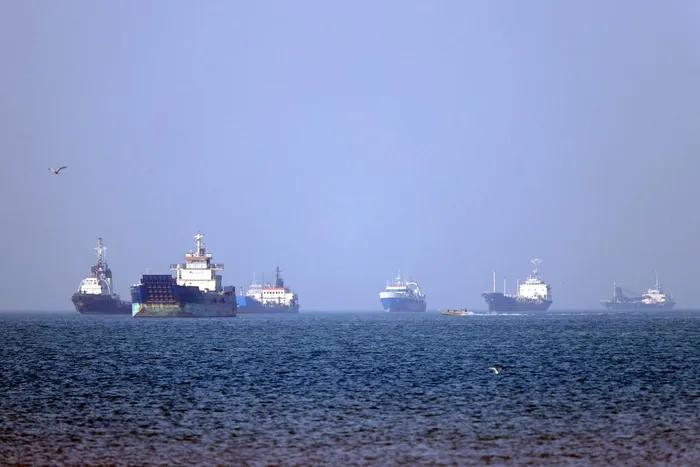
While the two sides have agreed to a 60-day negotiation period, uncertainty remains high after Iran again announced the closure of the Strait of Hormuz following renewed clashes involving Israel and Hezbollah in Lebanon.
Image: ISNA / AFP
Businesses around the world remain deeply concerned about the economic fallout from the Middle East conflict, despite a tentative peace agreement between the United States and Iran that has eased pressure on oil markets and improved global investor sentiment.
A new survey by Oxford Economics shows that companies expect disruptions to trade and shipping through the strategic Strait of Hormuz to persist well into 2027, highlighting fears that the region's instability could continue to weigh on global growth, energy markets and business confidence.
The concerns come as a new round of negotiations between Washington and Tehran is set to begin in Switzerland.
While the two sides have agreed to a 60-day negotiation period, uncertainty remains high after Iran again announced the closure of the Strait of Hormuz following renewed clashes involving Israel and Hezbollah in Lebanon.
The Strait of Hormuz is one of the world's most critical energy corridors, handling a significant portion of global oil and gas shipments. Any disruption has immediate implications for energy costs, supply chains and inflation worldwide.
According to Jamie Thompson, head of macro scenarios at Oxford Economics, businesses have largely accepted that the disruption will not disappear quickly.
“Businesses remain sceptical about the potential for a speedy resolution to the disruption in the Middle East,” Thompson said.
“Among respondents canvassed after the announcement of a US-Iran agreement, more than two-fifths expect transit through the Strait of Hormuz to remain below pre-war levels throughout the rest of this year and into 2027.”
The Oxford Economics Global Risk Survey, conducted among 144 businesses between May 28 and June 16, found that companies continue to anticipate weak global economic growth despite some improvement in sentiment following the ceasefire agreement.
“Businesses continue to anticipate subdued global growth in the near term. The average expectation of 2.2% growth in 2026 is weaker than our baseline forecast and businesses’ estimate immediately before the outbreak of the US-Israel war with Iran,” Thompson said.
While fears of a severe global recession have eased, many businesses still regard the Middle East as the biggest threat to the global economy.
“Almost three-fifths cite the Middle East as a very significant risk to the global economy over the next two years, even after the announcement of the US-Iran agreement,” Thompson said.
The survey also revealed that businesses are increasingly preparing for higher interest rates, particularly in the United States and the United Kingdom, as policymakers remain concerned about inflationary risks stemming from energy markets and geopolitical tensions.
Financial markets have responded positively to signs of de-escalation, with Brent crude oil prices falling toward $80 a barrel and heading for a weekly decline of about 8%.
However, analysts warn that businesses should not assume the worst is over.
Ipek Ozkardeskaya, senior analyst at Swissquote, said the interim agreement between Washington and Tehran had temporarily calmed markets and lowered oil prices, but significant risks remain.
“The interim peace agreement between the US and Iran got ‘oil flowing’ and echoed positively across global markets,” Ozkardeskaya said.
She noted that if tensions remain contained, oil prices could stabilise within a manageable range over the coming months.
“If tensions remain low, US crude could steady within the $60–80pb range for the next three to six months and return below $50 per barrel within 12 months,” she said.
Yet businesses remain vulnerable to any deterioration in negotiations.
“Moving forward, the energy transition will continue to develop and attract funds with or without Trump. But Trump’s Middle East war has clearly been a boon for alternative energy providers,” Ozkardeskaya said.
She cautioned that the peace process remains fragile because fundamental disagreements remain unresolved. “The peace is not a done deal,” she said.
Beyond energy markets, businesses are also grappling with a stronger US dollar and the prospect of tighter monetary policy from the US Federal Reserve. Rising US interest rates could increase borrowing costs globally and place further pressure on emerging markets dependent on imported energy and commodities.
BUSINESS REPORT