

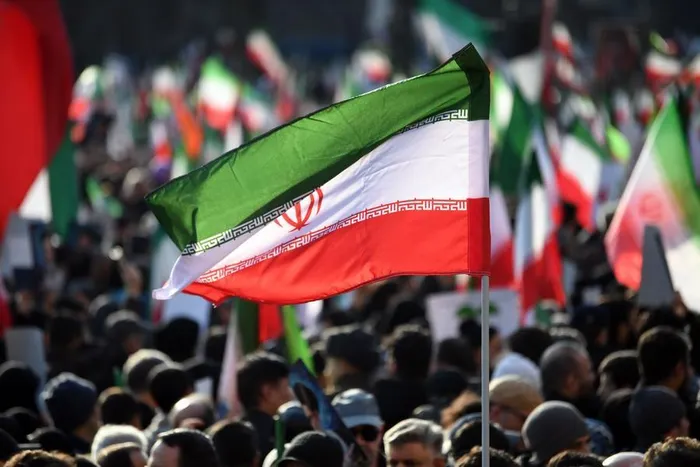
People take part in a demonstration in Tehran, Iran, on Jan. 12, 2026.
Image: XINHUA
When the full text of the 14-point Memorandum of Understanding between the United States and Iran was released, analysts expecting the language of a balanced peace agreement found something rather different. What the document describes, point by point, is a near-total concession by the world's most powerful military to a country it had spent decades sanctioning, isolating, and periodically bombing. A country whose entire GDP is smaller than the state of Washington's. The Geneva signing on Friday does not merely end a war, it marks the formal passing of an era in Middle Eastern geopolitics.
The terms deserve to be read on their own terms. Article 4 commits the United States to immediately begin removing its naval blockade upon signing and to fully end it within 30 days. Article 6 commits the United States, in coordination with regional partners, to develop a reconstruction and economic development plan for Iran worth at least $300 billion, with all required licenses and waivers for relevant financial transactions to be granted by Washington. Article 7 commits the US to terminating all sanctions on Iran, including UN Security Council resolutions, IAEA Board of Governors resolutions, and all unilateral US primary and secondary sanctions, on a schedule set in the final deal. Article 10 requires the US Treasury to issue oil export waivers immediately upon signing, covering crude oil, petroleum products, derivatives, and all associated banking, insurance and transportation services. Article 11 commits the United States to making all frozen Iranian assets fully available for use, with the funds usable for payment to any beneficiary designated by the Central Bank of Iran.
This is not the language of two parties meeting in the middle. It is a receipt. Every obligation in the first half of the document is American. Iran's single substantive concession, article 8, in which Iran reaffirms it will not procure or develop nuclear weapons, is a reaffirmation of a commitment Iran has made repeatedly for over five decades, to multiple international bodies, under multiple frameworks, and which the United States unilaterally chose to treat as insufficient.
That history is essential context, and it is being almost entirely absent from Western coverage of this deal. Iran signed the Nuclear Non-Proliferation Treaty in 1968 as a non-nuclear weapons state, agreeing at that point not to seek such weapons. In 2015, Iran went further than virtually any country in history. According to Gary Sick, during the history of the Nuclear Non-Proliferation Treaty, no country other than Iran had ever voluntarily agreed to such restrictions, as those contained in the JCPOA, a 159-page agreement that reduced Iran's uranium enrichment capacity by two-thirds, mandated continuous IAEA inspection, and eliminated its plutonium pathway. Up until May 2019, a full year after the United States withdrew from the JCPOA, the IAEA routinely verified that Iran was in full compliance. Washington abandoned the deal anyway, in 2018, not because Iran had violated it, but because the Trump administration in its first term decided the terms were insufficient. Since the United States tore up the deal and Iran in turn stopped honoring some of its commitments, Iran's breakout time, the time needed to accumulate enough fissile material for a nuclear weapon, was reduced from more than a year to about three to four months.
The war that began on the 28th February was therefore, in structural terms, a confrontation that the United States had helped engineer by dismantling the diplomatic architecture that had been working. The nuclear threat invoked to justify military action was substantially a product of the sanctions pressure and JCPOA withdrawal that preceded it. Iran arrived at this war more enriched, more isolated and more desperate than it would have been had the 2015 agreement held, largely because Washington chose to walk away from the table that had been set.
What makes the MOU's terms so analytically striking is that the administration that now commits to a $300 billion reconstruction fund and the termination of sanctions stretching back four decades is the same administration that launched the war, and the same political tendency that tore up the original deal. The intellectual consistency required to reconcile those positions is not available at any price.
The Israeli dimension of this agreement is, if anything, even more revealing of how completely the regional chessboard has shifted. The United States withheld the text of the Pakistan-mediated MOU from Israel ahead of its formal signing in Geneva. Netanyahu explicitly said Israel "does not know the terms" of the deal. The country that served as the primary strategic rationale for decades of US Iran policy, the country whose security concerns were cited to justify sanctions, military posturing, and ultimately the strikes of the 28th of February was excluded from the negotiation of its resolution and denied the courtesy of reading its terms before the rest of the world.
Israel's strategic gambit has, by any honest reading, failed. The assumption underlying the 28th of February campaign, that sufficient military pressure would force Iran to capitulate on its nuclear programme, reduce its regional influence and accept terms dictated by Washington and Tel Aviv, has collided with reality in 115 days. Iran did not capitulate. It closed the Strait of Hormuz, absorbed the strikes, maintained Hezbollah's operational capacity in Lebanon, and waited. Iran's missile program and its support for regional resistance fronts are explicitly excluded from the final deal agenda.The war achieved the opposite of its objectives.
The question of American superpower credibility is no longer abstract. The United States deployed carrier groups, imposed a naval blockade, and launched strikes on Iranian infrastructure and then agreed to pay $300 billion for reconstruction, lift forty years of sanctions, withdraw its forces, and unfreeze Iranian assets, in exchange for a nuclear non-proliferation commitment Iran had already made in 1968 and reaffirmed in 2015. The leverage was real. The outcome was not commensurate with it. Whether that reflects the limits of military power against an adversary willing to accept economic pain, the strategic incoherence of the Trump administration's decision-making, or the fundamentally changed nature of geopolitical power in a multipolar world, the answer is probably all three and the signal sent to every government watching is unmistakable.
Iran did not need to win militarily. It needed only to not lose. It held a single chokepoint, accepted the consequences, and outlasted the political will of an administration that could not articulate a coherent endgame. The Strait of Hormuz was always Iran's strongest card, and Tehran played it with a patience and discipline that its adversaries, intoxicated by military superiority, consistently underestimated.
The Middle East that emerges from the Geneva signing is structurally different from the one that preceded the February strikes. Iran enters the post-war period with its deterrence posture validated, Hezbollah's position in Lebanon formally protected under the agreement's Lebanon provisions, decades of sanctions lifted, its economy capitalised for reconstruction, and its nuclear programme intact under the same international monitoring framework it accepted in 2015. The axis of regional influence, always contested, never fixed, has rotated. The question for the coming decade is not whether Iran has established itself as the dominant regional power. The terms of the MOU answer that question on their own. The question is what the countries that believed overwhelming force could resolve the Iranian question will do with the lesson it has so expensively taught them.
Written by:
*Chloe Maluleke
Associate at BRICS+ Consulting Group
Russia & Middle East Specialist
**The Views expressed do not necessarily reflect the views of Independent Media or IOL.
** MORE ARTICLES ON OUR WEBSITE https://bricscg.com/
** Follow @brics_daily on Twitter for daily BRICS+ updates and instagram @brics_daily