

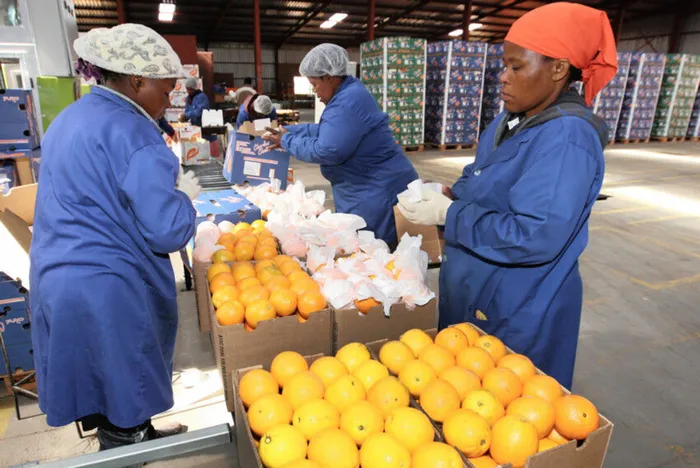
The growth of our citrus exports to India increased by a remarkable 85% in 2025, compared with 2024. This comes on the back of continued increased exports - from just below 4,000 pallets in 2016 to 54,000 in 2025.
Image: : Simphiwe Mbokazi Independent Newspapers
Boitshoko Ntshabele
Agriculture Minister John Steenhuisen is set to visit India in the next few days. The visit is set to deepen ties across trade and agriculture. For South Africa’s citrus industry — our country's largest agricultural export sector — this is a moment to acknowledge both the recent growth in citrus exports to India, as well as the immense potential that this massive market holds for local growers and our rural economies.
India’s appeal is not difficult to grasp. At over 1.47 billion people, it is the world’s largest consumer base. But scale alone is not the story. What distinguishes India today is how that scale is evolving.
Health awareness is rising. A growing middle class is developing a taste for premium produce. So-called "quick commerce" is expanding noticeably. These broader trends are relevant to the local citrus industry. At the same time, India’s production cycle does not align with year-round demand. This is a gap that counter-seasonal producers are positioned to fill. South Africa fits that profile with precision.
The growth of our citrus exports to India increased by a remarkable 85% in 2025, compared with 2024. This comes on the back of continued increased exports - from just below 4,000 pallets in 2016 to 54,000 in 2025.
Recent market development investments by the Citrus Growers Association of Southern Africa (CGA) have contributed to this trajectory. A marketing campaign under the banner of “Beautiful Country, Beautiful Fruit, Exceptional Taste” has been active in India for over a year.
Earlier this year, the South African brand Sweet C won Fresh Produce India’s market campaign award for how they positioned their mandarins. General and more brand‑specific initiatives play an important role in building awareness of South African citrus and expanding consumer appetite.
South Africa has quietly built one of the world’s most competitive agricultural export sectors. In 2025, it narrowly surpassed Spain to become the largest citrus exporter by volume. This is not an accident. The country’s export model, strict phytosanitary compliance and counter-seasonal advantage have made it a reliable supplier into global markets.
Yet the industry’s current success also presents a paradox: growth is no longer constrained by production capacity but by market access.
The minister's visit to India comes amid a broader realignment of global supply chains. Conflict in the Middle East, changes in demand and shipping, shifting alliances, and rising trade protectionism have all underscored the risks of over-concentration in traditional markets.
South Africa and India are also of course both members of the BRICS grouping. Yet, as has been pointed out before, less than 10% of South Africa's agricultural exports currently go to BRICS markets, despite these markets' outsized share of global demand. The gap is as telling as it is actionable.
What would it take to turn this opportunity into a durable trade corridor? Not a single breakthrough, but a series of pragmatic steps.
First, greater regulatory alignment. Progress on phytosanitary protocols such as in-transit cold treatment — which reduces costs for local exporters while securing food safety and quality — will determine how efficiently fruit moves.
Second, tariff considerations. Even incremental adjustments in the tariffs levied on SA citrus imports could materially improve our position relative to many of our competitors, who already benefit from preferential agreements with India.
Third, coordination across the value chain. This must continue to involve, and expand, through action between growers, exporters, logistics providers, and policymakers to ensure that supply can always meet opportunity when it arises.
In global trade, opportunity rarely announces itself loudly. More often, it emerges gradually. India’s citrus market is one such case. It is large, growing, increasingly open to imports, and structurally aligned with South Africa’s export strengths. It also remains, for now, underdeveloped from a trade perspective.
That combination will not last indefinitely. Competitors are of course already present. Preferential agreements are already shaping the playing field. Markets, once established, tend to be sticky.
But change can be beneficial not only to the hundreds of rural South African towns who have built their economies on citrus, but also for the Indian consumer, who values fresh, healthy citrus. Progress will depend on whether stakeholders — public and private, South African and Indian — choose to treat this moment as something of an inflection point.

Boitshoko Ntshabele is the CEO of the CitrusGrowers' Association of Southern Africa (CGA).
Image: Supplied
* Boitshoko Ntshabele is the CEO of the CitrusGrowers' Association of Southern Africa (CGA).
** The views expressed do not necessarily reflect the views of IOL or Independent Media.
BUSINESS REPORT