

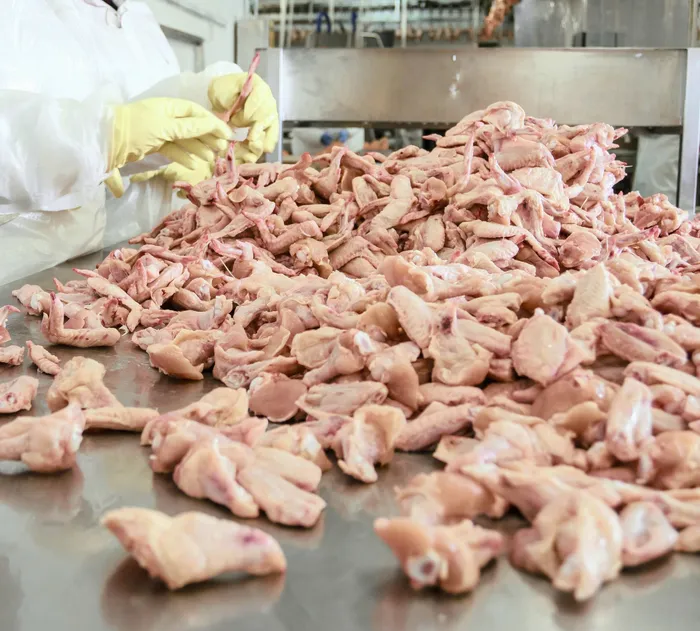
The South African poultry industry is well equipped to take on other foreign producers in growing export markets in Asia, the Middle East and Europe, argues the writer.
Image: File
By Chris Coombes
South Africa has a real opportunity to turn chicken exports from a relatively small business into a much larger scale operation that would create hundreds of jobs and earn the country billions in foreign exchange.
The country exported only 42 000 tons of chicken last year, just over 2% of South Africa’s chicken production, and it brought in R1.4 billion. With government help, that could double or treble in the next few years.
The South African poultry industry is well equipped to take on other foreign producers in growing export markets in Asia, the Middle East and Europe. We are the second most-competitive poultry producing country after Brazil, according to a recent report by the Bureau for Food and Agricultural Policy (BFAP).
South Africa continues to produce a chicken cheaper than all European countries, and we have now overtaken the United States as well. That puts us in a very good position to compete in foreign markets with everybody except Brazil – the world’s largest poultry exporter and the least cost producer.
Around 90% of South Africa’s chicken exports go to other African states, mainly Lesotho, Botswana and Namibia. We mostly export to Africa the same products we sell in the South African market – fresh and frozen chicken portions. While the volumes to African countries are larger than “deep sea” exports to Asia and the Middle East, margins in regional markets are smaller.
The real opportunity for greater export volumes lies in what is known as “value added” products – SBB (skinless boneless breast) and cooked and par-cooked chicken portions that sell for higher prices than raw product. There is a large and growing demand for this, particularly in the Middle East and Asia.
Sovereign’s experience shows what can be done, and the potential for other poultry producers to compete in export markets.
Sovereign is South Africa’s third largest poultry producer. We were among the first to export chicken to the Middle East – we started selling to Dubai in 2012 – and we now account for more than 90% of South Africa’s deep sea exports.
The BFAP competitiveness report also made the point that the expansion opportunities in the domestic market are limited, but there is a whole world of opportunities outside the country. If the South African poultry industry is to continue to grow, and wants to grow significantly, it has to develop export markets, BFAP said.
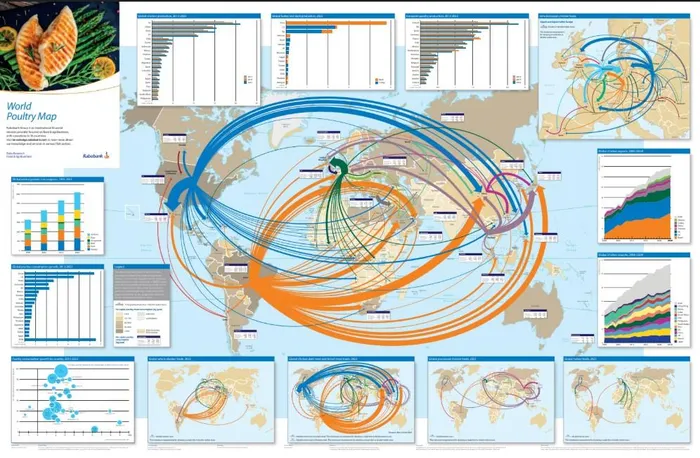
World Poultry Map
Image: Supplied
At the moment, Sovereign exports less than 5% of our poultry production, but we would like to increase this to 10% and even 15% in the years to come. If other poultry producers do the same – some have already started exploring export markets – then South Africa could be earning huge amounts from chicken exports within a decade.
Look at what is out there.
The main export market is the Middle East, more specifically the Gulf Co-operation Council (GCC) which includes Kuwait, United Arab Emirates (UAE), Saudi Arabia, Bahrain, Qatar and Oman. Because of excessive heat, agricultural output is small and most food is imported.
These countries are predominantly Muslim, and therefore do not allow the consumption of pork. As poultry globally is one of the cheapest forms of animal proteins the GCC per capita consumption of poultry is one of the highest in the world. South African Halal requirements are very stringent and this stands the SA poultry industry in good stead when competing with other countries who export to the GCC.
This creates an exceptional opportunity for countries looking to grow their export footprint. Saudi Arabia is a potentially huge market, but this depends on the Department of Agriculture negotiating access to Saudi for South African companies.
The Far East is another opportunity, including China and Hong Kong. China is the largest consumer of meat in the world. Pork is the dominant meat preference in China. With Chinese consumers getting wealthier and their proclivity towards healthier food choices, poultry is starting to close the gap with pork.
Poultry production capacity has increased in the Far East, but supply cannot keep up with demand. Another export opportunity. We already have Chinese customers who want our product, but cannot start until the Department of Agriculture has negotiated an export agreement with China.
The EU is another potential export market, and government-to-government negotiations are underway.
While progress is being made, there are other frustrations. For instance, we need to secure agreements with foreign countries that, in the event of bird flu outbreaks, exports will be banned only within a radius of 25km from an infected production plant. When the bird flu “compartments” are a whole South African province, exports become very difficult.
The South African government wants agricultural exports to increase. A substantial expansion of chicken exports is one of the main pillars of the 2019 Poultry Masterplan, currently being updated.
The Department of Trade, Industry and Competition has been very supportive of our export efforts, and we get lots of help at local level from the Department of Agriculture. Where we need more backing is in securing government-to-government export agreements.
Yes, there are obstacles but we believe they can and must be overcome.
Exporting chicken products is not easy. It requires persistence, dedication and investment in specialised production equipment because foreign markets often have different requirements than our domestic one.
We believe all the effort is worth it. There is a substantial market for South African chicken exports around the world, the country has world-class production facilities and can produce chicken at globally competitive prices.
We cannot do it alone, but with government support, South African poultry producers can claim their share of a huge export opportunity.

Chris Coombes is CEO of Sovereign Foods.
Image: Supplied
* Chris Coombes is CEO of Sovereign Foods.
** The views expressed do not necessarily reflect the views of IOL or Independent Media.
BUSINESS REPORT