

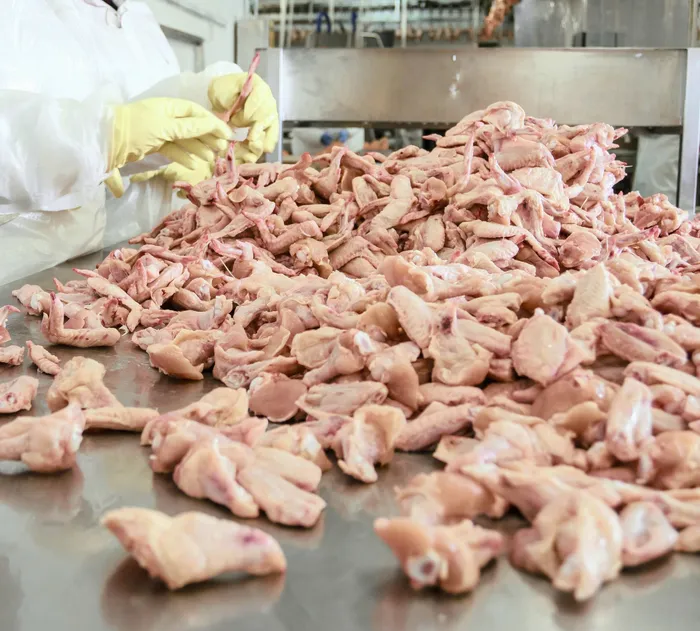
The poultry industry is the largest contributor to the agricultural sector with a total annual gross value of production of almost R87.95 billion, of which R72.09bn comes from meat in 2024 and R15.86bn from eggs.
Image: File
By Francois Baird
If growth in the South African poultry industry is to be driven by a rapid increase in chicken exports, then the government is going to have to put more resources and enthusiasm behind the export campaign.
FairPlay welcomes the finalisation of Phase 2 of the Poultry Masterplan, and in particular its plans for the continued expansion of the South African poultry industry and continued action against dumped and unfairly priced chicken imports. These were among the successes of the first phase of the masterplan. Today, South African poultry is the second most competitive poultry industry in the world.
We are also please to know that two important government departments – Trade and Industry, and Agriculture – are now committed to supporting VAT-free chicken. The removal of 15% value-added tax (VAT) from the chicken portions most consumed by low-income households has for years been resisted by the National Treasury and the finance minister.
The fact that VAT-free chicken is now in the poultry masterplan may at last result in a change of heart. Poverty and hunger are rising, and this relief is desperately needed.
The revised plan promotes a significant expansion of chicken exports. The original 2019 masterplan said the same thing, and it didn’t happen. Ministerial attention, from the Department of Trade, Industry and Competition (the dtic) and the Department of Agriculture will be essential to ensuring success the second time around.
In a statement last week, the dtic said the revised plan “seeks to pursue an export-driven growth strategy for South African poultry”.
That’s a necessary goal because, as the Bureau for Food and Agricultural Policy (BFAP) has explained, growth in the domestic poultry market will not be as rapid as it has been. Industry expansion thus depends on export growth.
The trouble is that export growth has been the unsuccessful portion of the 2019 masterplan. Instead of doubling and trebling over a decade as the plan envisaged, official statistics show that chicken exports actually dropped from 50 000 tons in 2019 to just under 42 000 tons last year.
So what’s going to be different this time around? FairPlay would hope that it will be determination, both by the Association of Meat Exporters and Importers (AMIE) and by government, backed by strictly monitored timelines and holding to account those who fall behind.
Unfortunately, much of the failure to reach the poultry export targets set in Phase 1 rests with government departments – principally the dtic and the Department of Agriculture. They have been helpful, but not helpful enough. More energy is required.
Exports depend on government-to-government contacts and international export agreements. The prospective importing country must inspect and approve South African production facilities, and these inspections have to be arranged at government level.
The European Union (EU) and Saudi Arabia are potentially significant markets for South African poultry exporters. However, an audit by Saudi officials has not been agreed many months after it was requested. European Union authorities inspected South African facilities in May 2025, but a year later their report is still awaited.
Crucially, uncooked chicken exports must be accompanied by a health certificate signed by State veterinarians, and South Africa does not have enough State vets to do this at scale. The shortage of veterinary personnel and facilities was identified in Phase 1 of the poultry masterplan, with responsibility to fix it assigned to the agriculture department.
Despite multiple promises, and some action, the shortage is still there. It was identified as a concern by EU inspectors during what appeared to be an otherwise favourable visit.
The agriculture department and its veterinarians are preoccupied at the moment with the foot-and-mouth disease crisis. That crisis, too, has shown up the need for significant investment in veterinary staff and laboratories.
The private sector is being allowed in to help alleviate the veterinary shortage to address foot-and-mouth outbreaks. It may well take the involvement of private veterinarians under State authority to ease the burden on chicken export certification.
The export drive will also require more support from AMIE. They frequently have a lot to say about chicken imports, but they have been strangely silent on the issue of exports, which could help make up for their declining import revenue.
Surely exporters can help spot opportunities, identify potential markets and facilitate contacts in countries where they already operate? Where is their chicken export strategy?
Although the poultry industry is critical for South Africa’s future, many South Africans do not appreciate its size, importance and its contribution to food security.
It is, as the dtic recognises, the largest contributor to the agricultural sector with a total annual gross value of production of almost R87.95 billion, of which R72.09bn comes from meat in 2024 and R15.86bn from eggs.
Chicken feeds the nation and is South Africa’s most popular and most affordable meat protein. It comprises more than 60% of all meat consumed in the country, because the poultry industry produces twice as much meat as the beef industry and four times that of the pork industry.
That makes it a strategic national industry to which the poultry masterplan can provide continued support if it is driven with enthusiasm from the top. The revised masterplan requires details, responsibilities, a timeline, money and determined oversight to ensure that things happen. Failure to act on investment and oversight led to the export failures of Phase 1 of the masterplan. They are all essential if Phase 2 is to succeed.

Francois Baird is the founder of the FairPlay Movement, an organisation that fights trade dumping and campaigns for fair competition and a level playing field in trade.
Image: Supplied
* Francois Baird is founder of the FairPlay Movement, an organisation that fights trade dumping and campaigns for fair competition and a level playing field in trade.
** The views expressed do not necessarily reflect the views of IOL or Independent Media.
BUSINESS REPORT