

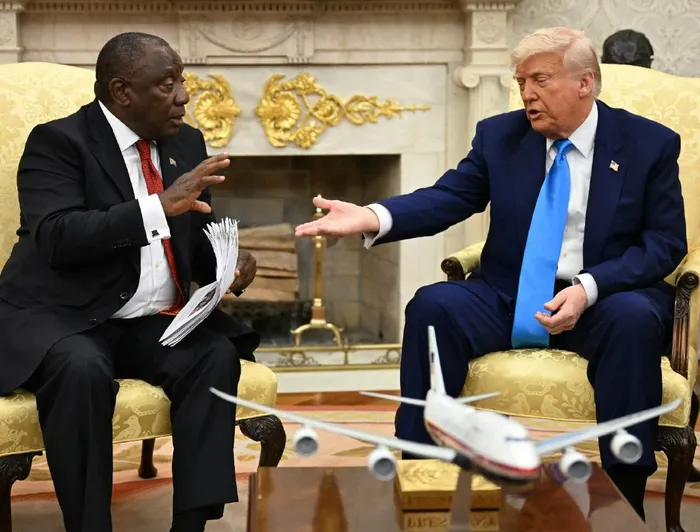
One of Washington’s central concerns is China’s growing dominance in African trade. Greer argued that after more than two decades of Agoa, “China was the largest beneficiary of African trade”.
Image: AFP
The United States is preparing a major overhaul of the African Growth and Opportunity Act (Agoa), signalling a shift away from a purely development-focused trade arrangement towards a more reciprocal model that could place South Africa under increased pressure to open its markets to American goods.
The Office of the United States Trade Representative (USTR) last month formally requested public comment on the “modernisation” of Agoa, saying reforms were needed to ensure the programme “meets the needs of American workers and businesses” and advances US “national security and economic security goals”.
Agoa, first enacted in 2000, grants qualifying African countries preferential duty-free access to US markets. The programme was temporarily extended by US President Donald Trump in February this year until December 31, 2026, after its previous authorisation expired in September 2025.
US Trade Representative Jamieson Greer last week told lawmakers the Trump administration would work with Congress on a multi-year extension, but stressed that reforming Agoa was now “a top priority”.
“This is something that is at the top of our agenda, and I think there is a real opportunity together to create a longer-lasting, more reciprocal Agoa,” Greer said during a congressional hearing on US trade policy.
Greer also said the administration would seek public input “on how we can improve Agoa to meet the goals that you and I share”.
One of Washington’s central concerns is China’s growing dominance in African trade. Greer argued that after more than two decades of Agoa, “China was the largest beneficiary of African trade”.
The USTR’s consultation document repeatedly highlights the erosion of America’s trade position in Africa. It noted that while sub-Saharan Africa’s imports surged to $570 billion since 2000, the US share of the market declined sharply as China, the European Union and India expanded their presence.
According to the document, US imports from sub-Saharan Africa remained relatively low despite Agoa, while many African countries continued to maintain tariff and non-tariff barriers against American exports.
South Africa is specifically singled out in the review. The USTR said South Africa maintains “high tariffs on US poultry, wine, and spirits while providing preferred access to the European Union”.
It also criticised restrictions on US pork imports and accused South Africa of maintaining unjustified sanitary and phytosanitary barriers.
FairPlay founder Francois Baird said the proposed reforms presented both opportunities and risks for South Africa.
“The good news is that the Trump administration is going to back a long-term extension of the Agoa deal, and is going to give this top priority,” Baird said.
“The bad news is the repeated insistence that a renewed Agoa must include increased access to African markets for American producers.”
Baird warned that Agoa had historically operated largely as a one-way arrangement, with African countries receiving preferential access to US markets without offering reciprocal concessions.
“The only market access on which the US has insisted has been the 72 000-ton annual duty-free quota for US chicken imports into South Africa,” he said.
“Now African countries are likely to face a variety of demands to remove any restrictions on American goods and to give preferential treatment to US producers.”
Trade advisory firm XA Global Traders Advisors said the latest review showed AGOA was increasingly being viewed through the lens of American industrial strategy and geopolitical competition.
“The language coming from Washington suggests that Agoa is no longer being viewed primarily as a development instrument,” the firm said in its analysis.
“It is increasingly being framed as a strategic trade tool designed to advance American commercial, industrial, and geopolitical interests.”
XA Global Traders Advisors noted that the US goods trade deficit with South Africa widened to $10.1 billion in 2025, with US imports from South Africa reaching $16.5bn compared with exports of $6.4bn.
“From Washington’s perspective, this is becoming politically difficult to justify under a unilateral preference programme,” said Wongani Msiska, trade analyst at XA Global Trade Advisors.
Msiska also cautioned that South Africa may be overestimating the importance of Agoa to the broader US economy.
“All of SA’s exports to the US, of which Agoa exports account for about a third, amount to around 0.3% of American imports,” he said. “Agoa never was anything more than an American political tool. All that has changed is how obvious this now is.”
BUSINESS REPORT