

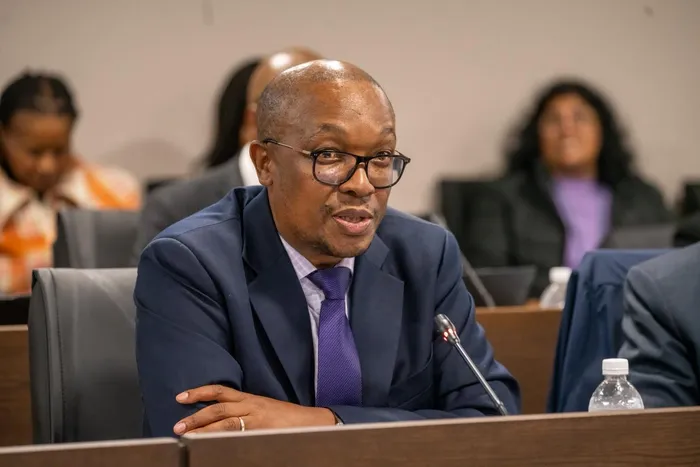
The portfolio committee on Tuesday received a briefing from the Department of Trade, Industry and Competition (the dtic) on the status of South Africa's trade relations and ongoing trade negotiations.
Image: Supplied
South Africa is confronting an increasingly unpredictable global trading environment marked by rising protectionism, geopolitical tensions and shifting alliances, Parliament heard during a detailed briefing to the Portfolio Committee on Trade, Industry and Competition.
The portfolio committee on Tuesday received a briefing from the Department of Trade, Industry and Competition (the dtic) on the status of South Africa's trade relations and ongoing trade negotiations.
This included an update on the current global challenges affecting South Africa's trade relations, including developments involving major partners such as the United States, China and the European Union.
Zuko Godlimpi, deputy minister of the dtic, painted a stark picture of the global economy, warning that South Africa is operating in “an increasingly volatile global trading environment, which presents a series of strategic threats but also opportunities at the same time.”
Godlimpi explained that the country’s response is anchored in what government calls the “Butterfly Strategy,” aimed at strengthening trade within Africa while maintaining ties with both Eastern and Western markets.
“Our strategic orientation has been… to consolidate South Africa's export growth in the African continent but without decoupling from the rest of the world,” Godlimpi said.
However, he cautioned that intensifying global competition, particularly as major economies redirect exports due to trade barriers, poses risks.
“That presents a threat of an over capacity problem, goods coming in at an extremely cheap rate,” he warned, adding that South Africa is deploying trade remedies to “insulate the South African economy not to be devastated.”
At the same time, new supply chain shifts are opening doors.
“As they are all scrambling for new partners, that presents an opportunity for South African exports to go both to the east and to the west,” Godlimpi said.
Ambassador Xolelwa Mlumbi-Peter, deputy director-general for trade at the dtic, reinforced concerns about a global shift away from multilateralism.
“We [are] seeing a number of trading partners moving away from a rules-based multilateral trading system towards trade policies that are increasingly shaped by national security concerns,” she said.
This shift has led to “the extensive use of unilateral trade measures, including trade barriers,” she added, warning that such actions “create a fertile ground for trade wars, [with] disproportionate impact on developing countries.”
Despite these headwinds, South Africa’s trade performance has shown resilience.
Mlumbi-Peter noted that exports reached R2.1 trillion, with Africa accounting for the largest share at 26.7%, followed by the European Union, China and the United States.
She said the government was now targeting deeper continental integration through the African Continental Free Trade Area (AfCFTA), with ambitions to increase exports to the rest of Africa to R1.1trln by 2030. However, progress remains gradual.
“Exports so far amount to R2.6 billion, starting from a low base,” Mlumbi-Peter acknowledged.
Challenges include logistics, non-tariff barriers and limited awareness among customs officials.
“When our products get to the border, authorities are sometimes not aware of how to facilitate trade under AfCFTA terms,” she said.
On global developments, the United States’ evolving tariff regime and ongoing review of the African Growth and Opportunity Act (Agoa) remain key concerns.
Mlumbi-Peter confirmed that while earlier higher tariffs were scrapped, “it is 10%, implemented on all its trading partners including South Africa.”
Meanwhile, China’s new preferential trade scheme—offering zero tariffs on 100% of tariff lines—has already begun to boost exports, with initial shipments of South African agricultural products entering the Chinese market.
Parliamentarians raised concerns about South Africa’s narrow export base and the need to support more firms to access global markets.
DA MP Toby Chance highlighted that “roughly 5% of exporters account for 95% of export value,” calling for stronger support mechanisms.
Godlimpi acknowledged the challenge, pointing to gaps in trade finance.
“One of the weaknesses that we've had is the absence of a robust trade finance ecosystem. The banks work with those who have proven balance sheets,” he said, adding that government is working with financial institutions to expand access for small businesses.
Looking ahead, Godlimpi warned that uncertainty will persist.
“In the international trading environment there is no smooth sailing, there are headwinds across,” he said.
Meanwhile, committee chairperson Mzwandile Masina said that while global conditions remain difficult, South Africa is adapting.
“We are not sitting back. We are beginning to craft response strategies to alternative markets,” he said, noting that the country’s trade surplus shows “positive results, given the dynamics shaping our global economic system.”
BUSINESS REPORT