

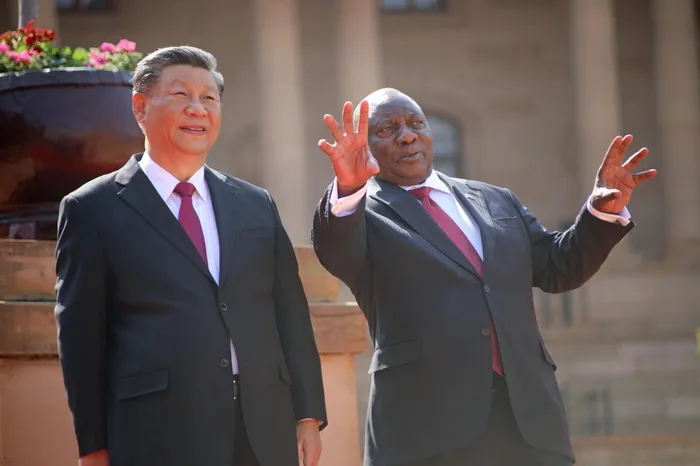
President of the Peoples Republic of China, Xi Jinping with President Cyril Ramaphosa during a previous visit at the Union Buildings in Pretoria. From May 1, China is opening zero-tariff trade to all African nations with which it has diplomatic ties.
Image: Timothy Bernard / Independent Media
What do African traders need most right now: more markets, fewer barriers, or partners who respect their choices? They are getting them all.
Starting May 1, 2026, a historic two-year opportunity opens for Africa. China will offer zero-tariff treatment in the form of a preferential tariff rate to all 53 African countries with which it has diplomatic relations.
This builds on an existing policy: China has already granted 100% tariff-line elimination to 33 least developed African nations since December 2024. The result was immediate: China’s imports from those countries jumped 15.2% year-on-year in just three months, reaching $21.42 billion. This new expansion, effective Friday, adds the remaining 20 African countries that have diplomatic relations with China but are not classified as least developed.
The Customs Tariff Commission of the State Council has detailed that for the 20 countries China is adding to the zero-tariff scheme, zero-tariff treatment applies only to in-quota volume. At the same time, tariffs on shipments exceeding the quota remain unchanged. And during the two-year implementation period, China will continue to promote the signing of economic partnership agreements for shared growth with African countries.
In doing so, China becomes the world’s first major economy to unilaterally open its vast consumer market to the African continent with no political conditions attached. For African exporters, farmers and manufacturers, this is a game-changing boost — one that can accelerate Africa’s industrialisation and strengthen its economic sovereignty. The move is a steady fulfilment of a long-term promise rooted in decades of China-Africa cooperation and shared development aspirations, first envisioned at FOCAC in 2003 and reaffirmed at the 2024 FOCAC Beijing Summit.
For decades, African economies have been locked into a familiar pattern: export raw materials, import finished goods. The value added elsewhere, the jobs created elsewhere. But with tariff barriers removed, a new incentive structure is emerging.
Ethiopia, the birthplace of Arabica coffee, produces about 600,000 tons annually, supporting millions of livelihoods. Under China’s zero‑tariff policy (first for least developed countries in December 2024 and that includes Ethiopia, now expanded to all 53 African nations), Ethiopian coffee has gained a decisive edge. In the 2024-2025 fiscal year, Ethiopia exported over 34,000 tons of coffee to China, earning $218 million, making China its fourth‑largest coffee market with a 27% average annual increase in sales volume.
But the real transformation goes beyond volume. Tesfaye Gebru, general manager of AWO Coffee Company, now operates a roasting facility in Ethiopia’s Hawassa, supported by stable, growing demand from China. Zero tariffs have pushed the entire coffee sector toward more standardized, higher‑quality production. Even Ethiopian Ambassador to China Tefera Derbew Yimam notes that this zero-tariff policy enhances local production, processing and branding capacities, leading to increased returns.
Take South Africa. Agriculture Minister John Steenhuisen calls China's zero‑tariff decision an "absolute game‑changer" for wine and citrus exports. Until now, South Africa competed against countries like Australia, which already enjoys duty-free access to China under a bilateral free trade agreement, China-Australia Free Trade Agreement (though that access has at times been affected by trade disputes). Putting South African products on the same footing will make them "fiercely more competitive," Steenhuisen said. Even better: new phytosanitary rules signed in Pretoria in early April ease the extreme cold‑treatment requirements for citrus shipments to China, cutting energy costs and improving fruit quality.
These are not isolated success stories. Across the continent, the zero‑tariff policy is already reshaping trade patterns—and that is precisely why it attracts attention from certain quarters.
Unlike the U.S. African Growth and Opportunity Act (AGOA), with its annual eligibility reviews based on governance and human rights criteria and its recurring need for short-term legislative reauthorisation, or the EU’s Everything But Arms (EBA) scheme, which can leverage human rights benchmarks to suspend market access, China’s zero-tariff policy attaches no political strings, no ideological alignment, and no reciprocal demands. It is a unilateral opening extended to all, based purely on shared development. As African Union Commission Chairperson Mahmoud Ali Youssouf told Xinhua in an April 2026 interview: “This is timely and brotherly support amid global uncertainty.” That is a view shared across African capitals: China does not lecture; it delivers market access.
Critics in some Western media often frame this policy as “geopolitical influence.” But this narrative ignores one simple fact: Africa chooses its partners, and Africa benefits from this deal. As South Africa’s Minister John Steenhuisen himself put it last year, “Don’t give us aid, give us trade.” China’s zero‑tariff policy delivers exactly that.
China-Africa cooperation has never been about “taking side”; it’s about expanding Africa’s options. In a world where protectionism is rising and many Western economies are closing their doors, China is opening its market unilaterally, generously, and without preconditions. This also aligns perfectly with the UN’s Sustainable Development Goals and the African Union’s Agenda 2063.
None of this suggests that zero tariffs alone will solve Africa’s industrial challenges.Infrastructure gaps, logistics bottlenecks, and production capacity constraints remain real. Some less developed countries may face short-term hurdles in scaling up to meet Chinese demand. But these are precisely the areas for deeper Sino-Africa cooperation. China has signaled its commitment through technical training, investment in industrial parks, and platforms like the China International Import Expo (CIIE) and the China-Africa Economic and Trade Expo (CAETE).
This year marks the 70th anniversary of China-Africa diplomatic relations. The zero-tariff policy, taking effect on May 1, 2026, is a fitting anniversary gift: practical, people-centred, and future-oriented, reflecting China’s long-standing commitment toAfrica.
China’s message for Africa is clear: the door to the world’s second-largest consumer market is wide open, tariff‑free, with no political strings attached. This is not aid, not dependency, but empowerment and win-win bilateral trade. As the global trade faces turbulence and uncertainty, China’s zero-tariff policy will unlock Africa’s growth potential, strengthen its economic sovereignty, and drive shared prosperity.
* Xu Yawen is a reporter and international affairs commentator with CGTN Radio based in Beijing, covering Chinese foreign policy, technology, and the economy.
** The views expressed do not necessarily reflect the views of IOL or Independent Media.