


The museum's exhibitions have examined many sides of the American project.
Image: The Washington Post
A year after President Donald Trump vowed to overhaul the narrative presented at the Smithsonian, the administration has delivered a sprawling, 160-page critique of its flagship museum.
Produced by the White House’s Domestic Policy Council and backed by over 500 footnotes, the report sets out to expose how "ideological capture" at the National Museum of American History (NMAH) actively "Erases Our Heritage." In execution, however, the document achieves precisely the opposite. It attempts to sanitize American history, scrubbing away any complexities that conflict with a feel-good fable of a nation whose flaws were merely incidental and safely confined to the past.
The report rarely engages with the claims it ridicules—such as well-documented facts about post-Civil War anti-Chinese sentiment—treating its own dismissals as self-evident proof of museum bias. When the authors get close to historical realities, they quickly retreat. For instance, museum director Anthea Hartig is attacked for noting that Black girls are suspended six times more often than white girls. The authors argue that this stems from trauma, socioeconomic status, and mental health rather than race, willfully ignoring how these factors intertwine with racial disparities.
Selective formatting and omission are standard throughout the document. One section claims, 'America’s Flagship Museum insists the country hasn’t changed since 1957.” This assertion lacks a footnote because the Smithsonian makes no such claim. While museum exhibits do note ongoing racism, the report’s corresponding footnote merely leads to an image of a historic Emmett Till marker riddled with bullet holes. The Smithsonian added this artifact to its collection to illustrate the ongoing struggle over historical memory, yet the report weaponizes it as proof of institutional bias.
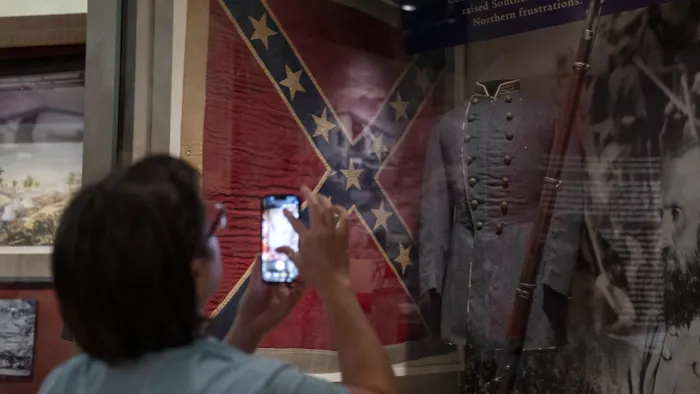
The museum is among Smithsonian organizations that have come under criticism from some officials who allege the institution promotes "extreme political activism".
Image: The Washington Post
The authors rely heavily on decontextualized, minor sources to claim that museum leaders are captured by progressive historiography. They attack a text panel about the American Revolution for asking if the founding was part of a "wider, unfinished movement for liberty—deeply imperfect but with sacred aspirations open to all people?" By omitting the phrase "sacred aspirations" from their textual critique, the authors accuse the museum of calling the revolution purely "deeply imperfect." Ironically, they include an image of the full wall text, inadvertently showing a museum doing exactly its job: engaging the public with challenging questions.
Similarly, a panel on immigration labeled a “Slander of America” simply outlines historical debates on the ideal character of citizenship, referencing the 1882 Chinese Exclusion Act. The authors balk at the museum's acknowledgment that anti-Chinese sentiment fueled this law, writing: “In addition to attacking America’s white Christian Founders, NMAH’s exhibits also portray restrictive immigration laws as a tool of white supremacy.”
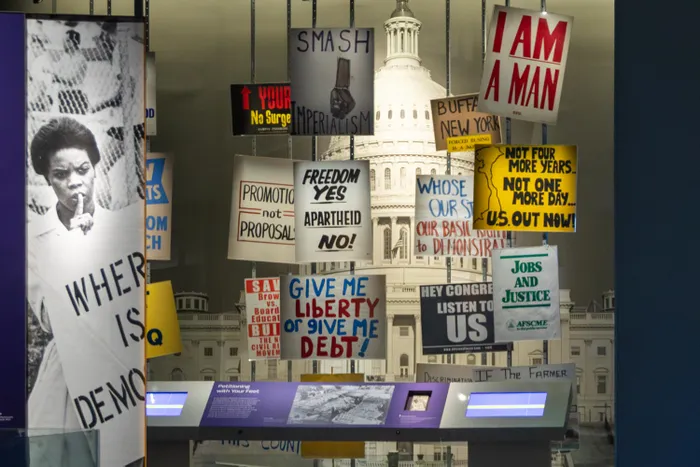
Social movements that shaped the United States are explored inside the National Museum of American History, as seen last year.
Image: The Washington Post
They might benefit from reading California Governor Henry Huntly Haight’s 1867 inaugural address, which explicitly defended denying the ballot to "Asiatic" populations to prevent "corrupting the source of political power." The report echoes this historical apologia, implying it is not racist to suppress the history of race.
At times, the critique edges into absurdity, complaining about a lack of displayed flags or attacking an employee for a speculative speech that imagined America from a future hindsight. Such speculation has roots in classical criticism, like Macaulay’s “New Zealander,” and is hardly un-American. More disturbing is the vitriol aimed at words like “problematize,” framing it as a radical agenda when it is actually the essence of critical historical thinking.
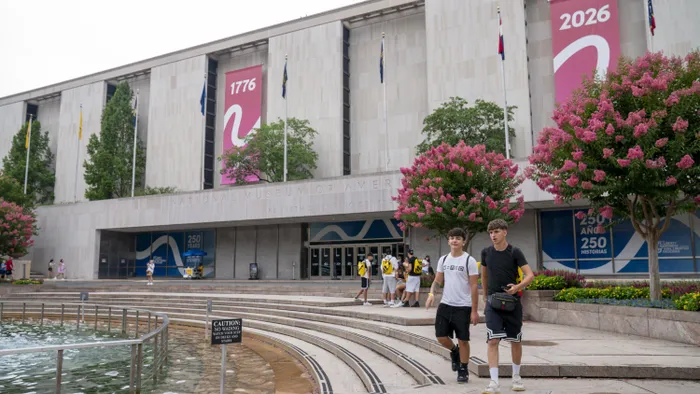
The Smithsonian National Museum of American History.
Image: The Washington Post
By a perverse logic, this document serves as an accidental guide to doing history right, highlighting the struggles that define the American narrative. The best historical analogy is Munich’s 1937 "Degenerate Art" exhibition, where Nazi ideologues attempted to mock modern art but inadvertently created a premier compendium of the era's greatest artists, including Matisse and Chagall. Similarly, this White House report digs into the Smithsonian and accidentally reveals a vibrant institution doing precisely what it should: prompting inquiry and introducing new perspectives.
Ultimately, the report lands few substantive blows, but its true objective is an opening salvo to compromise the independence of the Smithsonian and undermine the possibility of objective history. The standard here is not truth or documentary evidence, but strict conformity to a singular narrative of American exceptionalism. It does not argue that historical blemishes are false, only that they are irrelevant. It is an approach perfectly captured by the old Soviet joke: the future is certain; it’s the past that keeps changing.