

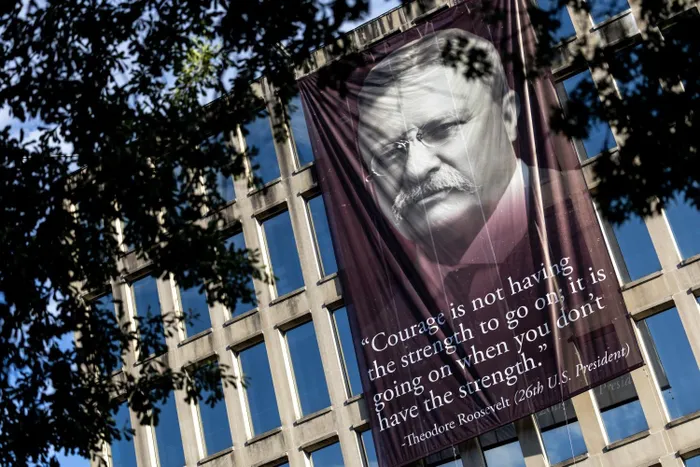
A banner says, “Courage is not having the strength to go on; it is going on when you don’t have the strength,” with a portrait of Theodore Roosevelt, outside the Theodore Roosevelt Federal Building in D.C.
Image: The Washington Post
A giant banner bearing the face of Theodore Roosevelt decorates the facade of the Office of Personnel Management in downtown Washington and carries an inspirational quote it attributes to the late leader. There’s one problem: Historians say the 26th president never uttered the phrase.
“Courage is not having the strength to go on; it is going on when you don’t have the strength,” says the quote, which is overlaid in serif font under Roosevelt’s portrait and attributed to him.
But scholars of the quotable Roosevelt say there’s no evidence he ever said those words, even though references linking him to it appear online.
“What I can say for certain is that the quote did not originate with Theodore Roosevelt,” Michael Patrick Cullinane, co-director and public historian of the Theodore Roosevelt Centre, said about the federal government’s poster on the Theodore Roosevelt Federal Building, which houses OPM.
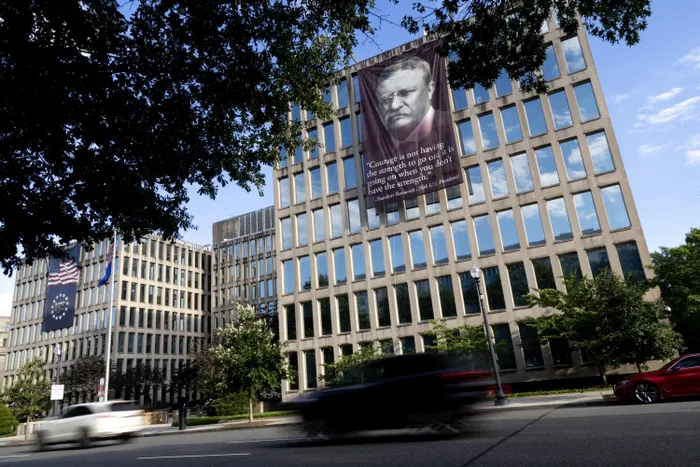
The banner on the Theodore Roosevelt Federal Building, which houses OPM, in D.C.
Image: The Washington Post
The Theodore Roosevelt Centre, housed at North Dakota’s Dickinson State University, keeps a list of quotes by the president - about valour, patriotism, leadership, fear, action - maintained and updated for years by historians and researchers along with original documents of origin. Searching the word “courage” pulls up three pages - but no quotes matching the one on the poster.
Phrases misattributed to Roosevelt are common enough that the Theodore Roosevelt Presidential Library’s website keeps a running list of them.
Cullinane said the Theodore Roosevelt Centre plans to add the quote about courage to its own online database of misattributed quotes.
When asked about the poster and the quote’s provenance, McLaurine Pinover, an OPM spokesperson, said the department hung multiple banners on the building to celebrate America’s 250th anniversary. The quote “is commonly attributed to Roosevelt and captures the spirit of the federal workforce,” she wrote.
“As excited as we are about America 250, it’s surprising the Washington Post has taken such an interest in our small agency’s building banners. Slow news day?” she said.
Steven Herman, executive director for the Jordan Center for Journalism Advocacy and Innovation at the University of Mississippi, attended an event on the sixth floor of a George Washington University building and was stepping to the back of the room to get a sandwich when he saw the Roosevelt poster that spans four floors on OPM’s facade.
Herman is a Roosevelt fan, he said, so when he saw the poster, he thought it seemed “pretty cool” and snapped a picture.
Afterward, he thought about how he “never saw that in any of the books I read about Teddy Roosevelt” and did his “due diligence” by researching the quote’s provenance. “This one, there was just no evidence.”
Then he thought, “This is actually kind of sad, but not surprising,” said Herman, former White House bureau chief for Voice of America. He posted a photo of the poster, pointing out the discrepancy, to social media.
Giant posters are going up around D.C. for celebrations of the 250th anniversary of the country.
The misquote is “inexcusable,” Herman said. “The federal government, as far as things like American history and literacy and civics, should set an example.”
Some online have attributed the quote to Napoleon Bonaparte, but top Napoleonic period scholars say it is likely not the French emperor either. “I have never come across a quote in this vein from N. It doesn’t sound like him to me. … It sounds too idealistic for N,” wrote historian Michael Broers, who has written a three-part biography of the figure.
As to the origin of the quote’s misattribution to Roosevelt, Cullinane said it seems to be a “Franken-quote,” pointing The Post to an American self-help book “The Mourning After” from the 1990s on how to deal with grief.
“I have the confidence that you will never meet anything you can’t handle,” the book says on page 81 before the quote from the poster appears word-for-word.