

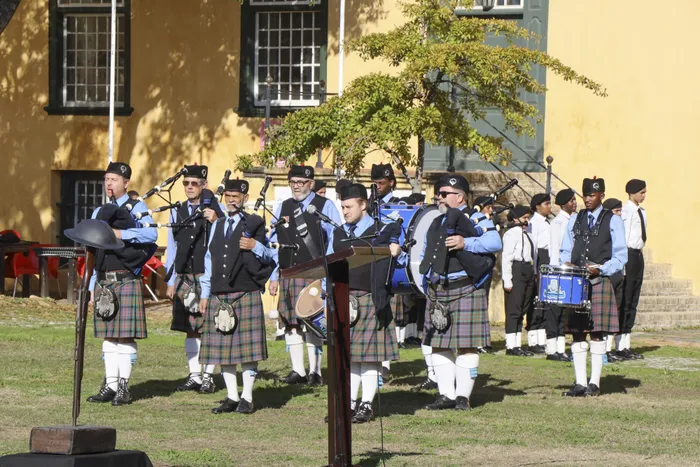
The Cape Garrison Artillery Pipe Band performing at the VE Day Memorial celebrations at the Castle of Good Hope.
Image: Gavin L.H. Withers
“Lest We Forget.” Since 1918, these three words have echoed across time-honored memorial services, a solemn warning against the historical amnesia that threatens to erase the harsh realities of war. On Sunday, May 31, 2026, those words carried a distinct, heavy resonance at the Castle of Good Hope.
Gathered under the Cape sky, military veterans, sea cadets, and citizens marked the 81st commemoration of Victory in Europe (VE) Day with a poignant focus: honoring the millions of individuals taken as prisoners of war (POWs) during World War II, specifically the thousands of volunteer South African soldiers who faced captivity.
The service commenced with the solemn cadence of flag bearers and veterans marching onto the grounds, accompanied by the stirring notes of the Cape Garrison Artillery band, led by Pipe Major Tony Reis. Yet, behind the traditional military pomp lay a raw, localized history of immense human sacrifice, political fracturing, and psychological scars that persist to this day.
Delivering the central memorial address, Dr. Karen Horn, historian and author of In Enemy Hands: South Africa’s POWs in WWII, peeled back the sanitized layers of wartime narrative. By the spring of 1945, South African POWs numbered some 17,303. The vast majority had been captured during the bitter, compounding defeats of Sidi Rezegh and Tobruk in the North African desert between 1941 and 1942, where Allied forces were overwhelmed by German Field Marshal Erwin Rommel, the "Desert Fox."
"The timing of the Nazi surrender was highly symbolic," Dr. Horn noted. "When the war ended in May 1945, it was springtime in Europe, a season for new life and growth."
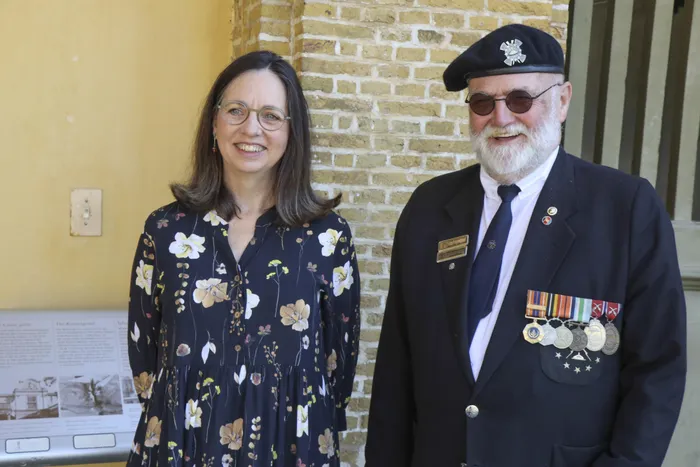
The memorial address was delivered by Dr Karen Horn (left) who is standing here with Sgt Major Roberts.
Image: Gavin L. H. Withers
But for South Africa's volunteers, the journey to that spring was forged in deep political irony. In 1939, South Africa was a country bitterly divided over its entry into the war. While many Afrikaners harboured fierce anti-British sentiments, thousands of men—both Black and white—joined the Union Defence Force as volunteers.
Their reasons varied from economic necessity to an explicit desire to combat fascism. Back home, some were branded as traitors; on the front lines, the horror of combat leveled all prewar politics. As one former medical officer of the 5th South African Brigade starkly recounted, "Our fellows were shot down like dogs."
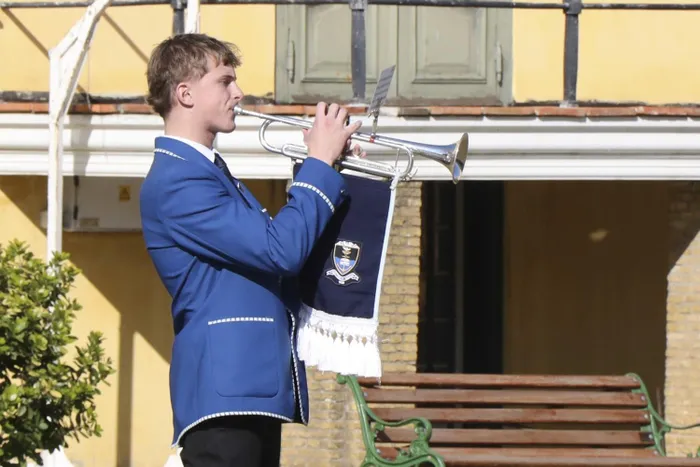
Trumpeter Alex Papageorge from SACS at the VE Day celebrations at the Castle of Good Hope.
Image: Gavin L.H Withers
For those captured, survival became a grueling daily resistance. Handed over to Axis forces, prisoners endured long marches across the brutal desert toward temporary holding facilities known as the "Hell Camps." Stripped of their freedom, rank, and social standing, men faced extreme starvation and disease.
In a cruel enforcement of racial ideology, the Axis forces segregated prisoners by race, entirely disregarding the Geneva Convention when it came to Black servicemen. Yet, captivity proved to be a profound equalizer. To survive, prisoners forged intense bonds of camaraderie, forming small survival units of two to four men to share Red Cross food parcels or sift through straw mattresses for stray grains of wheat.
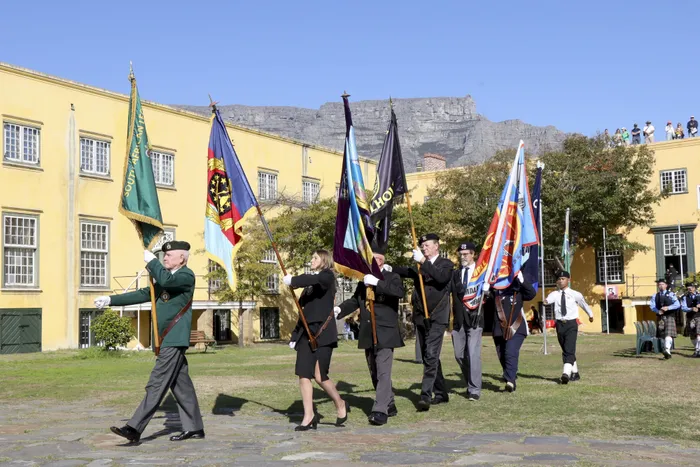
VO flag bearers march inside the Castle of Good Hope to celebrate VE Day.
Image: Gavin L.H. Withers
Humanity flourished in the darkest corners. When the Axis transport ships carrying POWs across the Mediterranean became unintended targets for Allied attacks, survivors clung to one another. Bernard Schwikkard, a survivor of the bombed ship San Sebastian, recalled sharing a single blanket with a Cape Corps soldier to survive the bitter coastal cold.
Resistance, too, broke through the wire. Black volunteer Job Maseko, motivated by the brutal ill-treatment of his fellow Black servicemen, constructed a makeshift bomb while a prisoner at Tobruk, successfully sinking a German supply ship in the harbour—an act of distinguished bravery that earned him the Military Medal.
The liberation of these camps brought unimaginable euphoria. Private Hillie Feldman, who spent three and a half years across Italian and German Stalag camps, recalled the absolute frenzy of being liberated by US General George Patton’s forces in April 1945: "FREE, FREE, FREE, FREE... we looked at each other and went absolutely crazy for a while."
Yet, return brought its own complex tragedy.
"By the time they returned home in 1945, it was winter in the Southern Hemisphere," Dr. Horn observed in a chilling conclusion. "History would show the Apartheid winter lasted much longer than anyone could have guessed, and solidarity became one of its many victims."
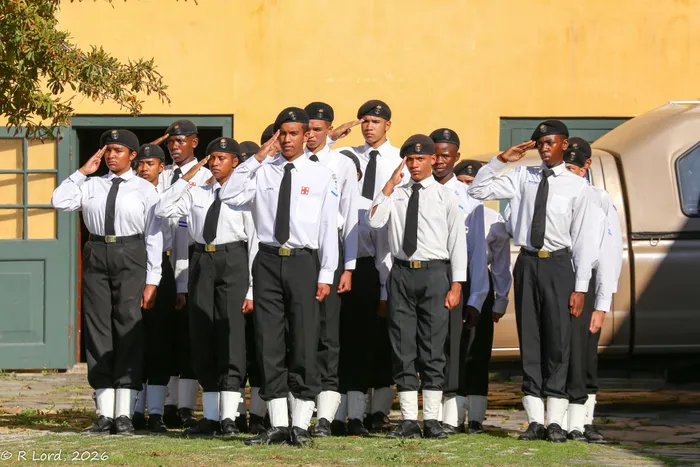
The Sea Cadets at the VE Day celebrations at the Castle of Good Hope.
Image: Regine Lord
The racial unity that kept men alive in the feces-stained hulls of transport ships vanished under the institutionalized segregation of the postwar South African state. Volunteers like Fred van Alphen Stahl had proudly declared, "We didn’t fight for a political party, we fought for South Africa." But the country they returned to quickly forgot the shared humanity of its veterans.
The legacy of war is not merely political; it is deeply psychological. Pastor Tony Bethke, who led the service, courageously broke military stoicism by sharing his personal battles with Post-Traumatic Stress Disorder (PTSD), urging modern veterans to seek professional help for their mental scars. He lamented that mankind has failed to learn from the rubble of 1945, pointing to the numerous active theaters of war across the globe today.
As the traditional two-minute silence fell over the Castle of Good Hope—a practice originally inspired by Cape Town's own wartime history—the final notes of the Last Post played by SACS pupil Alex Papageorge faded into the afternoon air. The ceremony concluded, but the message remained clear: remembering war is not about glorifying combat, but about honoring the heavy, lingering price paid by the individuals who endured it. We will remember them.