

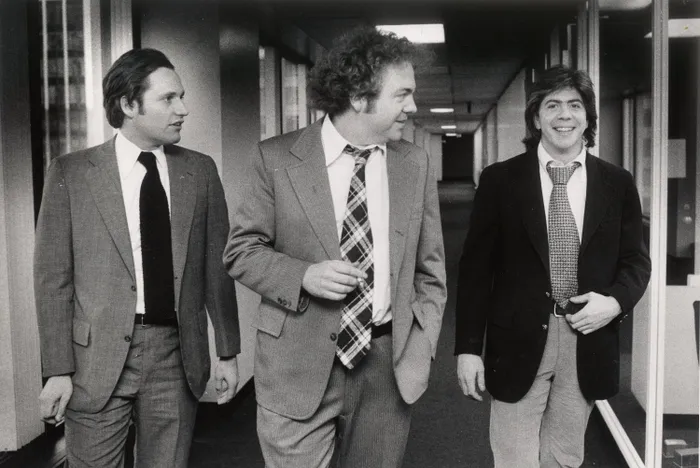
From left, journalists Bob Woodward, Scott Armstrong and Carl Bernstein at The Washington Post in 1974.
Image: Margaret Thomas/The Washington Post
Cameras, lenses and lighting were all part of Margaret Thomas’s tools as a photojournalist. But the technical side of taking pictures was perhaps the least challenging element of her work.
As the first female staff photographer at The Washington Post, which she joined in 1966, Thomas encountered resistance and off-colour jokes from colleagues and competitors before proving herself as an outstanding photojournalist.
Thomas, who covered riots, international disputes, global summits, the Watergate hearings and presidential politics across four decades at The Post, died June 6 at her home in Hume, Virginia, in the foothills of the Blue Ridge Mountains. She was 84.
Her death was confirmed by her niece Teri Mathews, who said the cause was not yet known.
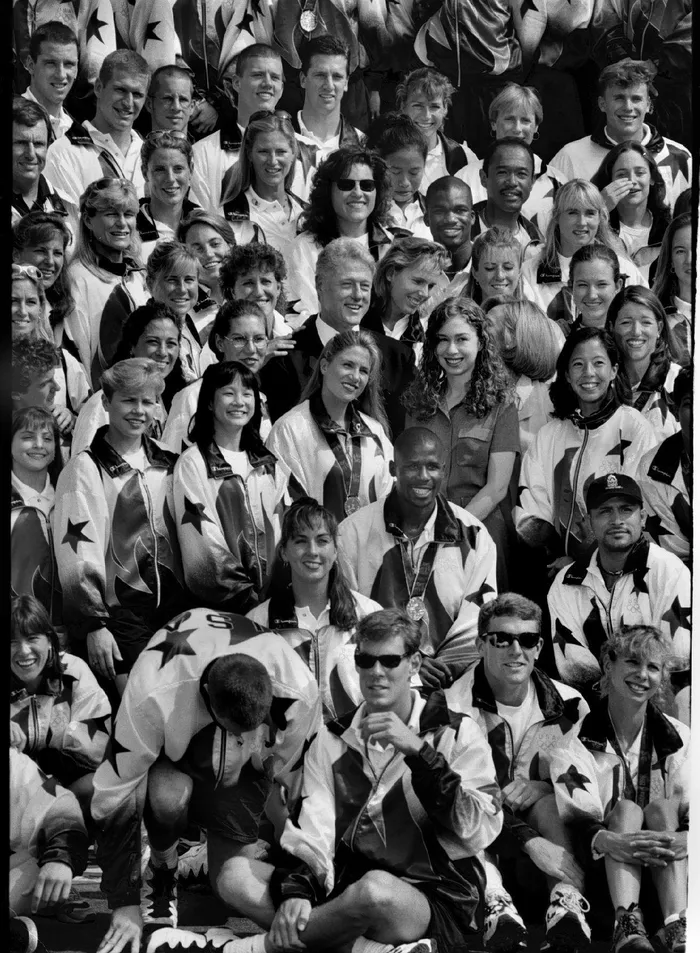
President Bill Clinton and his family with the U.S. Olympic team in 1996.
Image: Margaret Thomas/The Washington Post)
Thomas was barely 24 when she was hired at The Post, less than two years after Katharine Graham took over the company following the death of her husband. The newsroom was diversifying its largely White and male staff in the wake of the Civil Rights Act of 1964, which outlawed workplace discrimination on the basis of race, sex and religion.
Yet Thomas’s path was not an easy one. She later learned - as she wrote in an autobiographical essay in 2019, when she received the Lifetime Achievement Award of the White House News Photographers Association - that some male photographers at The Post 'pleaded' with photography director Richard Darcey not to hire her.
Thomas underwent a six-month probationary period in which she spent more time developing film in the darkroom than shooting pictures. But she found a mentor in Tom Kelley, a fellow Minnesotan who had been on The Post’s photography staff since the 1930s, and soon began to go out on assignment. She was almost always dressed in slacks, a rarity for female professionals at the time.
“She worked very hard, she was very serious,” Gerald Martineau, a longtime Post colleague, said in an interview. “And she was really tough.”
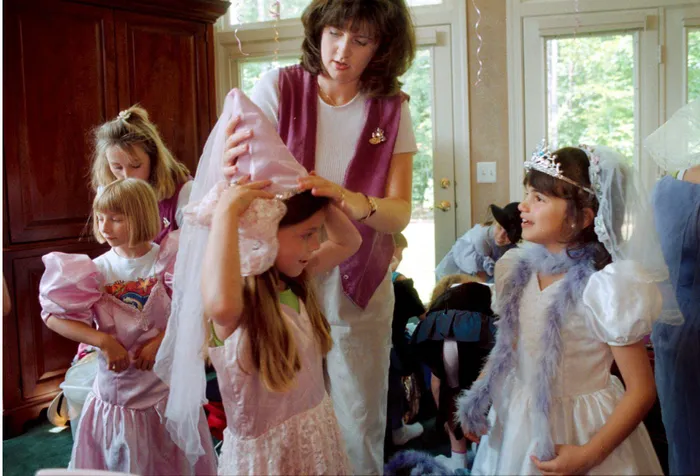
Sisters-in-law Joy and Dawn Yates, the creators of Little Princess Tea Parties, help guests dress up for a 7-year-old’s birthday party in Woodbridge, Virginia, in 1999.
Image: Margaret Thomas/The Washington Post
Relegated to the back of a sharp-elbowed crowd of male photographers on one of her early assignments, she remembered a tactic used by Margaret Bourke-White, an acclaimed Life magazine photojournalist of the 1930s and ’40s.
“I dropped to my knees and wiggled my way through a sea of legs,” Thomas recalled, “until I reached the front of the scrum and shot my photos from a lower perspective. I kept that technique in my bag of tricks for the duration of my career.”
In 1968, Thomas captured hazy images of smoke-filled streets in the District, where buildings had been set ablaze after the assassination of the Rev. Martin Luther King Jr. She later covered crime scenes and congressional hearings, and ventured away from the city to capture award-winning images of the U.S. Virgin Islands or Virginia’s horse country, where she lived for many years.
Thomas boarded a ferry in the Bronx that took her to New York’s potter’s field, where prisoners buried the city’s unclaimed or anonymous dead in white pine coffins. She traveled through the Midwest to chronicle a devastating 1988 drought. And she wielded her camera in conflict zones from Bosnia to Haiti, where she photographed rice farmers wielding threshing sticks and gang members brandishing machetes.
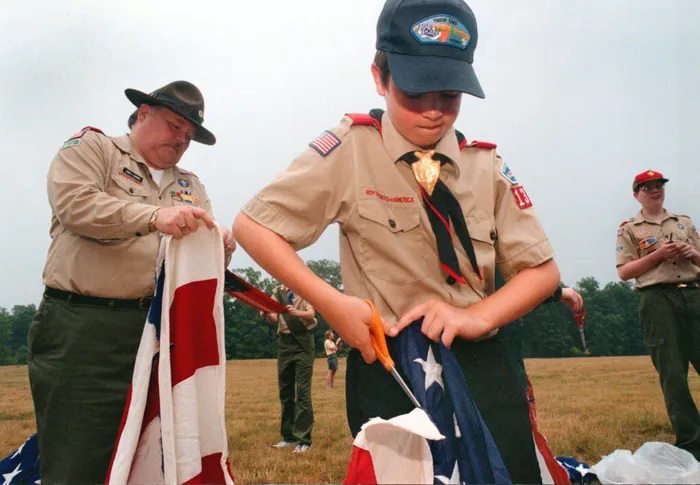
Boy Scouts participate in a Flag Day ritual at Quantico National Cemetery in 1999, reverently disposing of American flags that are no longer fit for display.
Image: Margaret Thomas/The Washington Post
When she wasn’t on the road, Thomas was often assigned to the White House, including during the presidency of Ronald Reagan. She typically carried three cameras over her shoulders, each with a different lens, along with a tripod and small ladder to give her unobstructed views over a crowd. The ladder was particularly useful during a 1985 visit of Britain’s Prince Charles and Princess Diana to the White House.
“To gain access to the outside press area, photographers had to run for an opening in a hedge that would allow only one person through at a time,” she wrote in 2019. “A British photographer repeatedly tried elbowing past me. Carrying my ladder in front, I blocked each effort until I cleared the hedge. Trailing behind me the bloody Brit pushed me to the ground, but on the way down I whacked him smartly with my ladder.”
The youngest of three children, she was born Margaret Frances Sandahl in Moose Lake, Minnesota, on Dec. 21, 1941. Her father was a postal worker, and her mother managed the home.
Thomas went to the Minneapolis College of Art and Design to study painting but soon found herself enthralled with photography. She graduated in 1963, then studied photography at Ohio University, receiving a master of fine arts degree in 1965. Within seven months, she was hired by The Post.
On one of her first assignments, Thomas was taking pictures from a canoe in the Potomac River. A fellow canoeist, David Thomas, came over to steady her boat and to keep her from tumbling into the water. They married in 1967 and remained together until his death in 2021.
Thomas won numerous awards from the White House News Photographers Association, including its photographer of the year prize in 1987. But the job took a toll. “I climb over fences, jump off walls, crawl around on my hands and knees or run at top speed while juggling gear,” she wrote in a 1993 essay. “And I hold my camera upright with elbows flexed for long periods of time waiting for the perfect shot.”
Over time, she began to notice pain and numbness in her right elbow and hand, leading to “the gnawing concern that my professional life might be over.” She underwent procedures to relieve elbow inflammation and carpal tunnel syndrome, then did a photo feature on the surgeon who treated her.
Feeling what she later described as “the need to expand my intellectual life,” Thomas went on leave from The Post for several years to study for a doctorate at the University of Texas at Austin. She wrote her dissertation on the history of women in news photography and received her PhD in 2007, the year after she formally retired. Her archive resides at the university’s Dolph Briscoe Centre for American History.
Well into retirement, Thomas photographed hunts and other equestrian events near her home in Virginia. She leaves no immediate survivors.
“For me, photojournalism isn’t a job,” she once said. “It’s a gift and a special calling.”