

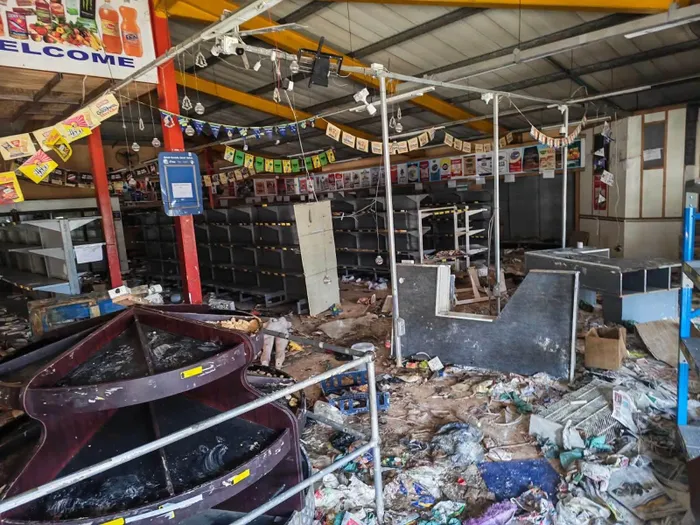
Economists say the biggest cost of June 30 may not have been the protests themselves, but the millions of rands in lost trade as businesses chose safety over opening their doors.
Image: supplied
Although widespread violence was largely averted during the anti-immigration marches on June 30, economists and business leaders say the uncertainty surrounding the demonstrations came at a significant cost to South Africa's economy, with millions of rands in trade lost as businesses opted to close their doors rather than risk operating.
Across Cape Town, shopping centres, township businesses, wholesalers, clothing retailers, furniture stores and informal traders either remained closed for the day or operated on reduced trading hours as concerns mounted over possible violence and looting.
Cape Chamber of Commerce spokesperson Bobby Jordan said while coordinated safety partnerships between business, law enforcement and government prevented widespread disruption to the broader regional economy, small businesses ultimately paid the price.
"While coordinated safety partnerships shielded the broader regional economy from widespread gridlock, the threat of unrest still imposed a financial and operational burden on SMMEs. We received widespread reports of small business closures," Jordan said.
He said the financial consequences were particularly severe for businesses that depend on daily turnover to survive.
"A single lost trading day carries a significant economic impact for small businesses that rely entirely on daily trade. While a precise total cost of the June 30 closures is impossible to quantify without exact closure rates, the scale of risk is massive. Small and informal businesses in Cape Town generate an estimated R650 million in economic value every single day."
Jordan said even if only a portion of those businesses remained closed, the financial losses would still amount to millions of rands.
"When fear paralyses even a fraction of that ecosystem, forcing township traders and retailers to close their doors, millions of rands in unrecoverable daily cash flow evaporate from the communities that need it most."
Unlike larger corporations that often have financial reserves to cushion temporary setbacks, Jordan said many SMMEs simply could not recover the income lost during the day.
"In most cases they cannot recover the loss. Consumers bought elsewhere. Cost of a day remained."
He added that uncertainty itself carries an economic cost.
"Uncertainty alone drives a heavy economic cost in these environments. It forces township economies and informal traders into a highly cautious approach, severely suppressing daily trade and disrupting regular workforce attendance as employees stay home out of fear for their safety."
Jordan welcomed the coordinated response that kept much of the province peaceful but said longer-term solutions were needed.
"While business and law enforcement successfully demonstrated what can be achieved through proactive crisis coordination, stakeholders warn that reactive containment is not a permanent strategy.
"To restore long-term confidence, the government must move past short-term management and decisively address the root causes, specifically community discontent over crime, immigration regulation, and a lack of labour law enforcement, by strictly enforcing compliance across all sectors."
Economist Ulrich Joubert said the consequences extended far beyond small businesses, affecting the economy as a whole.
"We must remember that it's not only SMMEs that are affected by events like 30 June, it's the total economy. Big business is also adversely affected because these events cause disruption."
Joubert said marches through townships, suburbs and city centres interrupted normal economic activity across various sectors.
"It's not only the township people that are affected or business people that are affected, but also in the towns and city centres where we see that this disruption had an impact."
While some consumers may have delayed purchases until the following day, Joubert said businesses generally do not recover the income lost during disruptions.
"Normally one must assume that that money is lost forever. So it has a negative impact on businesses, whether it's a small business or a big business."
He warned that repeated demonstrations and uncertainty could have a longer-lasting impact on consumer behaviour.
"These disruptions have a negative impact on overall consumer confidence. If these marches continue over the next six months, as organisers have suggested, they will continue to weigh on consumer confidence."
Joubert also expressed concern about the message such disruptions send to international investors.
"Why would anyone from overseas come and invest in South Africa if they see these sorts of disruptions? Unfortunately, the overall situation is negative. It has a negative impact on small business, on big business, on consumers in general and on investment."
He further cautioned against overlooking the economic contribution made by skilled foreign nationals.
"Many foreign workers bring valuable skills to South Africa. In many cases they fill jobs that South Africans do not want to do or they bring qualifications and experience that benefit the economy. From an economic perspective, skilled foreign labour is an asset because the country benefits from those skills without having paid for that person's education."
Joubert said while immigration concerns should be addressed through effective border management and the enforcement of immigration laws, government also had a responsibility to ensure businesses and communities were protected from disruption and criminality during protests.
Economist Dawie Roodt agreed that the day had undoubtedly affected businesses, particularly smaller enterprises that rely on daily income, although he believes some of the immediate losses could be recovered.
"There will be an impact on the economy, especially on smaller businesses that can't afford a day's lost business, because that is basically what in many cases happened on the day. But I'm not too concerned about that, because this lost revenue can usually be made up over the next couple of days or so. Lost production can be caught up, and South Africa has become quite resilient when it comes to these kinds of disruptions."
Roodt said his greater concern was the broader economic implications of growing hostility towards foreign nationals.
"It seems to me that we have been quite successful in expelling a lot of illegal immigrants, but also probably a lot of legal immigrants to South Africa."
While he stressed that everyone should comply with the country's immigration laws, he said immigrants make an important contribution to the economy.
"The reality is that those immigrants in South Africa are, on a net basis, significant contributors to the South African economy. In many instances they are job creators as well. They are not taking jobs away on a net basis, they are actually adding jobs to the economy."
Roodt warned that the consequences of xenophobia would extend well beyond a single day of disruption.
"I'm afraid the economy is going to suffer over time because of the xenophobia that we're currently experiencing in the country. That's the price we're going to pay, and it's a price that we will pay for a long time to come."