

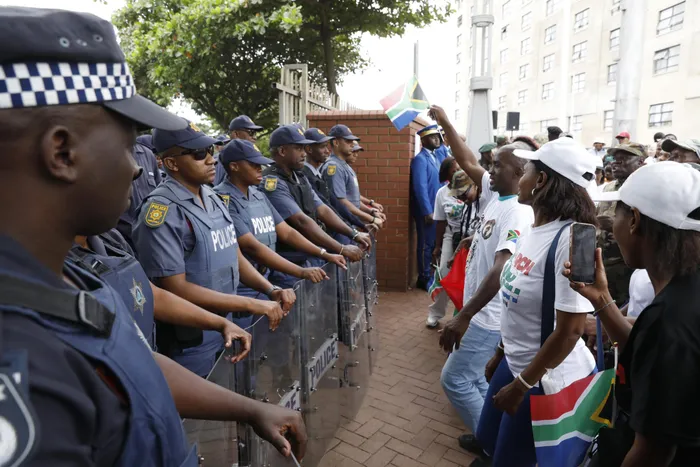
SAPS and safety structures said they are ready for 30 June
Image: Doctor Ngcobo / Independent Newspapers
As South Africa moves closer to planned anti-immigration demonstrations on 30 June, police, private security companies, community policing structures, Western Cape authorities, faith leaders and humanitarian workers have warned that the country cannot afford another July 2021.
The warning comes amid rising tensions over immigration, with hundreds of foreign nationals seeking voluntary repatriation, while security agencies prepare for possible disruptions.
The July 2021 unrest, which erupted after the imprisonment of former president Jacob Zuma, spiralled into days of looting, arson, road blockades, attacks on businesses and widespread destruction, mainly in KwaZulu-Natal and Gauteng.
More than 300 people died, supply chains were disrupted, shops were emptied, warehouses were burnt and communities were left traumatised.
Authorities now say those lessons must guide the response to 30 June.
It has been reported that March and March leader Jacinta Ngobese-Zuma has rejected claims that the planned action amounts to a national shutdown, accusing authorities of creating unnecessary panic. The movement has set 30 June as a deadline for undocumented foreign nationals to leave the country, with protests also expected on the day.
Western Cape Police Oversight and Community Safety MEC Anroux Marais urged residents to reject violence, intimidation and lawlessness. She said she had been briefed at the Western Cape Provincial Operational Command Centre on SAPS’ readiness.
“Any protest action must be peaceful, lawful and within the confines of the Constitution. The rule of law must be respected at all times,” Marais said.
She confirmed that the Provincial Joint Operational Centre had been activated to coordinate preparations and responses, with increased law enforcement deployments, intelligence-gathering and contingency measures through disaster management structures.
Marais also warned against misinformation and disinformation on social media, urging residents not to share unverified information, inflammatory content or messages intended to incite violence or fear.
At national level, Acting Police Minister Firoz Cachalia met with representatives of the private security industry, SAPS and the Private Security Industry Regulatory Authority to strengthen cooperation.
Cachalia acknowledged that tensions had emerged over immigration-related challenges, but said government was dealing with these issues through appropriate channels. He said all stakeholders had a responsibility to ensure South Africa remained stable, peaceful and safe.
Acting National Commissioner of SAPS Lieutenant General Puleng Dimpane said the lessons of July 2021 remained fresh, particularly the gaps in coordination, communication, early warning systems and collaboration between those responsible for safety and security.
She said police had reflected on those failures and had learnt that no single organisation could respond to threats of this magnitude alone.
“Planning and preparation are therefore not optional. They are essential,” she said.
Dimpane said SAPS, working with other law enforcement agencies, metro police and private security, was prepared. Operational plans had been finalised, resources had been mobilised and communication channels had been strengthened.
She said police would protect lawful and peaceful demonstrations, but warned that criminal conduct would not be tolerated. The blocking of roads, intimidation of communities, destruction of property, attacks on businesses, looting, violence and attempts to undermine public order would be dealt with.
“To those who may be considering exploiting the demonstrations to commit criminal acts, our message is equally clear: the SAPS is ready, the SAPS is prepared,” Dimpane said.
National Community Police Consultative Forum spokesperson Siyanda Biyela said community safety structures also had a role to play in maintaining peace.
He said CPFs, sector forums, youth desks and patrollers had been directed to remain vigilant, support efforts to keep communities safe and provide early warnings on threats that could lead to violence, looting, public disorder or damage to infrastructure.
However, Biyela stressed that CPF and community safety structures should avoid direct confrontation with demonstrators and immediately report any criminal activity or threat to SAPS.
“The responsibility for enforcing immigration laws rests with the relevant state institutions and law enforcement authorities,” Biyela said.
The security preparations come as inner-city churches and the RESPOND Network raised concern over a humanitarian crisis in Cape Town, where hundreds of Zimbabwean men, women and children have slept outside the Zimbabwean Consulate while waiting to be processed for voluntary repatriation.
Rev Sikawu Makubalo of the Central Methodist Church, Rev Riaan de Villiers of Grote Kerk Cape Town and Rev Annie Kirk of St George’s Cathedral Anglican Church said they had witnessed scenes that should trouble the conscience of the nation and the continent.
The churches said mothers and children had been exposed to the cold and rain, while seven buses had already transported people seeking voluntary repatriation. They said thousands of Malawians and Mozambicans had also fled their homes in recent weeks because they feared for their safety.
The faith leaders acknowledged frustration over poverty, unemployment and crime, but urged South Africans not to direct their anger at foreign nationals. They also criticised Home Affairs over delays and said employers who exploited undocumented foreign nationals should be held accountable.