

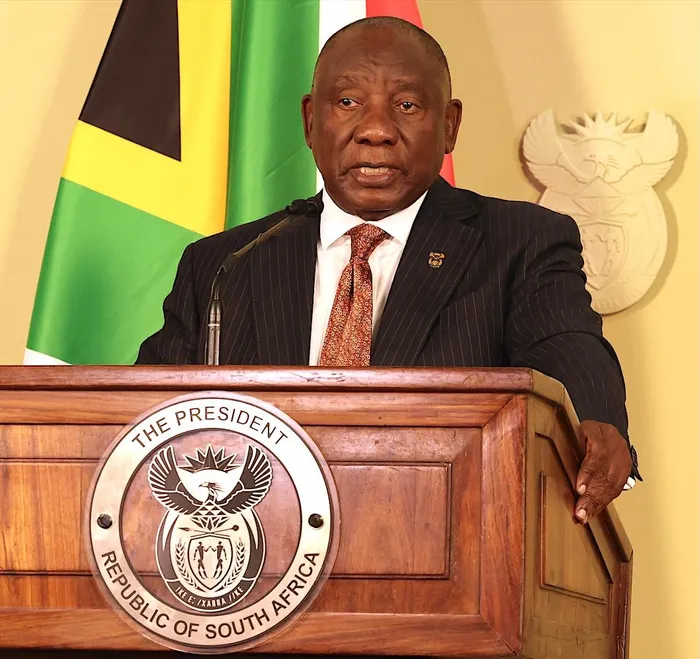
President Cyril Ramaphosa announced a slew of planned amendments to illegal migration and the recent surge in protests against foreign nationals.
Image: Siyabulela Duda/GCIS.
Civil society organisations have criticised President Cyril Ramaphosa's latest address on illegal immigration and anti-foreigner tensions, arguing that it failed to provide urgent solutions to stop ongoing violence against foreign nationals and did not adequately address the deeper issues fuelling unrest.
Global South Against Xenophobia (GSAX), together with the Botshebelo Unemployed Movement (BUM), One Voice For All Hawkers Foundation and Inspire Network, issued a statement on Monday expressing concern over what they described as significant shortcomings in the President's national address delivered on Sunday.
The criticism follows a period of heightened tensions across parts of South Africa, including the Western Cape, where incidents involving foreign nationals have sparked concern among government, civil society groups and international observers.
Weekend Argus previously reported that the first group of 300 Ghanaian nationals departed from OR Tambo International Airport under a voluntary repatriation programme after more than 800 citizens registered for assistance to return home.
Similar developments have been reported among other African nations. Mozambican authorities said 300 of their citizens had already returned home, while more than 500 others were being assisted with repatriation. Nigerian authorities have also reported that more than 1,000 citizens have registered interest in returning home amid growing tensions.
In the Western Cape, recent incidents in areas including Mossel Bay, Kleinmond and Stanford prompted the activation of disaster management and law enforcement interventions, while foreign nationals sought shelter or assistance to return to their home countries. The unrest has also been linked to several deaths and injuries, further intensifying calls for government intervention.
In his address, Ramaphosa announced a range of interventions aimed at strengthening the country's immigration system, improving border management and tightening the enforcement of immigration laws. He also outlined plans to modernise identification systems and accelerate reforms intended to improve the management of migration.
However, GSAX and its partners said the President's proposals did not go far enough.
The organisations said they welcomed government's willingness to address weaknesses within the immigration system, but argued that the address failed to directly challenge narratives that portray foreign nationals as the cause of crime, unemployment and other social problems.
According to the coalition, one of the most pressing concerns was the absence of immediate measures to stop attacks on migrants and other vulnerable groups.
"The address lacked clear, decisive law enforcement, prosecutorial, and legal measures to stop immediate attacks by vigilante mobs targeting foreign nationals and vulnerable groups," the coalition said.
The organisations argued that communities affected by recent violence needed reassurance that those responsible for intimidation, assaults and acts of vigilantism would face swift consequences.
GSAX further contended that the President's speech did not sufficiently engage with the economic conditions that continue to drive frustration and social tensions within communities.
The coalition said poverty, unemployment and inequality remain major contributors to conflict and competition over limited opportunities and resources. It argued that these longstanding challenges cannot be separated from discussions around migration and social cohesion.
"The President failed to address the unequal, neoliberal, and extractive economic policies that deepen poverty, unemployment and social conflict," the group said.
The coalition also raised concerns about foreign nationals who have fallen out of legal status because of administrative delays within the Department of Home Affairs.
According to the organisations, many migrants have been left in limbo for extended periods while waiting for permits, visas and other applications to be processed. They warned that the delays leave individuals vulnerable to arrest, detention and deportation despite having attempted to comply with legal processes.
GSAX said the President's address did not include any proposals aimed at resolving these backlogs or protecting those affected by them.
The criticism comes as government faces mounting pressure to respond both to public concerns around illegal immigration and to growing reports of xenophobic incidents in several parts of the country.
Ramaphosa's address sought to strike a balance between enforcing immigration laws and discouraging vigilantism, while reiterating that immigration enforcement remains the responsibility of law enforcement authorities and not private citizens or community groups.
Civil society organisations, however, maintain that stronger and more targeted interventions are needed to prevent further violence and ensure that foreign nationals are protected.
GSAX and its partners said they would continue advocating for measures aimed at combating xenophobia, safeguarding vulnerable communities and upholding constitutional rights.
The coalition said meaningful solutions would require not only immigration reforms, but also action to address inequality, economic exclusion and administrative failures that continue to leave many people vulnerable.
"Our constitutional democracy requires decisive action against xenophobia, vigilantism and all forms of exclusion," the organisations said.