

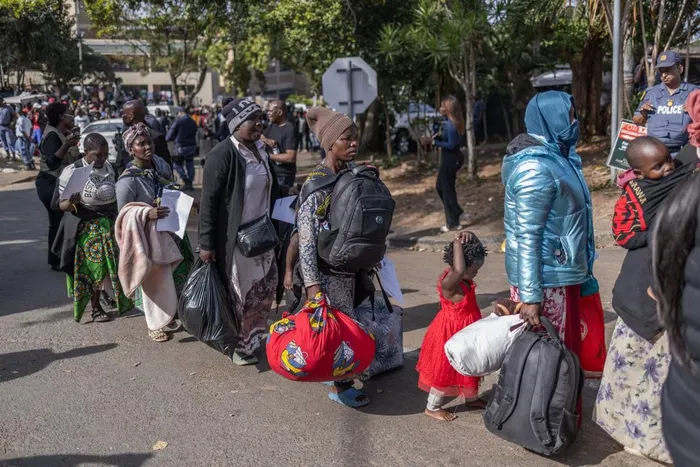
Migrants stand in a queue to board the first of seven buses at the Sherwood Park in Durban to travel back to Malawi.
Image: RAJESH JANTILAL / AFP
Nigeria and Ghana are uniting their efforts to challenge anti-illegal immigration protests at the upcoming African Union Summit, presenting a powerful front of solidarity.
This decision followed a bilateral meeting during the ECOWAS Mid-Year Summit in Freetown, Sierra Leone. The talks centred on fighting xenophobia and ensuring the protection of African migrants throughout the continent.
Recent events in South Africa have sparked protests, as some groups accuse foreign nationals, especially fellow Africans, of taking jobs and resources from locals. These developments have further inflamed tensions.
On 17 July 2026, Nigeria's Minister of State for Foreign Affairs, Ambassador Sola Enikanolaiye, met with Ghana's Minister of Foreign Affairs, Samuel Okudzeto Ablakwa. The ministers reaffirmed their robust partnership, called for bold diplomatic action, and renewed their dedication to achieving reparative justice for the trans-Atlantic Slave Trade.
They highlighted the significance of the recent United Nations resolution on this matter. The ministers expressed grave concern over the recent surge of Afrophobic protests and attacks targeting African nationals in South Africa.
They issued a strong condemnation of all forms of xenophobia, Afrophobia, intolerance, and violence, warning that such acts threaten the very foundations of Pan-Africanism, regional unity, the African Union's ideals, and the African Continental Free Trade Area.
They also stressed that migrants accused of crimes must be dealt with through the rule of law rather than mob violence.
By standing together diplomatically and championing legal protections, the ministers seek to reassure African migrants that their safety and rights are at the forefront.
These commitments are poised to spark deeper collaboration between governments and local authorities, opening the door to greater security, enhanced support services, and a safer environment for migrants confronting discrimination or violence. The ministers vowed to work alongside other African Union member states to bolster monitoring, create early warning systems, and use preventive diplomacy to tackle future challenges.
They urged all member states to champion Pan-Africanism, mutual respect, and the free movement of people. They also backed ongoing public education and dialogue, reaffirming their commitment to working together through ECOWAS, the African Union, and other international organisations.
In May and June of 2026, the Border Management Authority and the Ghanaian High Commission arranged voluntary repatriations, processing 963 Ghanaian nationals departing South Africa in various operations, according to IOL.
Between June 10 and July 15, 2026, Nigeria evacuated and repatriated 1,490 South African citizens. An increase in anti-immigrant demonstrations and pressure on undocumented foreign nationals preceded this official evacuation.
Separately, 586 illegal Nigerian nationals were formally deported and banned from entering the country for five years by the South African Department of Home Affairs.
South Africa's government has firmly rejected the label of being a xenophobic nation. Official statements maintain that public protests and government actions are strictly targeted at addressing illegal immigration and crime, rather than at foreign nationals as a whole.
Immigration expert Gideon Chitanga of the Centre for Africa China Studies at the University of Johannesburg has called for African nations to refrain from spreading divisive messages that fuel tensions and support hostile groups or organisations within Africa, specific countries, or communities.
''The South African government has discussed its efforts to address these problems.
''Other African governments should support local efforts to handle complex immigration issues in South Africa, work closely with South African institutions to solve them legally, and coordinate their actions.’’
Chitanga noted that the protests fuel division and pose significant obstacles to continental economic integration, urging leaders to consider carefully whether to contribute to such divisions.
''There is still room to focus on major continental socio-economic and political issues. Without neglecting the protests, there is no reason to amplify them or give them greater prominence, which could jeopardise the main agenda of continental institutions.’’
Chitanga added that united action by African countries to tackle both domestic and continental socio-economic and security challenges would go a long way toward resolving illegal immigration.