

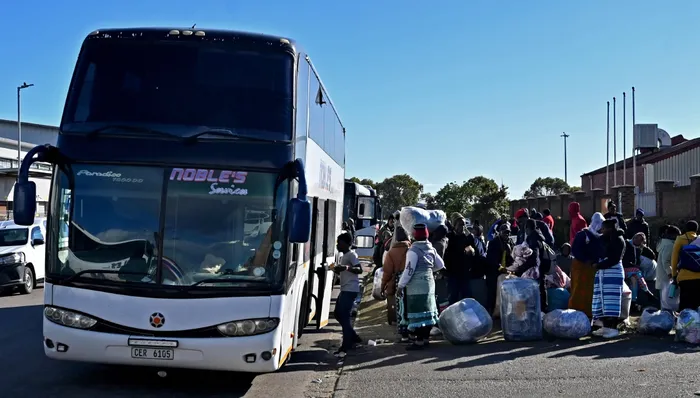
Foreign nationals wait for transport as repatriation efforts continue following anti-illegal immigration protests and intensified immigration enforcement across South Africa.
Image: Bheki Radebe / ANAStudio
Thousands of migrant workers have allegedly lost their jobs, businesses are reporting growing shortages of skilled labour, and parts of the country's transport and agricultural sectors say they are beginning to feel the economic effects of South Africa's anti-illegal immigration campaign, weeks after protests demanding the removal of undocumented foreign nationals swept across the country.
What started as isolated demonstrations in May gathered momentum ahead of the self-imposed June 30 deadline set by anti-illegal immigration groups such as March and March and the Labour and Civic Organisation (LACO), which demanded undocumented foreign nationals leave South Africa.
Since then, protests have continued across parts of Gauteng, KwaZulu-Natal, and the Western Cape, with Cape Town becoming a focal point for demonstrations targeting foreign-owned spaza shops, traders, and businesses accused of employing undocumented migrants.
While LACO has maintained that its campaign aims to create employment opportunities for unemployed South Africans, there is little independent evidence that the jobs vacated by foreign nationals are being filled by locals.
Recent fact-checking by Africa Check also found no evidence to support claims that removing undocumented migrants would automatically reduce unemployment or create jobs on a significant scale.
Instead, labour organisations say employers have increasingly used the anti-illegal migrant climate to dismiss workers, while businesses are now grappling with shortages of experienced labour.
The Casual Workers Advice Office (CWAO) said dismissals began before the nationwide protests reached their peak. Through its Simunye Workers Forum, the organisation documented cases involving workers at Harvest Fresh Farms, Sunshine Plastics, Fortune Plastics, ZGG Farms, and Guard Master/Wire Ventures, where migrant workers from Malawi, Zimbabwe, Lesotho, and Mozambique allegedly lost their jobs or were told not to return to work.
CWAO organiser Andile Nyembezi said the organisation has now received an estimated 3,000 reports of dismissals, intimidation, and workplace discrimination, up from about 1,500 cases reported earlier this month.
"As we speak, we are still receiving new dismissals. Workers come into our offices every day. We estimate the number has now doubled to around 3,000," he said.
Nyembezi said agriculture, plastics, and recycling had emerged as some of the hardest-hit sectors.
"The farming industry has been heavily affected because workers live where they work. When they lose their jobs, they also lose their homes."
He accused some employers of using immigration enforcement as an excuse to remove workers after employing them for years.
"Instead of helping workers regularise their status after benefiting from their labour, employers are simply dismissing them. If someone has worked for you for 15 years and you suddenly call the police because they don't have papers, then both the employer and employee should be held accountable."
He said the impact extended beyond workplaces, with migrant workers facing eviction from homes and communities.
"Women, including pregnant women, children, and migrant workers, have been tied up with ropes and dragged from homes and workplaces. It has been a rough period for African migrant workers."
Some sectors now say they are beginning to feel the economic consequences of the departures.
The impact of the campaign is also being felt in farming communities and townships, where some South Africans say the departure of migrant workers and business owners has had unintended consequences.
Patricia Jansen, not her real name, a seasonal farm worker from De Doorns in the Western Cape, said several foreign nationals who lived and worked alongside her decided to leave the area despite having valid documentation because they feared becoming targets.
"They were scared. Even those who had the correct papers no longer felt safe staying here," she said.
Jansen said many of the workers had become part of the community over the years and their departure had affected both households and local businesses.
"They are our brothers and sisters. We worked together and looked after one another. I'm disappointed by what has happened."
KwaZulu-Natal sugarcane farmers have warned publicly that experienced cane cutters are becoming increasingly difficult to replace, while organisations representing women farm workers have cautioned that agriculture has long depended on migrant labour.
SANTACO KwaZulu-Natal office manager Sfiso Shangase said some taxi operators had already reported lower passenger numbers.
"The departure of foreign nationals has had an economic impact on the transportation industry because some of them used our vehicles to travel to their respective destinations," he said.
Shangase added that operators were also struggling to find skilled artisans to repair vehicles.
"Many foreign nationals had these skills. There are still some available, but prices are now higher and turnaround times are longer because there are fewer people."
CODETA chairperson Nceba Enge said commuter numbers in Cape Town had remained largely unchanged but acknowledged the shortage of specialist skills.
"There were people making seat covers for taxis and others who were skilled auto electricians. We now struggle to find someone to repair our vehicles immediately," he said.
The campaign has continued to evolve across several provinces. In Gauteng, anti-illegal immigration groups have targeted factories, farms, and businesses accused of employing undocumented foreign nationals, while labour organisations say many of the dismissals they have documented have occurred in the province.
In KwaZulu-Natal, protests have spread through parts of Durban and the North Coast, where some sugarcane farmers have warned that the loss of experienced migrant workers is beginning to affect harvesting operations.
In the Western Cape, demonstrations have focused largely on undocumented traders and foreign-owned spaza shops.
LACO has staged a series of protests outside businesses and public facilities, arguing that employment opportunities should be reserved for South Africans and calling for tighter controls over informal trading permits issued by the City of Cape Town.
The developments come as the government is trying to increase support for South African-owned township businesses through the Department of Trade, Industry and Competition's R500 million Spaza Shop Support Fund.
The fund, launched earlier this year, is intended to help qualifying South African-owned spaza shops and convenience stores expand through grants, loans, infrastructure improvements, business training and wholesale partnerships.
By the end of May, more than 2,300 applications had been approved, with support valued at almost R180 million, although officials have acknowledged that much of the funding has yet to be disbursed.
The government has argued that the programme forms part of a broader strategy to strengthen township economies while ensuring that local businesses become more competitive.
At the same time, the Department of Home Affairs and the Border Management Authority have continued nationwide operations targeting undocumented foreign nationals.
Thousands of people have been processed through the Musina Repatriation Centre and returned to neighbouring countries in recent weeks as immigration enforcement has intensified.
Authorities have repeatedly stressed that while immigration laws will continue to be enforced, communities should not take the law into their own hands or target people based on nationality.