


Unmarried surviving partners can claim maintenance from a deceased partner's estate if they can prove financial need.
Image: ChatGPT
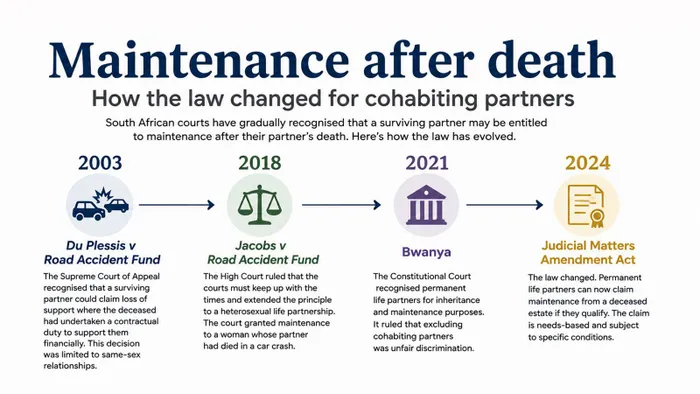
More than two decades ago, the Supreme Court of Appeal decided that the Road Accident Fund had a duty to pay loss of support to a someone whose life partner had been killed in a car accident – even though there is no such thing as a common law marriage.
In that case, which predated same-sex marriages being legally recognised by three years, the couple had lived together for more than 11 years, pooled their finances, named each other as sole heirs in their wills, and held a commitment ceremony.
Du Plessis v Road Accident Fund found that the deceased partner had undertaken a contractual duty to support his partner financially – and that this obligation was worthy of legal protection.
Judge Cloete wrote that the couple’s “marriage” ceremony, witnessed by family and friends, the pooling of income, the shared family responsibilities and the deceased’s express commitment to support his partner all pointed to a tacit, reciprocal duty of support. This judgement was, however, limited to same-sex relationships.
In the unreported matter of Brenda Jacobs vs the Road Accident Fund in 2018, Judge Colleen Collis ruled that the courts basically had to keep up with the times, particularly when relationships and marriages have developed, divorcelaws.co.za says.
Collins granted an order in favour of a woman whose partner passed away in a car crash. The two had were living together and Jacobs had claimed support from the Fund as he had supported her financially, a bid the Fund declined as the couple were not legitimately married.
The judge in that matter specifically referenced the Section Nine of the Constitution, in the Bill of Rights, which states that “the state may not unfairly discriminate directly or indirectly against anyone on one or more grounds including… marital status…”.
In 2021, cohabitating partners were finally legally recognised as permanent life partners when Jane Bwanya won her case against the Master of the High Court, seeking both inheritance and maintenance on the basis of an intestate spouse as her deceased partner’s will left his estate to his mother – who had predeceased him.
The Constitutional Court ruled against the Master of the High Court – which had refused to recognise the union – and reversed its own 2005 ruling in Volks v Robinson, which had held that excluding unmarried partners was not unfair discrimination because they had chosen not to marry.
In its ruling, the Constitutional Court declared parts of the Maintenance of Surviving Spouses and Intestate Succession Acts unconstitutional, ordering Parliament to fix the law within 18 months. The Judicial Matters Amendment Act gave effect to that order on 3 April 2024, formally expanding the definitions of “spouse” and “survivor” under the Act.
Under the changes, the surviving partner can claim from the estate for “reasonable maintenance needs” against the deceased’s estate – but only until their own death or a new permanent union, and only to the extent they cannot support themselves from their own means and earnings.
It is not a share of the estate; it is a needs-based claim, assessed against what the survivor can already provide for themselves. This change is also not unconditional as the court must balance the size of the estate available for distribution, the survivor’s own means, earning capacity and financial obligations, and the standard of living the couple shared while the deceased was alive.
Where a dependent child also has a claim against the estate, the survivor’s maintenance claim ranks equally with the child’s – and if the two compete, both are reduced proportionately. There is also a catch built into the post-Bwanya definition of “survivor”: a partner who has already received an equitable share of the estate through inheritance may not have a maintenance claim on top of it.
Maintenance after a life partner dies is not a share of the estate; it is a needs-based claim
Image: ChatGPT
Proving the relationship existed at all remains the hardest part. Harry Joffe, head of legal services at Discovery Life, says each case is judged on its own merits and may require evidence such as shared finances, affidavits from friends or family, and other proof that the relationship was permanent and involved reciprocal duties of support.
De Rebus points to EW v VH, saying it is “the only case brought before a court following the court’s ruling in Bwanya” while noting that a request for interim maintenance was denied, not because the claim lacked merit, but because it was brought in motion court.
In that case, there was no oral evidence, and material facts were in dispute that the court could not resolve on paper. The case offers no real guidance on what a court requires to establish a permanent life partnership deserving of maintenance. This ruling, the publication said, “offers no clear guidance on the elements that a court requires to establish the existence of a permanent life partnership deserving of maintenance”.
Simon Dippenaar, managing attorney at SD Law in Cape Town, advocates keeping a clean record of contributions such as retaining messages that refer to “our house” or “our business,” and saving photos that show a life together. “This is not about suspicion; it is about stewardship. If one of you is injured, if a family challenges an estate, if a bank queries authority, this mundane evidence will become critical,” he says.
Judge Collis remarked: “Cohabitation outside a formal marriage and, dare I say, even where one of the parties is still married, is now widely practised and accepted by many communities.”
PERSONAL FINANCE