


Those who can claim from the RAF include anyone who sustained a bodily injury in an accident, except a driver who was the sole cause, as well as dependants of a deceased breadwinner and close relatives who paid funeral costs.
Image: Алесь Усцінаў | Pexels
Delays in Road Accident Fund (RAF) claims are not uncommon. A recent High Court ruling, however, makes clear that those delays cannot be used against claimants when the Fund itself is responsible for them.
In Bheki Cele v Road Accident Fund, the Mpumalanga High Court considered whether a claim had prescribed after more than five years had passed since the underlying accident. Cele sued the fund for injuries sustained in a collision near Nelspruit in July 2017.
Rather than appointing a private attorney, he lodged his claim directly with the RAF – a route the fund actively encourages. It employs Information Officers at all branch offices to assist claimants free of charge, though a claimant may still decide to employ a lawyer, who will be entitled to charge a fee for professional services rendered.
The RAF's own website describes what happens next. Once a claim is lodged, "the RAF must be offered a reasonable period of time in which to assess its liability in respect of the claims lodged, enter the claims into the relevant computer system, perform the necessary enquiries, and thereafter arrange for electronic funds transfer directly into your, or other nominated bank account”.
Claimants will be advised by letter which claims have been admitted, how any payment was made up, which claims require further explanation and which have been rejected.
The RAF, acting as Cele's legal representative through its internal claims system, failed to process the claim or alert him that it was approaching prescription. Four years and seven months passed.
"No explanation has been offered for this," Ngwenya noted. When it became clear the fund was not acting, Cele terminated its mandate in January 2022 and appointed private attorneys, who issued summons in February 2024.
The RAF argued that the claim had prescribed – in the hands of Cele's new lawyers, who had just five months between taking over the matter and the five-year deadline.
Acting judge Ngwenya was not persuaded. The fund had not disputed that it had assumed Cele's legal representation, that it had failed to process the claim before prescription, or that Cele had terminated its mandate because of that failure.
"It had a duty to ensure that the plaintiff's claim was properly dealt with. I find that the fund did not handle the plaintiff's case with care," Ngwenya said.
The court found it would be unfair to expect Cele's attorneys to act within a significantly shortened period when the Road Accident Fund Act affords claimants five years to institute a claim.
Cele "should have the full benefit of the five-year period afforded to it by the statute. In this instance, the fund wasted four years and seven months, and no explanation has been offered for this." The special plea was dismissed, and the RAF was ordered to pay costs.
Knowing who can claim and the applicable time limits matters. Those who can claim from the RAF include anyone who sustained a bodily injury in an accident, except a driver who was the sole cause, as well as dependants of a deceased breadwinner and close relatives who paid funeral costs.
A claimant under the age of 18 must be assisted by a parent, legal guardian or curator ad litem. Where the identity of the driver or owner of the guilty vehicle is known, a claim must be lodged within three years of the accident and finalised within five.
Hit-and-run claims must be lodged within two years and also finalised within five. Claims range from loss of income by a victim's family through to medical and funeral costs.
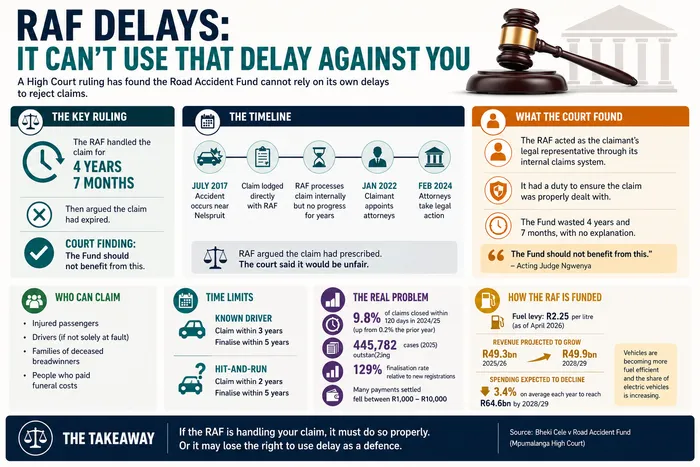
The ins and outs of Road Traffic Fund claims.
Image: ChatGPT
Webber Wentzel associate Maano Manavhela says the judgment "serves as a further reminder that the RAF cannot benefit from delays of its own making, particularly where it has failed to explain prolonged delays in the finalisation of a claimant's matter”.
The court, Manavhela adds, found it would be unfair to expect the plaintiff's attorneys to act with undue haste within a significantly shortened period when the Road Accident Fund Act affords a claimant five years within which to institute a claim.
The RAF's own data shows it closed just 9.8% of all claims within 120 days in the 2024/25 year, an improvement on the 0.2% recorded the prior year. National Treasury estimates performance of 15% for the current year.
The backlog of outstanding cases stood at 445 782 in 2025, with a finalisation rate of 129% relative to new registrations. Many payments settled fell between R1 000 and R10 000.
The RAF is funded through the road accident fund levy, currently R2.25 per litre as of April 2026, with revenue projected to grow at an average annual rate of 0.4% from R49.3 billion in 2025/26 to R49.9 billion by 2028/29.
National Treasury notes that fund spending is expected to decrease by 3.4% on average each year to reach R64.6 billion by 2028/29, as vehicles improve in fuel efficiency and the share of electric vehicles increases.
The RAF has historically faced questions about its financial health, including a legal dispute with the Auditor-General of South Africa over its selection of accounting standards, which it lost.
In its 2025 annual report, interim board chairperson Kenneth Brown noted that attempts to limit liability to seriously injured claimants and the introduction of a "narrative test" to curtail general damages led to higher average claim settlements.
PERSONAL FINANCE