

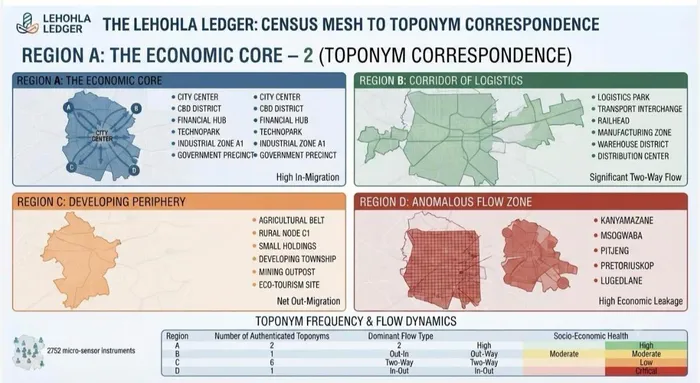
A geography of the mesh showing unequal siphon among different regions in South Africa, which is causing stagnant economic growth and a failure of the social contract.
Image: Screenshot / Lehohla Ledger
South Africa’s astronomical youth unemployment is calculated by design, not by accident, owing to the government’s repeated failure to use data to guide decision-making, solve problems, and reform policies to drive better economic growth.
This is according to former Statistician-General Dr Pali Lehohla. He was this week addressing an IEC seminar under the theme, “The Disappearing Labour Theory: Understanding Recent Voting Patterns in South Africa's Elections”.
The former Statistician-General presented various data showing the challenges collapsing the country, which he said have been presented to the country’s leaders in the last 30 years.
He said the biggest challenges can be seen in the Geography of the mesh, which is a spatial ‘mesh’ or grid-based framework that refers to small-area geographic units, used by Statistics South Africa (Stats SA) to map and aggregate demographic data without distorting local.
The mesh classifies regions as categories A, B, C, and D, which are mining hotbeds and informal settlements. D is rated as critical where the social contract has collapsed.
Among the major challenges pointed out is that the extractive In-Out siphon model drains mineral and agricultural wealth outward, leaving production communities with almost nothing, which results in high poverty rates.
Lehohla said the country’s economy is constrained to R7 trillion, when it should be R21 trillion. He added that the ripping off is coming from the mines in the Free State and KwaZulu-Natal, and this is based on statistics from 1996, 2001, 2011, and 2022, resulting in cumulative sovereign harm over the past 32 years.
“The main culprits are mining with R5.1 trillion, finance at R3.9 trillion, manufacturing at R2.8 trillion because we don’t process what we have; we let go; professional services (consultants) R1.1 trillion, water and sewerage R0.8 trillion, electricity, gas, and steam R0.4 trillion, agriculture and forestry R0.2 trillion. Those who know economists will understand what the mines do and what their relationship is with financial houses,” he said.
He stated that this siphon funnels wealth generated in mining and fields into metropolitan core enclaves, leaving the majority with an empty economic floor.
“As a result of the siphon, black people have lost R12 trillion, Coloureds R715 billion, Indians R286 billion, whites R1.3 trillion,” he highlighted.
Lehohla warned that the biggest culprits in siphoning everything out of South Africa are “black surrogate capitalists and their white masters”.
The term ‘Black surrogate capitalists’ refers to Black business elites or beneficiaries of programmes, such as Black Economic Empowerment, who act as proxies or fronts for traditional, established white capital, maintaining structural economic inequality rather than achieving genuine economic liberation.
In the Lehohla Ledger, he recommends a shift to ‘Out-In’ logic to ensure wealth generated circulates locally rather than siphoning out. He argues that the new regenerative ‘Out-In’ models keep value inside the community so local people and places thrive.
Lehohla also criticised government economists, saying they have failed to provide meaningful solutions.
“There are no economists in government, and I don’t know what to call them. They are there to keep books, and they keep mileage. I was a chief statistician of the country. Who is the chief economist, whom, if they make a mistake and the economy doesn’t grow, we have to put direct blame on them?” he asked.
He stated that, “I put my neck on the block for the consumer price index (CPI), but we don’t have such economists. Then how do you think democracy can run. So, that is why we need to run a sensus on idiots and know how many idiots we have in this country, and particularly in power.”
Another challenge mentioned by Lehohla was that the educational progression ratio (EPR) constraint condemns the 90% majority, where some learners, despite passing mathematics with 100%, face a failed destination because of their (mesh) geographic location.
“They are destined to fail. There is no way they can succeed in Soweto because the conditions are drastic. We have created those conditions, and that’s the task of democracy (to correct these),” he said.
On the grants state fallacy, failing to add local community internal value-addition, he said welfare money comes through recipients but does not stay because they have to spend it at big retail chains to buy necessities.
Lehohla stated that Operation Vulindlela’s micro-adjustments are failing to break the structural ceiling; instead, they are focusing on elite consulting over industrial policy. Operation Vulindlela is designed to accelerate structural reforms and remove binding constraints on economic growth.
He also mentioned that privatisation disrupts grids and is hollowing out State-Owned Enterprises’ training base.
Lehohla stated that South Africa does not need a National Dialogue; instead, it must use statistical data for decision-making.
He noted that the country is not following the utilisation model where there is that central place which is the stomach or a hub of some sort where statistics or things are digested adequately so that they produce something.
“I have been talking about this to ministers, presidents, and everybody for the last 17 years that I was the Statistician-General and the last 34 years I was in a statistics environment.”
He added that labour disappearance index correlates the facts that cause democracy collapse.
“The official statistics start with utilisation, and that’s where the tyre meets the tarmac, and the politics can be very rough. In South Africa, we have not reached that stage. I don’t know whether it is because of the deficiency of science-ficiency in politics or is just because they respect information. Well, I doubt if they do because if they did, they would use it; but they don’t,” Lehohla said.
A deficiency of ‘science-ficiency’ in politics means that laws and leaders often ignore facts, data, and testing. Instead of using clear evidence to solve problems, politics often relies on guesswork, personal beliefs, or quick tricks to win votes.
“The knowledge as understanding, we are devoid of that in the country at the moment. Therefore, we cannot have good lights, we cannot have competency, we cannot and we cannot have authority. The absence of the state is because it is not a science-led state. It is based on knowledge as information, in any form, on Twitter (X), or anything; that’s the kind of state we have. And with that kind of state, we cannot go anywhere,” Lehohla said.
He warned that democracy cannot thrive on process alone; it requires a functional economic base, and when large segments of the population are permanently unemployed, democratic rights feel abstract and disconnected from daily survival.
Dr Benjamin Roberts, a research director at the Human Sciences Research Council (HSRC), presented data from the Voter Participation Survey, showing that public trust in political and state institutions has dropped sharply since the late 2000s.
He said that popular support for democracy as the ‘only game in town’ has dropped to a historic low. “It’s fallen from a high of 67% in the mid-2000s to only 36% with the latest surveying... so it’s a fairly dramatic decline.”
Roberts said while trust in the IEC has also declined, it remains higher compared to political parties or Parliament.
“Trust in key public bodies, including local government, parliament, national government, and political parties has fallen precipitously from approximately 70% to barely 20%,” he said.
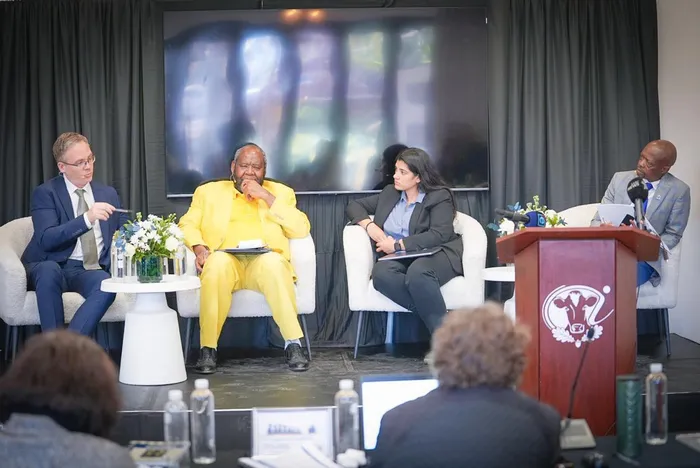
From lef: Dr Benjamin Roberts, a research director at the Human Sciences Research Council, Former Statistician-General Dr Pali Lehohla, and Tasneem Essop, a researcher from Wits University’s Society, Work and Politics Institute during the Electoral Commission’s Thought Leadership Seminar recently held in Centurion.
Image: IEC X Account
Tasneem Essop, a researcher from Wits University’s Society, Work and Politics Institute (SWOP), said that voter disengagement among working-class communities and unemployed youth is not a failure of civic consciousness, but a rational reaction to a system where political promises have repeatedly failed to translate into basic dignity, municipal services, or fair livelihoods.
“Historically, trade unions and formal workplace structures served as the vital organs for civic education and democratic participation in South Africa. As formal labour disappears, the primary organisational vehicle that connected everyday socioeconomic struggles to the ballot box vanishes with it,” Essop said.
IEC Commissioner Dhaya Pillay said that without equitable distribution of resources and genuine labour market inclusion, citizens inevitably retreat from formal democratic mechanisms, choosing individual survival over collective civic participation.