

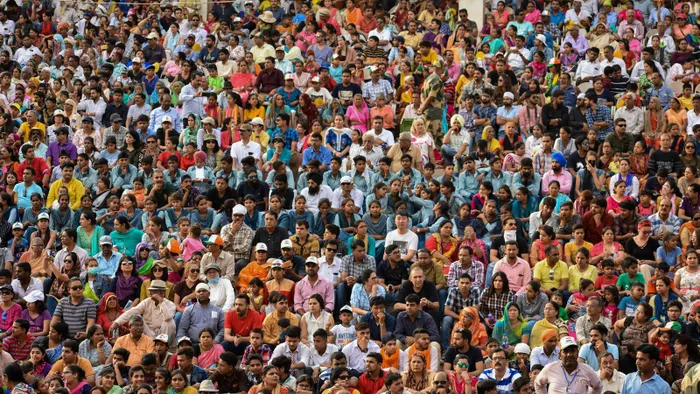
The 1996 population structure showed a large base associated with higher fertility rates and a greater proportion of people aged up to 24.
Image: Neelakshi Singh | Unsplash
South Africa’s population has grown by almost 53% since the country’s first democratic census, rising from 40.6 million people in 1996 to more than 62 million in 2022.
Statistics South Africa, marking World Population Day and 30 years of democratic censuses, said the population grew at an average annual rate of 1.7% over the 26-year period.
The 1996 starting point is significant because earlier population counts were conducted under an apartheid statistical system that senior officials later described in uncompromising terms.
Researchers John Kahimbaara and Frederick Orkin, along with former statistician general Pali Lehohla, wrote in a 1998 paper that the Central Statistical Service had “basically been shaped to serve White South Africa, and especially metropolitan business interests,” and had been “geographically fragmented in line with apartheid policy.”
African residents, they wrote, were “regarded as objects of measurement and administrative policy rather than as citizens or potential users.” The last apartheid census in 1991 was, in their words, “a pastiche of small-area detail, of variable quality.”
While counts from formal suburbs and commercial farming areas, predominantly occupied by white people and other minority groups, were generally accepted as reasonably accurate, the picture elsewhere was different.
In many predominantly African townships, informal settlements and rural areas, mapping was not uniformly available, while some areas were deemed inaccessible because of political unrest.
In some cases, teams of enumerators “swept” areas without prior demarcation or detailed administrative controls. In others, dwellings were counted using aerial photographs, and populations were imputed using household densities obtained from sample surveys.
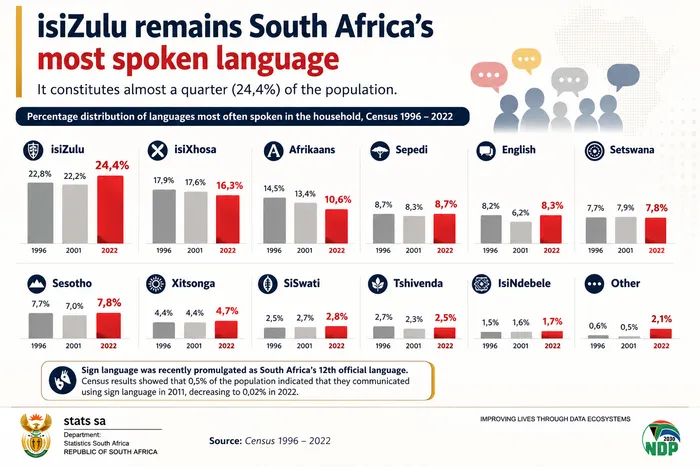
Language spoken in South Africa.
Image: StatsSA
Census questionnaires were also printed only in English and Afrikaans, despite the African majority having one of nine African languages as their mother tongue. “Nor were the enumerators trained for the widespread ad-hoc translation and interviewing that inevitably ensued,” the officials wrote.
Most of these areas, as well as the so-called independent states, were excluded from the post-enumeration survey. As a result, overall population totals could not be reached by applying the survey to the various counts. Instead, totals were modelled for the four race groups and counts were adjusted upwards, in some areas and age categories by as much as 70%.
“The fact that the totals were the outcome of a model rather than the counts was covered in a technical report, but never clarified to the public,” they wrote.
Census 1996 was subsequently reconceived around a “democratic” approach in which “every citizen and community of the new South Africa was to be treated by the CSS’s census process with equal respect and methodological attention.”
Against that new baseline, Census 2022 shows not only a larger population, but one whose age and geographic profile has shifted significantly.
The elderly recorded the fastest average annual growth between 1996 and 2022 at 3%, while the population of children aged up to 14 grew by just 0.7% a year.
The adult population grew by 2.8% annually, increasing from 8.8 million in 1996 to almost 18 million in 2022. South Africa nevertheless remains a youthful population, with people aged 15 to 34 making up the largest age group at just over 21.6 million in 2022.
The country’s median age also increased by six years, from 22 in 1996 to 28 in 2022.
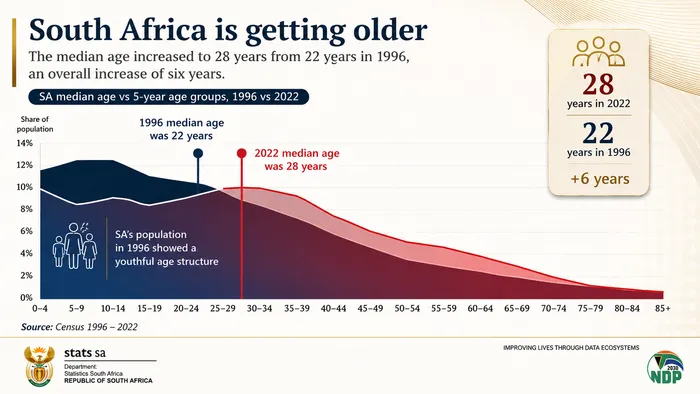
An aging population.
Image: StatsSA
Stats SA said the 1996 population structure showed a large base associated with higher fertility rates and a greater proportion of people aged up to 24. By 2022, the proportion of younger people had declined, while the share of those aged 25 and older had steadily increased.
Where South Africans live has also changed. Gauteng overtook KwaZulu-Natal to become the most populous province in 2011 and had more than 15 million residents by 2022.
The Western Cape moved from fifth to third place, overtaking the Eastern Cape and Limpopo, while the Free State and Northern Cape remained the least populous provinces.
The country’s population-group profile has also shifted. Black Africans accounted for 81.4% of the population in 2022, up from 77% in 1996, while the white population’s share declined from 11% to 7.3%. The Indian or Asian population remained below 3% across all four censuses, while coloured South Africans accounted for 8.2% of the population in 2022.
Changes in the age profile have also reduced the number of dependants relative to South Africa’s working-age population — a shift with significant implications for economic planning.
The national dependency ratio declined from 64.4% in 1996 to 48.8% in 2022, driven largely by the child dependency ratio falling from 56.4% to 39.2%. In practical terms, this means there are now fewer dependants for every working-age person than there were in 1996 — a window of opportunity economists refer to as a demographic dividend.
At the same time, the old-age dependency ratio increased from 7.9% to 9.6%. “Driven by a 3% annual growth rate among the elderly, this increase emphasises a gradual ageing trend within the South African population relative to the active labour force,” Stats SA said.
Stats SA said the shift reflected a demographic dividend characterised by an expanding working-age population relative to dependants.
IOL BUSINESS