

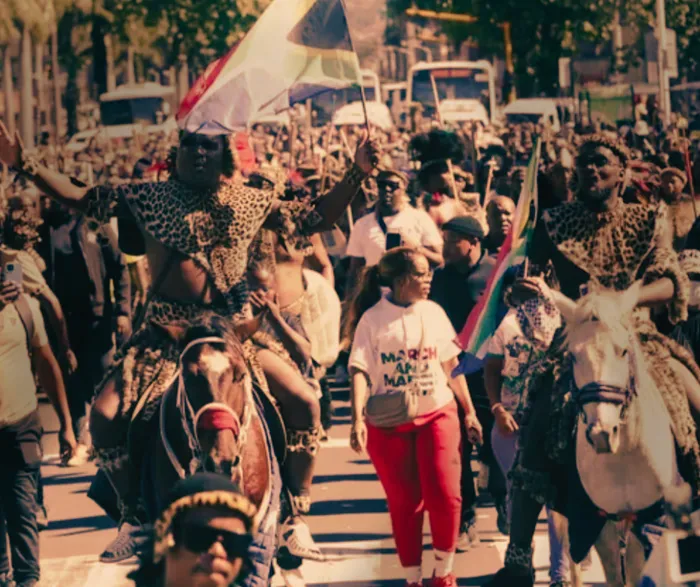
Political analysts say illegal immigration is likely to become one of the defining issues of South Africa's 2026 local government elections, as rising public frustration over unemployment, poverty and service delivery increasingly intersects with debates around migration, border control and social cohesion.
Image: Doctor Ngcobo / Independent Newspapers / IOL Graphics
Illegal immigration has long been a recurring political issue in South Africa and is once again moving to the centre of public and political debate ahead of the 2026 local government elections, with analysts warning that intensified rhetoric around undocumented migration could deepen xenophobic tensions in already strained communities.
The issue has gained renewed prominence in political discourse, with parties, government leaders and protest movements linking undocumented migration to unemployment, crime concerns, labour competition and pressure on public services.
Recent months have seen renewed marches and public mobilisation around illegal immigration in parts of Gauteng and KwaZulu-Natal, alongside increasing political attention on immigration enforcement and calls from civic groups for tougher action against undocumented migrants.
Concerns around immigration enforcement and undocumented migration have also been raised by several political parties.
Political parties have increasingly weighed in on the immigration debate, with some calling for stricter enforcement against undocumented migrants, while others have warned against vigilantism and the targeting of foreign nationals.
Political analysts say the renewed prominence of immigration reflects deeper structural economic pressures rather than migration alone.
University of KwaZulu-Natal political analyst Zakhele Ndlovu said immigration has become increasingly divisive due to unemployment, poverty and perceptions of job competition in communities.
He said economic hardship is driving political change.
“For the first time since 1994, we could see South Africans vote not based on party loyalty and cult of personality but on issues,” Ndlovu said.
He added that frustration is central to rising tensions. “People are frustrated and angry because the promise of a better life is not materializing. Instead poverty levels are high and people are struggling to put food on the table and pay bills,” he said.
Ndlovu said immigration was likely to become increasingly important in the run-up to the elections, particularly if public pressure around the issue continues to grow.
UKZN political analyst Siyabonga Ntombela said immigration is closely tied to unemployment and poverty, making it unavoidable in political debate ahead of elections.
“Immigration issues correlate with unemployment and poverty, the two election campaigning points,” he said.
Ntombela said any political party contesting the local government elections would be expected to address concerns around illegal immigration.
“Any party competing for local government elections will have to address the pressing issue of illegal foreigners in SA. Failure to comment on this national issue suggests that the party is out of touch with reality,” he said.
He added that political parties had already begun taking positions on the issue and that public opinion appeared increasingly polarised.
Political analyst Professor Theo Neethling, a research fellow in the Department of Political Studies and Governance at the University of the Free State, said current tensions around illegal immigration should be understood within a much longer historical context.
“We must understand the current tensions surrounding illegal immigrants in South Africa, which have turned into xenophobia in many communities, within a much longer historical context than what we witness now in our political landscape,” he said.
Neethling pointed to earlier campaigns against suspected undocumented immigrants in the mid-1990s, the 2008 xenophobic attacks that left more than 60 people dead, and outbreaks of violence in Gauteng in 2019.
He said researchers have long linked anti-foreigner sentiment to high unemployment, poverty and poor service delivery, which have contributed to perceptions that foreign nationals compete with South Africans for jobs, housing and public services.
“Politically speaking, it is important to note that this sentiment was not originally just about nationality. It was strongly intertwined with frustration over unemployment, poor economic growth, poverty, crime, housing shortages and limited state capacity,” Neethling said.
He added that foreigners often became the visible target of broader socio-economic discontent and that xenophobia should not be viewed simply as an immigration issue, but also as a symptom of deeper structural and governance problems.
“The immigration debate has thus evolved into much more than a border control issue. It has become a test of state capacity, political leadership, social cohesion and South Africa’s relationship with the rest of the African continent,” he said.
Neethling said the approaching local government elections had placed political parties in a difficult position as they attempt to respond to public concerns about illegal immigration without being associated with xenophobia or violence against foreign nationals.
“There is strong public pressure for stricter immigration controls, but at the same time, few parties want to be associated with xenophobia or violence against Africans,” he said.
Political analyst Dr Imraan Buccus said xenophobia in South Africa is shaped by organised mobilisation, political narratives and structural inequality rather than spontaneous community action.
“Xenophobia does not emerge spontaneously. It is organised, cultivated and directed,” Buccus said.
He pointed to ongoing displacement of foreign nationals, intimidation in some areas and the rise of vigilante-style enforcement groups, warning that such conditions risk escalating further if not addressed decisively.
Buccus highlighted the situation in Durban, where displaced migrants remain in precarious conditions, including those sleeping outside Home Affairs offices and in informal shelters.
He warned that ultimatum-style mobilisation by anti-immigration groups has created fear and instability, arguing that international experience shows such dynamics can trigger coordinated violence if left unchecked.
Buccus said xenophobia is often used to redirect public frustration away from deeper structural challenges.
“The outcome is familiar: those who benefit from inequality remain untouched while poor and working-class communities are encouraged to turn against one another,” he said.
He also warned that inconsistent state responses risk worsening tensions, calling for stronger and more consistent intervention.
Meanwhile, Deputy President Paul Mashatile has rejected suggestions that South Africa should be described as xenophobic, insisting that tensions linked to illegal immigration are driven by labour practices and enforcement rather than hostility towards foreign nationals.
“I stand by that statement that South Africa is not a xenophobic country,” he said.
He said the government’s position remained that illegal migration and related tensions must be addressed through legal and constitutional means, adding that communities must act within the law and reject vigilantism.
“We’ve got a constitution that provides us with laws almost in every sector, let’s use those laws,” he said.
IOL Politics