

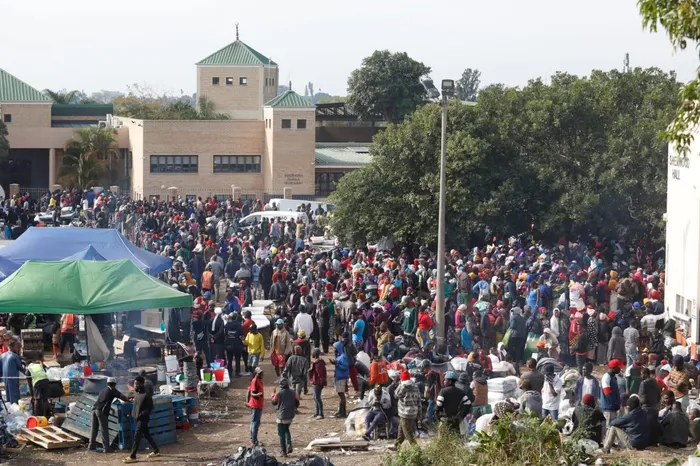
Hundreds of Malawian foreign nationals have taken refuge on the grounds at the Sherwood Hall.
Image: Doctor Ngcobo/Independent Newspapers
What began as a community facility in Durban has become the centre of a rapidly escalating humanitarian operation, with around 10,000 people from Malawi now sheltering at Sherwood Hall as authorities struggle to manage one of KwaZulu-Natal's most complex displacement situations in recent years.
As winter settles over the coastal city, conditions at night are becoming increasingly harsh. For many, the combination of uncertainty and dropping temperatures is deepening an already fragile situation.
Speaking on site on Sunday, KwaZulu-Natal Premier Thami Ntuli described the unfolding events as a crisis requiring immediate coordination between government, civil society and affected communities.
"This situation here, unfortunately, is a crisis, which we must manage," he said.
He stressed the need for structured coordination at the site, including the establishment of a committee to help streamline communication and response efforts.
"I am in agreement with the people who are here that we must establish a committee. We'll be doing just that."
With thousands already gathered and more arrivals still possible, Ntuli said government supports fast-tracking removal processes where appropriate, alongside repatriation efforts.
"I'm happy with the approach that has been taken by our national government to take a route of deportation because we can't wait for repatriation if it's going to take quite some time," he added.
He warned that the scale of the situation remains unpredictable, placing additional pressure on already stretched systems on the ground.
"When we already have over 10,000 people here, you don't know how many will be here tomorrow and next week. We might have more coming into this place," Ntuli said.
Despite the urgency, the Premier emphasised that those gathered should not be left vulnerable due to their concentration in large and improvised group settings, particularly as temperatures drop at night in Durban.
"We want to ensure that the people who are here are not adversely affected by being here in large groups," he said.
Ntuli also called for a coordinated and realistic long-term response, acknowledging that government had not anticipated the scale of the current situation and would now need to implement structured interventions.
"We will produce a plan that will be taking care of this situation because, as government, we did not anticipate what is happening. Now it's happening and we must step in to ensure that there is a proper plan," he said.
The government has confirmed that national departments are already mobilised, with processing and transport systems being expanded to manage the growing numbers, including transfers to the Lindela Repatriation Centre for those subject to deportation procedures.
Amid the mounting pressure, the Malawi government has described the situation as a national humanitarian emergency requiring broad cooperation and urgent logistical support.
"With an estimated 10,000 citizens in distress and awaiting repatriation, the scale and urgency of the operation have created unprecedented financial, logistical and humanitarian demands."
In the statement, it added a direct appeal for coordinated international and domestic support.
"We believe this is a national humanitarian mission that requires the collective effort, compassion and solidarity of all stakeholders. Together, we can ensure that affected Malawians return home safely, with dignity and hope for a fresh start."
IOL