

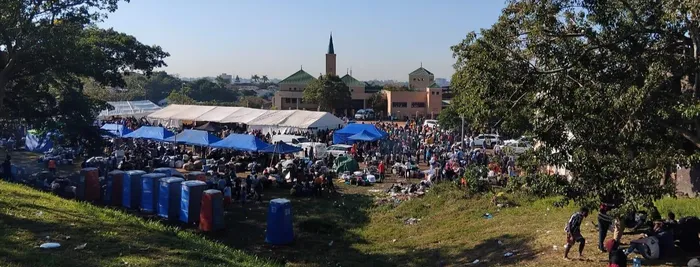
Sherwood Park in Durban where more than 7,000 displaced Malawian residents have sought safety from anti-immigration protests in Durban.
Image: Zainul Dawood
THE South African government has dismissed plans for refugee camps, focusing instead on managing illegal immigration and facilitating the repatriation of foreign nationals, as stated by Minister Mmamoloko Kubayi.
This declaration was made by the Minister of Justice and Constitutional Development, Mmamoloko Kubayi, at a media briefing on Sunday, following recent visits by the Inter Ministerial Committee on Migration (IMC) to informal settlements where foreign nationals have sought refuge amid growing uncertainty regarding residency status.
During her address, Kubayi emphasised that the government does not intend to create any refugee facilities, even on a temporary basis. She urged individuals legally residing in South Africa to either return to their original communities or voluntarily opt for repatriation to their countries of origin.
The clarification came after members of the Inter Ministerial Committee on Migration (IMC) visited the Che Guevara informal settlement in eThekwini, where approximately 457 foreign nationals had gathered amid uncertainty over their future.
According to government, only three people at the site were found not to have legal status in the country.
At a second site in Sherwood Park, Durban, an estimated 7,000 Malawian nationals had gathered while awaiting arrangements for their return home. Kubayi said the scale of the situation has prompted government to seek assistance and cooperation in managing the repatriation effort.
She added that the Malawian government has already commissioned eight buses to transport its citizens back home, while the South African government announced that it would provide an additional ten buses to accelerate the process.
"Our transport requirements have drastically increased, and more than 1,000 buses are essential to facilitate this effort efficiently," she said.
Meanwhile, nearly 980 Malawians have already been deported from the Lindela Repatriation Centre on 10 June as part of intensified immigration enforcement operations.
Government reiterated that immigration enforcement remains the responsibility of the state and warned citizens against taking the law into their own hands.
Kubayi condemned attempts by private individuals to conduct identity checks or enforce immigration laws, describing such actions as illegal. Citizens were instead encouraged to report suspected criminal activity to the relevant authorities.
In a bid to underline the seriousness of the situation, Kubayi referenced recent statistics surrounding illegal immigration, noting that law enforcement agencies have made over 40,000 arrests since the beginning of the year. This includes an impressive tally of 7,400 arrests in the past month alone.
"There is a belief that the government is wilfully ignoring illegal immigration; however, this is far from the truth," Kubayi asserted.
While acknowledging public concerns over the strain that irregular migration places on social and economic resources, government warned against misinformation and xenophobic narratives.
The IMC said false videos and manipulated images circulating on social media were fuelling tensions and creating the false impression that South Africa is hostile towards foreign nationals.
"Government will not tolerate the circumvention of our immigration systems and laws," the IMC said, adding that undocumented migrants should comply with South African law and that employers must refrain from violating immigration and labour regulations.
The committee said managing migration would require cooperation between government, communities and neighbouring states, but stressed that all actions would be carried out within the framework of the Constitution and the rule of law.