

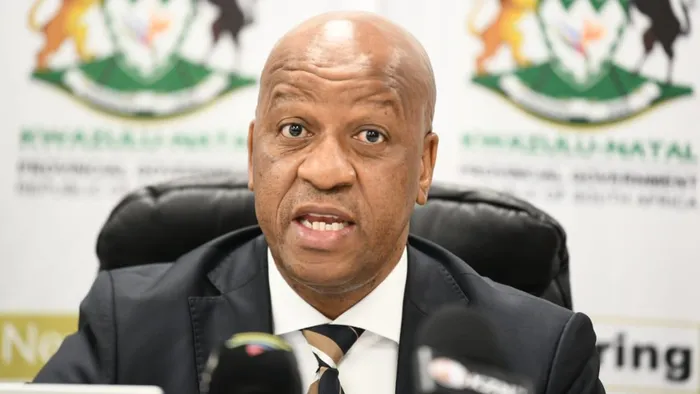
KZN Premier Thamsanqa Ntuli emphasises the need for UN collaboration as the province gears up for a summit addressing the challenges of undocumented foreign nationals.
Image: Supplied
KwaZulu-Natal Premier Thamsanqa Ntuli has called for stronger cooperation with United Nations agencies and international partners as the province prepares to host a summit on undocumented foreign nationals later this month.
Speaking during high-level diplomatic engagements in Durban on Thursday, Ntuli said migration remained an important contributor to economic development, cultural diversity, and social progress, but warned that unmanaged migration posed challenges for both communities and migrants.
The engagements were attended by the High Commissioner of Pakistan to South Africa, Malik Muhammad Farooq, as well as representatives of the United Nations system and foreign missions.
Ntuli said communities across KwaZulu-Natal had raised concerns about undocumented foreign nationals, including pressure on public services, local economic participation, criminality in certain areas, and growing social tensions.
"These concerns are real, and government has a responsibility not to ignore them, but to confront them responsibly, locally, and with humanity," he said.
The concerns about illegal foreign nationals has led to a series of protests and action being taken in parts of Durban. In recent weeks, several groups of foreign nationals claim they have been chased out of their homes. More than 1000 Malawian nationals are currently camped outside the Sherwood Hall, Sydenham after they were chased out of their homes in an informal settlement.
The premier stressed that migration itself should not be viewed as the problem.
"Migration has enriched societies, strengthened economies, contributed to social and economic development, and has been an important part of our development," he said.
"The challenge before us is therefore not whether migration should exist, but how it can be managed in a manner that is legal, humane, orderly, and beneficial to all."
Ntuli said the provincial government's approach was guided by respect for human rights, dignity, and the rule of law.
"We reject both xenophobia and lawlessness. We reject hatred, but we also reject disorder. What we seek is balance, a society where compassion coexists with accountability, and a society where rights are accompanied by responsibility," he said.
He outlined KwaZulu-Natal's provincial initiative under the banner "Engangeni ngesango iyafohla", which aims to address challenges associated with undocumented foreign nationals through local, developmental, and community-centred interventions.
According to Ntuli, the programme seeks to strengthen documentation systems, improve coordination among stakeholders, promote social cohesion, and ensure migration management is conducted within constitutional and legal frameworks.
The premier extended a formal invitation to United Nations agencies to participate in the Provincial Summit on Undocumented Foreign Nationals scheduled for June 25.
"We see this summit not merely as a government event, but as a platform for honest engagement, practical solutions, and shared responsibility amongst institutions, leadership, business, communities, and our international partners," he said.
Ntuli said migration challenges could not be addressed by any single province, country, or institution acting alone.
"The complexities of migration require partnerships grounded in expertise, evidence, and global experience," he said.
He added that KwaZulu-Natal was seeking cooperation with UN agencies in areas including migration management, refugee support, human rights, social cohesion, community resilience, and technical capacity building.
The premier also revealed that the provincial government had begun engaging various stakeholders ahead of a planned mobilisation on June 18, saying authorities wanted to understand the intentions behind the call and prevent any instability.
"We wanted to align any approach in an orderly and local manner so that it does not trigger unnecessary tensions between citizens of our country, our province, and our brothers and sisters from other countries," he said.
Ntuli linked the migration discussion to broader efforts aimed at strengthening social cohesion and tackling crime in the province.
He said KwaZulu-Natal would host a social cohesion and moral regeneration conference on Friday, bringing together stakeholders from different sectors to help develop interventions addressing current and future social challenges.
On crime, Ntuli described criminality as a major challenge affecting all residents regardless of nationality or socio-economic status.
He said community safety structures had been strengthened and that approximately 55,000 anti-crime volunteers were currently active across the province.
"The recent report I received was that we have been able to reduce crime by almost 30 percent," Ntuli said, while acknowledging that more work remained to be done.
He called on international partners and stakeholders to explore areas of cooperation with provincial authorities in support of community safety and social cohesion programmes.
For more stories from The Mercury, click the link THE MERCURY