

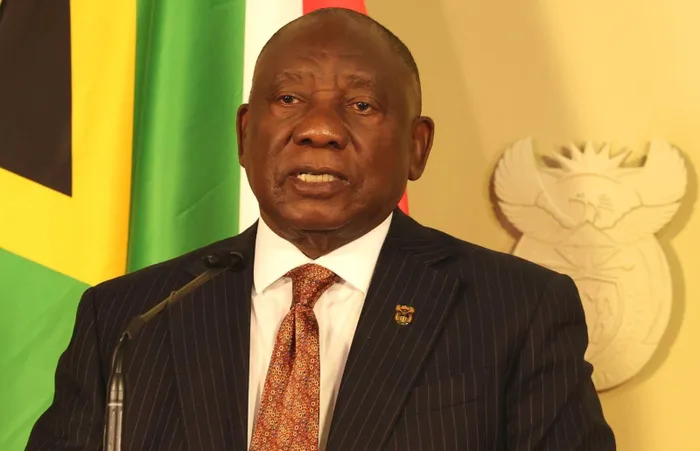
President Cyril Ramaphosa has outlined government's plan to deal with the migration crisis.
Image: Supplied
COSATU in KwaZulu-Natal is calling for the prosecution of employers who hire illegal immigrants. It stated that the current enforcement measures, including those outlined by President Cyril Ramaphosa on Sunday night, are not enough to deter this activity.
This comes as businesses themselves, some of whom have admitted to employing illegal immigrants, have argued that further action against them could lead to their businesses shutting down. These businesses contend that they are employing illegal foreign nationals because locals do not want some of these jobs.
The union spoke out after Ramaphosa warned that the government is going to increase inspections and fines for those businesses that employ illegal immigrants. Ramaphosa cautioned business people that they will face consequences for employing illegal immigrants, stating that such conduct will attract far stronger penalties and much stricter enforcement.
COSATU leader in KwaZulu-Natal, Edwin Mkhize, refuted the claim that companies employ foreign nationals because locals do not want certain jobs. He highlighted several industries that are serious offenders, including the clothing and textile, hospitality, construction, transport, security, domestic worker, and farming industries, among others. He added that this practice is widespread across all sectors.
Mkhize acknowledged that addressing the issue will require a multifaceted approach, but he emphasised that stronger action is needed against employers.
“At the moment, we find that an employer will get a notice and be issued with a fine. We still need to know whether they actually pay those fines. In our engagement with the workers, there have been allegations that the enforcement by labour inspectors is seriously poor. This is happening because there are no harsh consequences directed at the business owners; that is why we are calling for them to be arrested,” Mkhize said.
He welcomed the government’s commitment to increase the number of labour inspectors, pointing out that enforcement must be on a daily basis to rid the country of this criminal behaviour. “There are businesses that employ illegal immigrants; when labour inspectors come, they will tell the workers to run away and return when the inspector is gone. That is why we need these businesses visited each and every single day.”
Mkhize also mentioned serious abuses in some of these businesses: “There is a factory in the Newcastle area that employs hundreds of workers; a compound was built inside the factory where the workers stay. We found that about 20 people were being forced to share a room in that compound.”
Thanasagren Moodley of the eThekwini Clothing and Leather Council stated that the president's position on the matter was uninformed and could have damaging long-term effects on the economy. The council represents approximately 100 business owners within the Cut, Make, and Trim (CMT) clothing, leather, and footwear manufacturing industry, employing over 10,000 semi-skilled and unskilled individuals.
Moodley recently explained that over 80% of their essential machinists are foreign nationals, some of whom may be undocumented. He said this is due to a 20-year operational shift where local labour has consistently rejected machinist roles—a transition historically acknowledged by government regulatory bodies, unions, and the CCMA. In response to the warning by the president, he stated, “If they are saying that, they might as well tell us to close our business immediately. If we are raided every day and our members are being arrested, they should just tell us to shut down.”
“We are faced with serious difficulties created by the government itself. It is the government’s failure that has led to people being in the country illegally. If they do that, it will mean that some businesses will have to close, even if there are immigrants and illegal immigrants. The majority of workers in our business are local. Yes, we are struggling to fill some positions, such as machinists, but we employ 10,000 workers. If we are forced to close down, thousands of local people will still be affected. This will negatively impact the economy.”
A source in the trucking industry stated that the announcement by the president will have no impact on the industry because it is compliant with immigration and labour laws.
“The trucking industry cannot hire illegal immigrants. Even if the driver is from Mozambique, they still need a passport, and you cannot hire illegal immigrants, as your insurance will not cover you. The concerns that had been raised in the trucking industry before was that some people just do not want immigrants working in the industry.”
The Federated Hospitality Association of Southern Africa (FEDHASA) said it supports full compliance with South African labour and immigration laws. In a statement, it said the hospitality industry is a major employer and one of the most labour-intensive sectors in the economy. “Like many sectors, hospitality operates in a complex labour environment where businesses often manage high staff turnover, seasonal employment pressures, and significant administrative compliance requirements.
FEDHASA does not support the employment of undocumented or illegally employed individuals. Employers are expected to comply with existing legal requirements relating to work permits, visas, and employee verification processes,” it said.
It added that at the same time, it is important that the issue is approached in a balanced and practical manner, adding that the majority of hospitality businesses operate lawfully and should not be broadly characterised as deliberately employing undocumented workers.
“The hospitality sector also relies on a diverse workforce, including legally employed foreign nationals who contribute valuable skills, language capabilities, cultural knowledge, and international hospitality experience. Hospitality continues to be one of the country’s strongest employment multipliers, particularly for youth employment and entry-level job opportunities. Discussions around immigration and employment policy must be handled carefully and responsibly,” it said.
For more stories from The Mercury, click the link THE MERCURY