

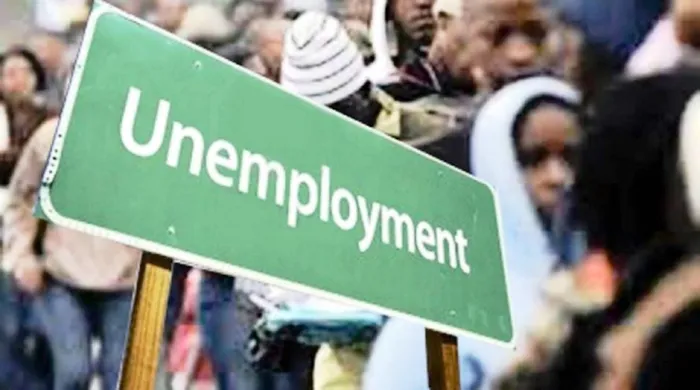
Retail, construction, and community and social services were among the hardest-hit sectors for youth job losses in the first quarter of 2026.
Image: File
Fewer jobs, rising discouragement and millions of young people outside employment, education or training are among the realities behind South Africa’s 54.65% youth unemployment rate, according to Harambee Youth Employment Accelerator’s latest Breaking Barriers quarterly publication.
The publication draws on the national Quarterly Labour Force Survey, Harambee’s income survey of 3,167 young people, SA Youth platform data and the lived experiences of young people navigating pathways into work.
The report follows the release of Statistics South Africa’s Quarterly Labour Force Survey for the first quarter of 2026 in May, which showed that youth unemployment remained one of the country’s most urgent crises. While the official QLFS youth unemployment rate for those aged 15 to 34 was recorded at 45.8%, Harambee’s analysis of the 18 to 35 age group places the figure higher, at 54.65%.
According to the report, the youth unemployment rate is up by 2.22 percentage points from the fourth quarter of 2025 and is one of the highest rates recorded outside the Covid-19 years.
The numbers behind the rate show the scale of the crisis. Harambee said 255,000 fewer young people were employed in the first quarter of 2026, with the losses split evenly between men and women.
The hardest-hit sectors were Community and Social Services, which shed 141,800 youth jobs, Construction, which lost 116,000, and Retail, which recorded a decline of 59,865 youth jobs.
The report also found that the number of young people classified as discouraged workers increased from 10.75% to 11.33%. The total number of young people not in employment, education or training, commonly referred to as NEET, now stands at 9.2 million.
"Fifty years after the student uprising that defined Youth Day on 16 June 1976, South Africa’s young people have secured their political freedom, but the struggle for economic inclusion continues," the publication states.
It said young people were facing "the persistent systemic barriers of the past" while also trying to survive in a world that was becoming “increasingly complex and unpredictable."
The publication said the latest unemployment data reflected "compounding challenges", including seasonal dips, global events and the absence of large-scale Public Employment Programmes.
"But this should not distract us. Like climate data, employment data is multilayered. It reflects short-term weather, seasonal cycles, and long-term trends, and it is the latter that we must focus on to turn the tide," the report states.

More than 130 leaders and employers came together at the SA Youth Employer Breakfast and Harambee at Makers Landing in Cape Town earlier this year. Harambee’s latest Breaking Barriers report says fewer jobs, rising discouragement and millions of young people outside work, education or training are behind South Africa’s 54.65% youth unemployment rate.
Image: Supplied
Harambee said economic growth was necessary, but warned that growth did not automatically translate into employment for young people.
"Growth creates jobs, but not automatically for young people," the report states.
It said that over the past 17 years, economic growth had translated disproportionately into jobs for older workers, while the youth share of jobs had declined.
"This weak correlation between growth and youth employment levels must be strengthened if we are to avoid a generation of young people being left behind," the report states.
The report points to first work experience as one of the most important interventions. Harambee said its income survey, based on responses from 3,167 young people, found that securing a first structured work opportunity makes a young person 10 percentage points more likely to remain in the labour market and 10 percentage points more likely to secure further wage employment.
Retail remains one of the most important entry points for young people. On the SA Youth platform, retail accounts for the largest share of formal employment absorption, making up 40% of 200,000 formal sector placements reported. However, the sector also lost nearly 60,000 youth jobs in the latest quarter.
Harambee said the SA Youth platform had become a key part of the country’s employment infrastructure, reaching more than 5.1 million young people and recording more than 2.3 million formal, self-employment and public employment opportunities since 2011.
The report also highlighted self-employment as an underused pathway. About 24% of young people earning on SA Youth do so through self-employment, including through partner-mediated pathways that the report says produce higher income, retention and stability.