

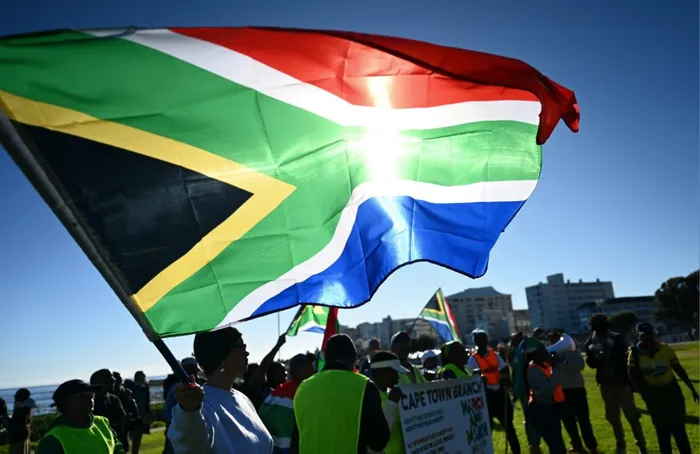
Anti-illegal immigrant group March and March holds a protest on the Sea Point promenade in Cape Town. A social justice group has raised concern that anti-immigrant protests could have an impact on South Africa's trade relations with other African countries.
Image: Ayanda Ndamane / Independent Newspapers
A social justice organisation is warning of economic damage to the country as a result of the anti-illegal immigrant protests, stating these will damage the country’s economic standing in the African continent.
The Pietermaritzburg Economic Justice & Dignity Group has stated that South Africa cannot build a more inclusive economy by turning its back on African countries. This echoes government sentiments that the anti-illegal immigrant protests are damaging the country’s image, affecting both business and arts sectors.
Mervyn Abrahams, the programme coordinator of the Pietermaritzburg Economic Justice & Dignity Group, said the continent is already one of South Africa’s most important markets, especially for value-added manufactured goods, agricultural products, and services. If South Africa wants to rebuild manufacturing, expand production, and create jobs, it needs larger regional markets and deeper African economic integration.
According to Stats SA, South Africa’s exports to the rest of the African continent are estimated at approximately R450 billion to R500 billion, representing more than a fifth of the country’s global export mix.
“These exports are not abstract numbers: South Africa’s merchandise and services exports to the rest of the continent support and maintain approximately 957,000 employment opportunities in the domestic economy, including well over 250,000 direct formal jobs tied to production, manufacturing, and farming for African markets.
“This trade is especially important because South Africa’s exports to neighbouring African countries, particularly within the Southern African Development Community, are far more diversified than the country’s raw mineral-heavy exports to Europe and Asia.
Intra-African exports are dominated by value-added and sophisticated manufactured products, as well as agricultural goods and services, which sustain a higher concentration of skilled and semi-skilled work inside South Africa,” he said.
The organisation said greater intra-African trade, including through the African Continental Free Trade Area, offers South Africa an opportunity to support industrial development at home, expand exports, strengthen agriculture, and create employment.
“But trade cannot be separated from people. Regional economic integration requires cooperation, mobility, trust, and mutual respect. A country cannot seek African markets for its goods while treating African people as enemies in South Africa.
“For this reason, South Africa should be deepening economic cooperation with African countries, not fuelling hostility toward African migrants,” it stated.
The statement added that a growing regional economy needs predictable movement of people, skills, traders, and entrepreneurs, supported by efficient documentation systems and respect for human dignity. Punitive responses alone will not resolve the failures of Home Affairs or build the inclusive economy South Africa needs.
“Attacks on African migrants damage the country’s moral authority, strain relations with neighbouring states, and weaken the trust needed for trade, investment, tourism, regional infrastructure, and continental cooperation.”
Author and commentator on African business matters based at the University of Limpopo, Victor Kgomoeswan, said there are already companies in South Africa that are facing backlash. He said this was also damaging to tourism and numbers show that a large number of people that visit South Africa come from the African continent; they stay longer and spend more with medium-sized businesses.
For more stories from The Mercury, click the link THE MERCURY