

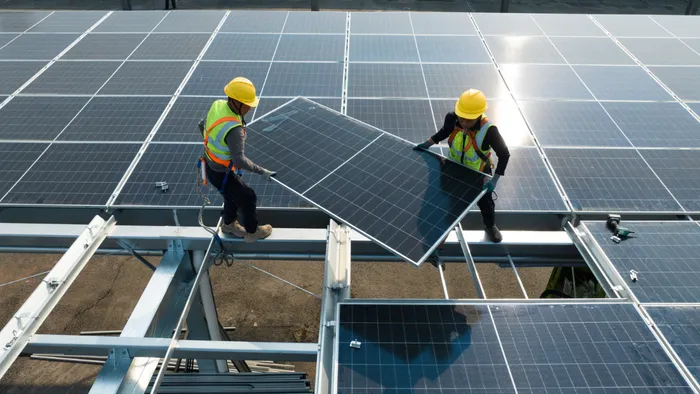
Many South African companies believed that signing a power purchase agreement would reduce costs and enhance sustainability. However, as doubts about actual savings and generation arise, energy managers must confront the uncomfortable truth: can they trust the data provided by developers?
Image: Supplied.
The power purchase agreement (PPA) was supposed to be a smart move.
Reduce grid dependency, lock in a price, tick the sustainability box. For many South African companies, signing an on-site solar PPA in 2022 or 2023 felt like getting ahead of the curve.
Yet today, at many of these organisations, energy managers and COOs are carrying a quiet suspicion that something isn’t adding up. The savings aren’t what the model projected. Generation seems lower than it should be. And when they go looking for evidence, the only place to find it is the developer’s monthly report.
This is the problem no one is talking about.
The assessment of a material financial exposure is entirely dependent on data supplied by the party with the most to lose if performance is poor. While most independent power producers are legitimate, and many PPAs are performing as contracted, the structure of the arrangement means that the organisation carrying the financial exposure (the energy user) has no independent basis on which to evaluate it.
In any other financial instrument, we would call this a conflict of interest. In energy, we’ve largely accepted it as normal. It shouldn’t be.
A PPA is not a simple fixed-price contract. It’s a living financial instrument with multiple obligation layers that recalculate monthly, often invisibly.
Minimum generation thresholds determine whether the developer has delivered what was contracted.
Time-of-use (TOU) credit windows define when generation counts most favourably toward your cost position. Curtailment clauses govern what happens when you can’t absorb what’s generated. Balancing requirements interact with your grid offtake in ways that affect your overall cost structure.
Many organisations are now adding wheeling agreements to their energy portfolios. These are a different instrument entirely: take-or-pay clauses, transmission loss factors, late delivery penalties, and contractual structures still evolving as the market matures.
The obligation stack is deeper. So is the exposure if it goes unmonitored. Yet most finance teams never see the actual generation data in real time.
The same CFO who would never accept a single-source, unverified report on any other material financial commitment is routinely signing off on energy positions assessed with only a monthly PDF from the counterparty.
When billing errors run for months unchallenged, generation shortfalls go uncontested, and TOU windows close without being captured, the underperformance compounds quietly. The gap has a rand value.
The South African energy market has matured rapidly. The financial governance applied to it has not.
IFRS S2 is bringing energy data into the audit committee’s line of sight in ways it hasn’t been before. Auditors are beginning to ask, and will ask with increasing sharpness, whether the data behind organisations’ energy and emissions disclosures can withstand scrutiny.
“We rely on developer-supplied reports and our own spreadsheets” is not going to be a sufficient answer.
The PPA you signed may well be delivering exactly what was contracted. But without independent data, you have no way of knowing. And the meter keeps running.
Manie de Waal is CEO of Energy Partners, the company behind Syntiro, South Africa’s award-winning purpose-built financial control system for energy.

Manie de Waal is the CEO of Energy Partners.
Image: Supplied
Follow Business Report on Facebook, X and on LinkedIn for the latest Business and tech news.