

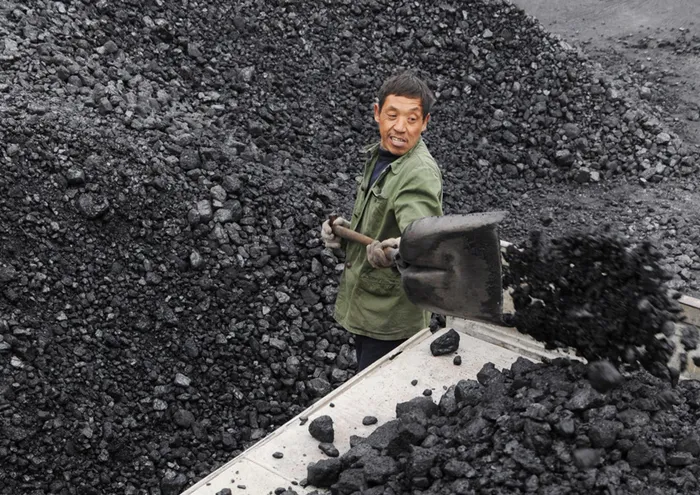
While businesses support decarbonisation, coal remains critical for many industrial operations due to cost, supply security and infrastructure limitations, according to Energy Partners.
Image: File photo: AFP.
South Africa’s push toward decarbonisation may be accelerating, but industry experts warn that the country’s heavy dependence on coal means the transition away from fossil fuels will be far more complex than many policymakers anticipate.
According to Manie de Waal, CEO of Energy Partners, coal remains deeply embedded in South Africa’s industrial economy and cannot simply be switched off without creating major operational and financial risks for businesses.
Coal still accounts for more than 80% of the country’s electricity generation and nearly three quarters of total energy consumption, making it one of the most coal dependent economies in the world.
De Waal said industrial heat generation remains particularly reliant on coal, largely because affordable and reliable alternatives are not yet available at sufficient scale.
“For businesses reliant on high temperature process heat, coal is a function of cost and availability. And these structural realities don’t shift as quickly as policy or ambition,” de Waal said.
He explained that while heat generation may account for around 10% of operating costs, it plays a disproportionately critical role in industrial production.
“Without reliable heat, production stops,” he said.
Although renewable energy technologies, alternative fuels and energy storage systems are advancing rapidly, de Waal argued that they are still unable to fully replace coal across many industrial applications.
Liquefied petroleum gas and liquefied natural gas are often presented as the most practical short term alternatives, but de Waal warned that these options face significant supply and pricing challenges.
South Africa is expected to face a structural gas shortfall as supplies from Mozambique’s Pande Temane gas fields decline toward 2028, increasing the country’s dependence on imported gas and exposure to international price volatility.
“The implication is a growing reliance on imported gas, exposing users to global pricing dynamics and logistics constraints. This introduces both cost volatility and supply risk at a scale that many industrial operators are not positioned to absorb,” de Waal said.
Electrification is another possible pathway, but de Waal said the costs associated with generating high temperature industrial heat through electricity remain prohibitively expensive for many businesses.
Meanwhile, biomass and biomethane are often promoted as long term alternatives, but their practical application remains highly site specific.
“They introduce additional system complexity, including handling, storage and combustion control requirements that differ materially from coal,” he said.
De Waal added that feedstock supply chains and transport logistics continue to limit the scalability of biomass solutions, particularly for large industrial users.
“For many businesses, the question is not whether to decarbonise, but how to do so without introducing unacceptable operational or financial risk,” he said.
Rather than focusing immediately on replacing coal entirely, de Waal believes the first realistic step for many companies is improving efficiency within existing systems.
“Though many businesses cannot move away from coal, the technology exists to drastically cut emissions,” he said.
According to Energy Partners, integrated system optimisation can reduce coal usage by between 8% and 15% through efficiency improvements and operational enhancements.
“We’ve seen businesses reduce coal usage by 8% to 15% through these interventions. They aren’t theoretical improvements, but measurable reductions in fuel consumption, emissions intensity and operating costs,” De Waal said.
He added that servitisation models, where specialist providers take responsibility for performance and optimisation, are helping companies sustain efficiency gains over time.
De Waal believes South Africa’s decarbonisation strategy must be grounded in the operational realities businesses currently face.
“A credible carbon strategy must reflect the reality that businesses are actually operating within,” he said.
“The immediate opportunity lies in extracting measurable efficiency gains from existing systems, while simultaneously investing in the technologies required to transition to a lower carbon future.”
Despite the challenges, De Waal said the country’s industrial transition can still succeed if approached pragmatically and incrementally.
“For South African industry, the transition will not be linear. But it can still be deliberate, measurable and economically grounded,” he further said.
Follow Business Report on Facebook, X and on LinkedIn for the latest Business and tech news.