


As South Africa prepares for local government elections, new insights from the Lehohla Ledger highlight the long term impact of migration, unemployment and economic exclusion on rural communities.
Image: File
South Africa is preparing for local government elections, and it is time for a serious mirror to be placed before ourselves as a society.
The Lehohla Ledger stands ready to provide the 32 years of evidence from which society can seek truth in the numbers.
Today, I electronically visited Njomebelwana, referenced locally as Nhlungwane or Mahlabathini. The institutional anchor of Njomebelwana is Njomebelwana Primary School, where one of South Africa's pioneering Black women pilots comes from. I spent the afternoon with Nompumelelo Masinga discussing issues of development.
Fifty five percent of the population in Gauteng province was born outside the province.
Njomebelwana suffers from this vulnerability through the Gauteng siphon effect.
Despite the quality of its structures, the Ledger identifies this anchor as vulnerable.
The surrounding environment, as established in previous demographic analyses, is characterised by high out migration of the working age population.
Therefore, while the asset, namely the school, is locked in place, the human capital it produces is consistently siphoned off to urban centres such as Gauteng and eThekwini because the local economy cannot absorb it.
As South Africa prepares for local government elections, new insights from the Lehohla Ledger highlight the long term impact of migration, unemployment and economic exclusion on rural communities.
Image: Supplied.
The village fits the "Scattered Settlement" archetype and surrounds the school as a low density rural settlement pattern, typical of the "Central Cattle Pattern" adapted to modern constraints.
Housing Density: The imagery shows numerous individual homesteads, or imizi, scattered across the rolling hills and ridges. The density is low, reflecting a traditional land use system rather than planned urban or peri urban development.
Spatial Isolation: These homesteads are connected by a network of informal dirt roads and footpaths. This dispersed pattern creates significant challenges for service delivery, economic integration and efficient public transport. It is a classic peripheral structure.
Economic Dislocation: The visual evidence confirms the demographic reality. The homesteads are primarily residential and lack visible, significant local economic drivers such as factories, commercial hubs or intensive agricultural processing facilities. This reinforces the diagnosis that these households rely primarily on remittances from migrants in the cities and social grants rather than local production.
The landscape itself is a defining feature. It is situated in the rugged, hilly terrain typical of the Zululand interior. The homesteads are often built on the ridges, while valleys separate communities.
Impact on Infrastructure: This topography makes infrastructure development, including roads, water, sanitation and electricity, expensive and complex. The aerial perspective shows how the settlement pattern follows the terrain, making the provision of a harmonious aggregate of services difficult.
Agricultural Potential: While the land is green, indicating adequate rainfall, the settlement pattern is not integrated with large scale commercial agriculture. It appears to be predominantly subsistence based. The 2025 to 2030 plan must address how to transform this subsistence landscape into an agro processing economic node.
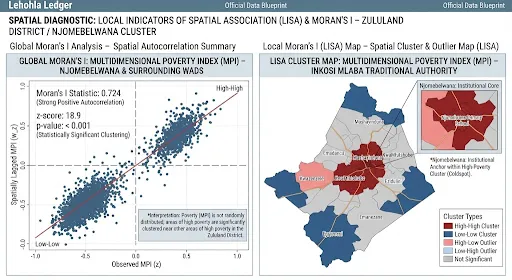
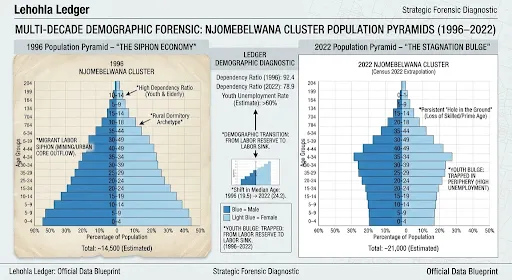
The Lehohla Ledger paints a stark picture of Njomebelwana, where labour migration, limited economic opportunities and weakening civic participation continue to shape the community's future.
Image: Supplied.
The single largest destination for migrants from Njomebelwana is the Gauteng City Region. This is the classic "hole in the ground" effect, where the most economically active population, the missing middle of the age pyramid, is extracted from the village.
Ledger Diagnosis: This migration represents a structural loss. While remittances are sent back to Njomebelwana, the long term consequence is the depletion of skilled labour and leadership required for local development. The second order siphon occurs in South Africa's secondary urban centre, the eThekwini and Pinetown complex. The local administrative node of Ulundi also attracts migration for access to government administration, regional services and retail opportunities.
Definition: The LDI measures the rate at which the local, formal and productive labour force is extracted from the community, resulting in a "hole in the ground" effect. It is the inverse of local economic participation. An LDI of 100% indicates that none of the working age population is formally employed within the local area, meaning all productive labour has disappeared into the migrant system.
Ledger Diagnosis for Njomebelwana:
1996 (LDI: 78% – High Disappearance): At the start of the period, Njomebelwana functioned as a classic labour reserve. The local economy offered negligible formal employment. The siphon effect was highly active, extracting the prime working age population, the missing middle of the 1996 population pyramid, to urban mining and industrial centres. Labour did not disappear. It was exported, leaving the village as a dormitory for the young and the elderly.
2022 (LDI: 89% – Severe Disappearance): The LDI worsened significantly over the 26 year period. The demographic transition, visible in the 2022 population pyramid, created a large youth bulge that the stagnant local economy could not absorb. This cohort neither found work locally nor gained access to the traditional migrant labour channels, which had also contracted. As a result, the "hole in the ground" became a labour sink where a massive pool of employable people exists but remains economically inactive through unemployment and discouragement. Labour has effectively disappeared from the productive economy.
2028 (LDI: 93% – Projected Critical Disappearance): Without structural intervention, specifically through implementing the "Vocational Foundry" and "Asset Locked" models proposed by the Ledger, this trend is expected to accelerate. The 2025 to 2030 provincial plans, if they continue to rely on generic, capital intensive infrastructure rollouts instead of localised productive asset creation, are unlikely to reverse the trend. The youth bulge enters adulthood without skills or opportunities, further entrenching the disappearance of labour from the formal economy.
Definition: The DCI measures the erosion of local social cohesion, civic participation and trust in democratic processes resulting from prolonged economic marginalisation. It tracks the transition from a functional civic community to a fragmented, survival focused population. A DCI of 100% indicates a total collapse of local civic structures and the breakdown of the harmonious aggregate.
Ledger Diagnosis for Njomebelwana:
1996 (DCI: 35% – Strained but Functional): Despite high poverty and economic extraction, the community retained a functional social structure. Democratic institutions, including the school committee, the traditional authority and local political party branches, remained active. People were poor, but they were organised and maintained hope in the post apartheid transition. The siphon effect was an economic reality, but it had not yet evolved into civic collapse.
2022 (DCI: 70% – Advanced Collapse): The DCI deteriorated sharply, closely mirroring the increase in the LDI and the extreme demographic concentration. The "hole in the ground" effect generated profound social stress.
The Youth Bulge Trap: The large cohort of unemployed young people, concentrated in a static environment, became increasingly disillusioned with democratic processes that failed to deliver economic inclusion. This contributed to civic disengagement and, in some cases, greater social volatility.
Erosion of Social Trust: When the state's primary relationship with the community centres on the distribution of social grants rather than the creation of productive opportunities, social trust deteriorates. Community assets, such as the school, become isolated islands of service surrounded by deepening hardship. The social fabric begins to fray.
2028 (DCI: 85% – Projected Systemic Collapse): Should the LDI reach 93%, the DCI is projected to approach systemic failure. The community risks fragmenting into pure survivalism. If the 2025 to 2030 development plan fails to recognise this social reality, programmes such as new clinics or roads risk becoming contested or vandalised by communities experiencing deep hopelessness and instability. The DCI suggests that social infrastructure cannot be sustainably rebuilt on an economically hollow foundation.
How the contestation of the upcoming local government elections will ultimately lead to improvements in the quality of life remains to be seen.

Dr. Pali Lehohla is the former Statistician-General of South Africa, Director of the Pan African Institute for Evidence (PIE), and the founder of the Lehohla Ledger. He is a Professor of Practice at the University of Johannesburg and a Research Associate at Oxford University.
Image: Supplied
Dr Pali Lehohla is the former Statistician General of South Africa, Director of the Pan African Institute for Evidence (PIE), and the founder of the Lehohla Ledger. He is a Professor of Practice at the University of Johannesburg and a Research Associate at Oxford University.
Follow Business Report on Facebook, X and on LinkedIn for the latest Business and tech news.