

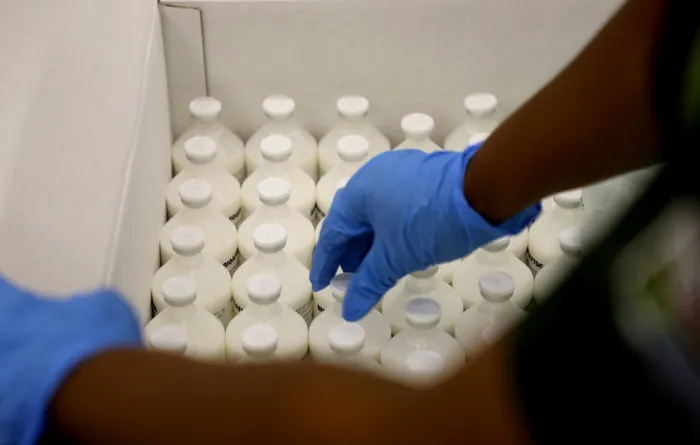
Minister of Agriculture John Steenhuisen announced on Sunday that 2 million Dollvet vaccines arrived at O R Tambo International Airport to boost the battle against Foot and Mouth Disease.
Image: Timothy Bernard / Independent Newspapers
South Africa’s fight against the ongoing outbreak of Foot and Mouth Disease (FMD) received a major boost this weekend with the arrival of two million Dollvet vaccine doses, while local vaccine production is also beginning to gain momentum.
Minister of Agriculture John Steenhuisen announced on Sunday that the latest shipment of Dollvet vaccines had arrived in the country, strengthening efforts to contain the disease and protect the livestock industry.
The development was welcomed by the Red Meat Industry Services (RMIS), which said a steady supply of vaccines remains critical to the success of the national vaccination campaign.
Steenhuisen said the Agricultural Research Council (ARC) was making encouraging progress in rebuilding local vaccine production capacity, bottling 20,000 vaccines with the process commencing for the bottling of another 20,000 before the end of June.
“This will bring our local production to 40,000 for the month. It remains imperative that we continue with the provision of a consistent supply of vaccine provision,” he said.
Steenhuisen said the latest figures show that provinces have heeded the call to vaccinate the cattle population at a faster pace.
“The department has reported that the total number of cattle vaccinated to date is 5 486 860.”
KwaZulu-Natal has administered the highest number of vaccinations at 1,163,193, followed by the Free State with 1,015,020 and the Eastern Cape with 891,924.
Other provincial figures include North West with 753,522 vaccinations, Mpumalanga with 531,096, Limpopo with 357,045, Gauteng with 351,945, the Western Cape with 309,044 and the Northern Cape with 114,071.
Steenhuisen singled out the Free State for its progress, praising the provincial government for exceeding one million vaccinations.
He said government would continue working closely with provincial authorities and feedlots to ensure vaccination efforts maintain momentum.
“It is also important that the feedlots utilise their allocations in order to keep the economic value chain going,” he said.
“I have also engaged with my department and requested them to expedite the Section 9 Report which should reach my Office within the next day or two in order to bring additional reprieve to our farmers.”
Steenhuisen also thanked veterinarians and private-sector partners supporting the vaccination programme.
“The goal must remain: to work together to vaccinate as many cattle as possible as quickly as possible in order to end the current outbreak and place us on the path to ensuring that this is the last major outbreak of FMD in South Africa.”
Dewald Olivier, the CEO of RMIS said the arrival of the additional vaccine doses was a significant step forward in the country’s disease-control efforts.
“A steady and reliable flow of vaccine is absolutely critical if South Africa is to maintain momentum in the national vaccination campaign,” he said.
“It is important, however, to correct one point: the latest update is not that 20 million doses are being bottled by the ARC, but rather that 20,000 doses were bottled on 12 June, with a further 20,000 expected before the end of June.”
Olivier added that it is still meaningful progress, because it shows local production capacity is steadily coming back on stream.
“Overall, we are progressing in the right direction, particularly in terms of vaccine availability. Public updates indicate that more than five million vaccinations have already been completed nationally,” Olivier said.
“Our key concern now is to make sure the vaccine is distributed effectively and gets into animals with the necessary speed and accuracy across the provinces. In the next phase, success will depend not only on supply, but on execution on the ground.”
BUSINESS REPORT