

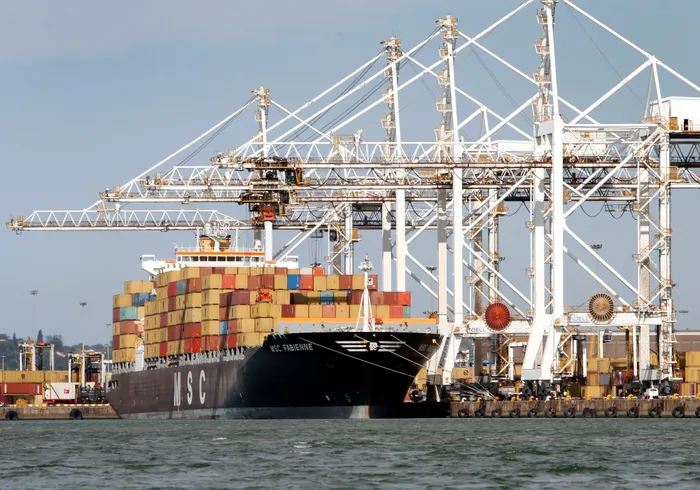
The World Bank Container Port Performance Index (CPPI) 2025 released last week indicated that the Port of Cape Town has seen a deterioration in operations due to weather-related disruption and issues with equipment reliability. Logistics experts have given mixed reactions to the findings.
Image: Shelley Kjonstad/Independent Media
The World Bank Container Port Performance Index (CPPI) has reignited debate about the performance of South Africa’s ports, with logistics experts offering differing interpretations of the findings, particularly regarding the Port of Cape Town's continued operational challenges.
Released last week, the CPPI 2025 report highlighted a deterioration in Cape Town’s performance, citing weather-related disruptions and equipment reliability problems as key factors affecting vessel turnaround times.
According to the report, Cape Town's operational difficulties persisted despite fluctuations in broader global supply chain congestion.
“Persistent weather-related disruption, combined with equipment reliability issues, led to high variability in ship times in port despite periods of easing supply chain stress. This deterioration was accompanied by a decline in berth utilization, suggesting that vessels increasingly accumulated time outside productive berth operations,” the report noted.
The World Bank added that the deterioration was accompanied by a decline in berth utilisation, indicating that vessels were spending increasing amounts of time outside productive berth operations.
The report acknowledged that efforts are being made to address these challenges.
Measures introduced at the port include a predictive wind model developed in partnership with the Council for Scientific and Industrial Research (CSIR), a helicopter piloting service designed to improve vessel access during periods of heavy swell, and a digital cargo planning platform aimed at improving operational efficiency.
“The port’s CPPI trajectory underlines how structural exposure to external conditions can dominate performance outcomes, independent of global demand cycles.”
However, industry experts caution against relying solely on the CPPI rankings when assessing overall port performance.
Dr Jacob van Rensburg, head of research and development at the Southern African Association of Freight Forwarders (SAAFF), said the index provides only a partial view of port efficiency.
“The CPPI is a vessel-time-in-port indicator, adjusted for vessel and call size; it is not a whole-system measure of port or logistics performance and does not, on its own, measure port throughput, cost, cargo dwell time, landside evacuation, hinterland connectivity, service reliability, or cargo-owner outcomes,” he said.
“While Durban, Ngqura and Port Elizabeth recorded material year-on-year improvements in the latest index, South Africa’s real challenge is to move beyond isolated indicators and build an integrated, transparent view of the full port-logistics system.”
Van Rensburg said that the improvements posted by Durban, Ngqura and Port Elizabeth, alongside progress by Cape Town, have been achieved under challenging circumstances and deserve recognition.
Malcolm Hartwell, head of transport at Deneys and a master mariner, pointed out that South Africa’s major ports continue to rank among the worst-performing globally.
“The difference between these two ports is that Cape Town’s CPPI has declined since 2024 whereas Durban’s has improved over the same period,” he said.
“The regional average score for Southern Africa is -98, and Cape Town has declined from -281 to -303 in this period and has a ranking of 400. Durban has improved markedly from -721 to -242; it is still ranked 398.”
Hartwell added that the only other South African ports ranked are Port Elizabeth, which has improved from its score from -169 to -24 and is ranked 314, and Coega, which has gone from -284 to -119 and is ranked 380.
“Our immediate neighbours, being Maputo and Walvis Bay, are ranked 273 and 372 respectively, which is also well below the regional average. There are only 8 ports in the Southern African region in the list, and the average of their scores is well below -98, which suggests an anomaly in the averaging used.”
Hartwell said that the latest CPPI data shows that regardless of the CPPI scores, Cape Town and Durban remain near the bottom of the list.
“Insofar as Durban is concerned, this does not seem to align with the positive data released by Transnet this year regarding the performance of their ports last year or the positive comments from people in the logistics industry in South Africa,” he said.
“The data, however, does show that our ports need to improve significantly to even get near the regional average. The many factors that affect waiting time will need to be analysed by the shipping lines and ports to see where the bottlenecks and delays are.”
Regarding Cape Town, Hartwell said the reasons behind the latest decline remain difficult to determine.
“The current score of -303 is, however, well above that of 2023 when it was -519. The analysis relates to 239 vessel calls, which is a relatively significant number compared to the other ports analysed. It may be that there were more significant weather delays last year, but it is not possible to extract the reasons for the decline from the scores in the report."
BUSINESS REPORT