

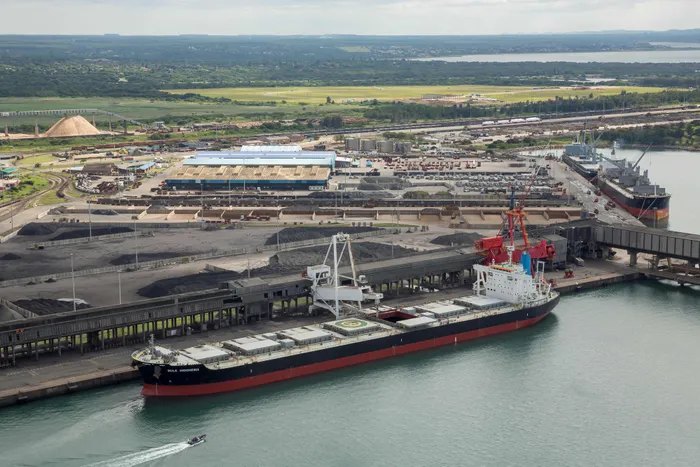
Transnet said in a statement on Tuesday that there has been a strong operational improvement across its port system, with a 9% year-on-year increase in vessel traffic.
Image: Supplied/Transnet
Transnet ports system recorded a strong operational recovery during the 2025/26 financial year, with vessel traffic rising by 9% year-on-year as efforts to improve efficiencies across the country’s ports begin to show results.
In a statement, Transnet National Ports Authority (TNPA) said vessel arrivals across South Africa’s eight commercial seaports increased to 8,630 during the financial year, up from 7,912 in 2024/25.
TNPA said the performance marked a significant milestone in Transnet’s “Reinvent for Growth” strategy, which is focused on restoring operational efficiency and improving the competitiveness of South Africa’s ports.
The ports authority said the rise in vessel traffic reflected improved coordination across the port system, supported by closer collaboration between TNPA and terminal operators.
Cargo throughput volumes also showed strong growth, increasing by 4.2% to around 304 million tonnes, representing the strongest growth recorded since the 2011/12 financial year.
According to TNPA, three of the five major cargo categories posted notable gains, while break bulk and liquid bulk cargo volumes showed gradual signs of recovery.
Automotive cargo volumes led the growth trend, increasing by 13.3%, with the Port of Durban exceeding throughput targets during the reporting period.
Container volumes rose by 7.1%, outperforming annual budget expectations by 3.6%, largely driven by a 22% increase in citrus exports. Dry bulk cargo volumes also climbed by 4.2% due to stronger export demand for chrome ore, magnetite and manganese.
Transnet Group CEO, Michelle Phillips, said that the overall strong growth performance signals an improved domestic economic landscape, including gains from the Transnet recovery initiatives and improvements in port and rail efficiencies.
“This growth in vessel activity and cargo volumes signals that Transnet’s interventions are yielding measurable results,” she said.
“Alongside this welcomed volume increase, Transnet remains focused on sustaining operational improvements, accelerating port infrastructure investment, and implementing structural reforms to support trade growth and cargo movement through South Africa’s ports.”
TNPA said that key infrastructure projects across the port system are gaining momentum to support future demand and improve operational resilience.
“At the Port of Durban, expansion plans are aimed at significantly increasing container handling capacity, while upgrades at the Port of Cape Town, including container stack improvements and truck staging facilities, are expected to improve efficiency and reduce congestion.”
Industry expert, Malcolm Hartwell, head of transport at Deneys and a master mariner, said the increase in vessel traffic suggested growing demand for port services and signs of operational improvement.
“The statement issued by Transnet in relation to the number of calls also reflected, however, that there was a 4% increase in cargo volume, which is the strongest growth since the 2011/2012 financial year,” he said.
“They also reported that three of the five main cargo type categories registered strong growth, particularly in the automotive and container sectors.”
Hartwell added that an increase in vessel traffic must indicate some improvement.
“Without knowing the vessel types, it is difficult to comment as the increase might simply be because far more ships are coming around our coast in the reporting year than Transnet has become far more efficient,” he said.
“Having said that, there is no doubt, having regard to all of the other reports coming out of Transnet, that their operational performance is improving on the back of numerous initiatives introduced over the last few years.”
Hartwell concluded that the increase in the number of vessels handled does indicate an improvement in operational efficiency.
“Anecdotally, vessels simply do not seem to be waiting as long as they used to in order to berth in South Africa’s main ports.”
BUSINESS REPORT