

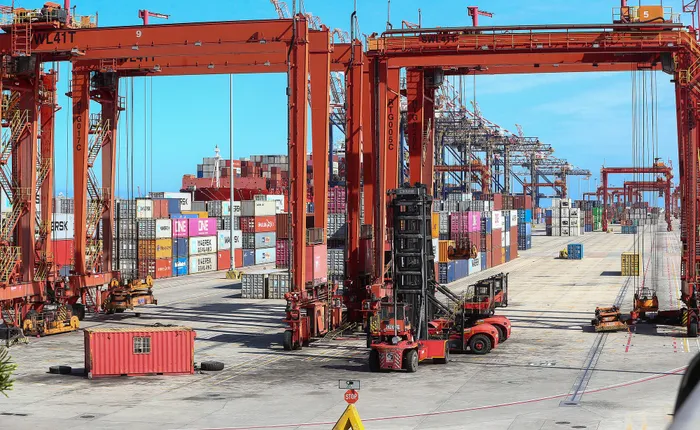
There have been mixed reactions following Transnet Port Terminal’s (TPT) announcement last week that they will introduce a fuel neutrality charge in May following fuel price increases, driven by ongoing global supply chain disruptions.
Image: Leon Lestrade/Independent Newspapers
There have been mixed reactions from industry stakeholders following Transnet Port Terminals’ (TPT) announcement that it will introduce a fuel neutrality charge at an initial rate of R52 per container from May, citing mounting fuel price pressures linked to ongoing global supply chain disruptions.
TPT said the decision comes as rising diesel costs continue to weigh heavily on its cargo handling operations, which rely extensively on fuel-powered equipment. The utility confirmed on Friday that the new charge will take effect from 1 May 2026 and will be calculated based on coastal diesel index thresholds.
“The fuel neutrality charge is being implemented as a transparent, cost-recovery mechanism to ensure the continued delivery of efficient, reliable, and sustainable terminal operations, while minimising disruption to customers and the broader logistics value chain,” said TPT.
The entity added that the charge will be reviewed in line with fuel price adjustments announced by the Department of Mineral Resources and Energy, signalling that further changes could follow depending on market conditions.
TPT also sought to reassure customers that it remains committed to maintaining service levels across its network.
“We place our customers at the centre of our operations and will continue to engage transparently and proactively with all industry stakeholders, ensuring consistent communication, clarity on any impacts, and collaborative solutions that support supply chain resilience,” it said.
“Furthermore, contingency plans ensuring fuel availability have been activated across our network of 15 terminals to ensure that all operational activities remain fully supported and that the business is able to adequately service its valued customers.”
However, the move has drawn criticism from segments of the logistics industry, with concerns raised about the cumulative cost impact across the supply chain.
Gavin Kelly, CEO of the Road Freight Association, was particularly critical of the terminology and implementation of the charge. Kelly questioned the notion of “neutrality,” arguing that any additional cost imposed on the logistics chain ultimately places a burden on consumers.
“Firstly, there is nothing “neutral” about adding R52 or any cost into the logistics chain. Secondly, when last the association loaded a container, there was no engine that consumed fuel,” he said.
Kelly noted that while the surcharge is unlikely to be directly borne by transporters, it will ultimately be passed on to customers using container services.
He also warned of potential confusion around how the charge will be collected, suggesting that poor communication could result in truck drivers being incorrectly expected to settle the fee at ports.
“The cost (surcharge) will be added to the transport bill of the customer. The total logistics cost will increase and be reflected in upward pressure of the final price of the goods when purchased by the consumer,” Kelly said.
“The added cost will be applied immediately by customers into their transport cost – as the surcharge will be “immediately” payable – and is not borne by the transporter per se.”
Industry expert Malcolm Hartwell, head of transport at Deneys and Master Mariner, echoed concerns about the broader implications of rising fuel costs. He warned that further increases in diesel prices—potentially as high as 50% in May—could trigger additional charges.
“That increase would be an additional R75 per twenty-foot equivalent units (TEU) if calculated on the same basis as the current increase,” he said.
Hartwell explained that while shipping lines are likely to initially absorb the cost, it is almost inevitable that these expenses will be passed down the chain.
“It seems likely given the massive increase in fuel prices that this cost and other additional diesel costs will be passed on by the shipping lines to their customers. Customers in turn will either have to absorb those charges or pass them onto the long-suffering consumer.”
Hartwell added that the knock-on effects could extend beyond logistics, contributing to inflationary pressures across the economy.
“This will no doubt have an impact on inflation as almost every product and service in the economy relies to some extent on the logistics chain and the costs incurred in that chain,” he said.
“It is also probable that this will reduce demand for some products and services and place further pressure on businesses and the consumers.”
BUSINESS REPORT