

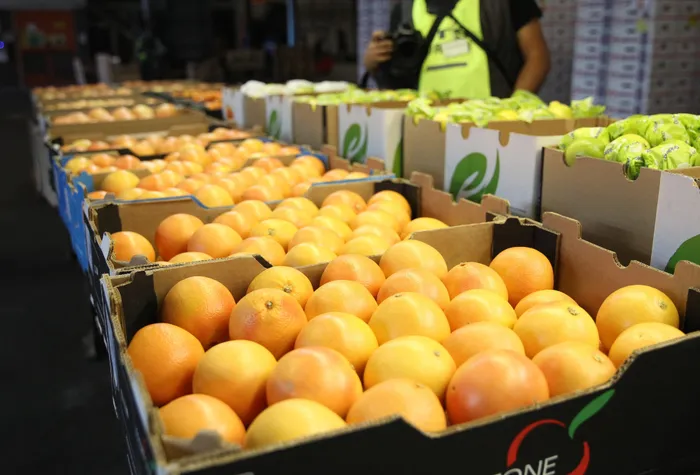
In 2025, Southern Africa exported around 204 million cartons of citrus, with South Africa contributing approximately 193 million cartons.
Image: Doctor Ngcobo / Independent Newspapers
Transnet Port Terminals (TPT) is gearing up for a demanding 2026 citrus export season, building on the momentum of a strong performance last year that saw export volumes surge by 22%.
The State-owned port operator said it has finalised extensive readiness plans in collaboration with industry stakeholders to ensure smooth operations during the peak export window, which runs from April to September.
South Africa exports a wide range of citrus fruits—including oranges, mandarins, lemons, clementines, limes and grapefruit—to more than 100 global markets during this period.
TPT said its preparations have focused on critical logistics areas such as refrigerated container demand forecasting, stack capacity management, vessel berthing schedules, and contingency planning for early or delayed cargo arrivals.
These measures are aimed at minimising disruptions and maintaining efficiency across key terminals in KwaZulu-Natal, the Eastern Cape and the Western Cape.
According to Michelle van Buren Schele, general manager for commercial and planning at TPT, the organisation has worked closely with shipping lines to ensure balanced routing and adequate connectivity between citrus-producing regions and major international markets.
She said all terminals will continue to operate around the clock, offering a 24-hour service across four employee shifts.
“In the event the terminals encounter delays due to weather or operational challenges, there will be immediate communication, and stacks will be extended, where possible,” she said.
TPT noted that coordination with industry players will remain ongoing throughout the season, supported by weekly logistics meetings aimed at monitoring performance and addressing emerging challenges in real time.
A key operational priority will be the rapid turnaround of vessels, with loading plans expected to be finalised within two hours of berthing.
The operator also emphasised the importance of maintaining the integrity of refrigerated cargo. Faulty containers must be reported at least four hours before vessel departure to prevent delays and protect the quality of perishable exports.
Over the past three years, TPT has invested approximately R9 billion in port infrastructure and equipment upgrades. This includes the acquisition of modern rubber-tyred gantry cranes, rail-mounted gantry cranes, mobile harbour cranes, haulers, reach stackers and ship-to-shore cranes.
The investment is aimed at improving efficiency, boosting capacity, and supporting the long-term growth of South Africa’s export sectors.
“With citrus fruit exports growing year on year, South Africa maintains its position as the second largest global supplier after Spain – with current industry plans exploring new markets for further growth,” Van Buren Schele said, adding that the priority this season is to ensure that they deliver predictable operations, improved planning, and an enhanced customer experience.
On Friday, the Department of Agriculture signed a new phytosanitary agreement with the People’s Republic of China to amend cold treatment requirements for citrus exports.
The revised cold treatment protocols are designed to improve export efficiency, reduce costs for producers and exporters, and ensure that higher-quality fruit reaches consumers in China.
The citrus industry remains a cornerstone of the country’s agricultural economy.
“In 2025, Southern Africa exported around 204 million cartons of citrus, with South Africa contributing approximately 193 million cartons. Export earnings surpassed $2 billion (R32 billion) for the first time, reaching an estimated $2.47bn (R39bn).”
BUSINESS REPORT