

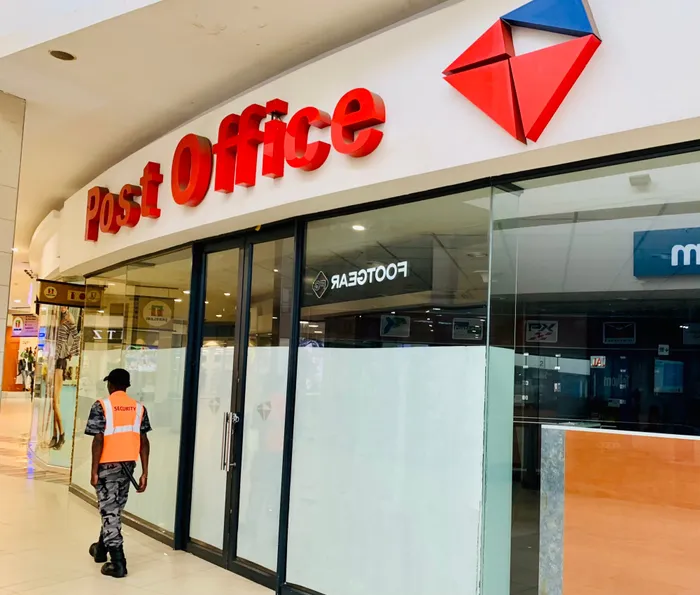
Trade Unions and an economic expert have welcomed last week’s announcement that Business Rescue Practitioners had submitted an application for the South African Post Office (SAPO) to the Gauteng High Court to exit Business Rescue and be handed over to the new board.
Image: Bhekikhaya Mabaso / Independent Newspapers
Trade unions and an economist have welcomed the move to return the South African Post Office (Sapo) to normal governance after Business Rescue Practitioners (BRPs) submitted an application to the Gauteng High Court for the entity to exit business rescue and be handed over to its newly appointed board.
The development marks a significant milestone in Sapo’s lengthy recovery process, which began in 2023 when the state-owned postal operator entered business rescue amid mounting financial difficulties, operational challenges and declining revenues.
Congress of South African Trade Unions (Cosatu) parliamentary coordinator, Matthew Parks, described the announcement as encouraging and a positive response to calls from organised labour for fresh leadership at the struggling entity.
“This is encouraging news following the recent appointment of the Sapo board. These respond positively to the call by the federation and its affiliate, Communications Workers’ Union (CWU), and workers at Sapo for fresh, competent, and committed leadership to be put in place and tasked to restore this once thriving public entity to its former glory and for Sapo to exit business rescue,” he said.
Parks said Sapo's deterioration over the years had been largely driven by poor leadership and a failure to adapt to structural changes in the postal and communications sectors.
“Matters have been made worse by the tenure of the Business Rescue Practitioners (BRPs) appointed through a court agreement with the creditors and the Department of Communications and Digital Technologies in 2023, with little to show beyond retrenching thousands of Sapo employees and plunging their families into absolute poverty and despair, closing hundreds of branches and thus further shrinking its customer base and potential to recover,” he said.
Despite these challenges, Parks pointed to the recovery efforts underway at State-Owned Enterprises such as Eskom, Transnet, Metro Rail and South African Airways as evidence that Sapo can also be revived through competent management and strategic reforms.
He highlighted the Sapo and Postbank Amendment Acts, passed by the sixth Parliament, as providing a framework for the turnaround of both institutions.
According to Parks, the legislation enables Sapo to enter the lucrative courier market and become a one-stop service centre for citizens seeking government services, while also paving the way for Postbank to become a fully licensed state-owned bank focused on serving working-class and rural communities.
Cosatu is now seeking urgent engagements with the relevant ministry and parliament’s portfolio committee to provide assurances to workers regarding job security, outstanding payments and a comprehensive turnaround strategy.
“It is critical that the Treasury provide the necessary financial support to enable such a revival of Sapo to be implemented as a matter of the highest priority,” Parks said.
Prof Simphiwe Madikizela from the University of South Africa’s Department of Economics, said the planned exit from business rescue was an important development for the future sustainability of the institution.
“In spite of technological advancements and the Fourth Industrial Revolution and artificial intelligence (AI), which is here to stay and we should embrace it and leverage on it, there will always be a role for human beings as AI can’t provide empathy,” he said.
“Sapo will, for the foreseeable future, remain strategic, important, and significant for the majority of the population in our rural areas and peri-urban areas or townships and farm areas that are in less developed areas, far from the big cities. The elderly and other important citizens still rely on the Sapo for services.”
Madikizela cautioned, however, that significant challenges remain and that the success of the next phase would depend largely on the quality of leadership appointed to steer the organisation.
“It will very much depend on the skill set, expertise, and competence of the new leadership that gets appointed to take the organisation forward and the new board that will take over on 22 June 2026 to ensure that they build on the success and milestones that have been achieved to see to it that this important institution does not fail in its mandate to deliver services to the people of South Africa.”
Nathen Bowers, CWU national bargaining coordinator, welcomed the move, saying it removes the immediate threat of liquidation.
“However, the relief comes after immense workforce cuts, with over 4,000 staff losing their jobs through the section 189 process," Bowers said.
"The road ahead remains steep. The BRP process accomplished what it is meant for; passing the reins to a new board means SAPO is returning to normal governance as a sovereign entity.”
Meanwhile, Newton Masuku, national spokesperson for the South African Federation of Trade Unions (Saftu), also welcomed the announcement but stressed that additional interventions would be needed to ensure SAPO’s long-term viability.
“Our affiliate DEPACU: Democratic Postal and Communications Union have pointed out that the Business Rescue process has taken too long," he said.
"We have previously welcomed the appointment of the new board, but other interventions such as infrastructure development and more government support are needed, but it is good news.”
BUSINESS REPORT