

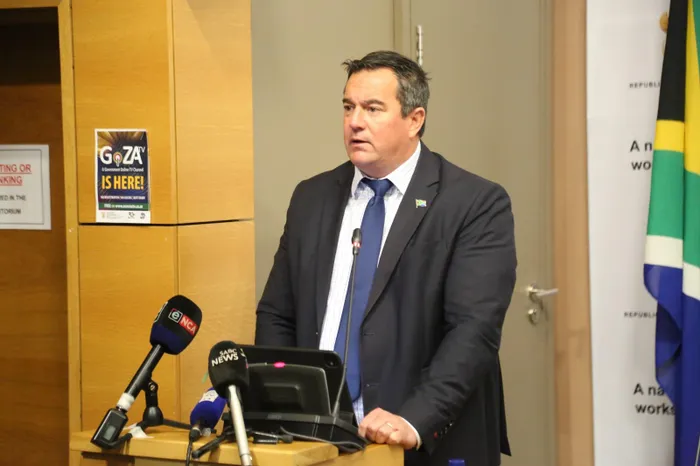
Minister of Agriculture John Steenhuisen warned that climate-related risks are likely to intensify in the coming years, requiring both government and industry to strengthen resilience across the agricultural sector.
Image: GCIS
Minister of Agriculture John Steenhuisen has called for urgent interventions to restore critical infrastructure damaged by recent flooding in the Western Cape and Eastern Cape, warning that prolonged disruptions could threaten agricultural production, exports and the livelihoods of vulnerable farmers.
Addressing the media on Monday, Steenhuisen said he had already engaged with Electricity and Energy Minister Kgosientsho Ramokgopa to address power outages in parts of the Western Cape, where fruit destined for international markets is being stored in cold storage facilities.
“About a week ago, I met with Minister Ramokgopa, where I impressed upon him that we get electricity restored in the Western Cape so that we don't lose the fruits that are sitting in cold storage for exports,” he said.
Steenhuisen stressed that restoring damaged transport infrastructure was equally critical to ensuring agricultural exports continue to flow to international markets. He highlighted the strategic importance of Mitchells Pass, a key transport route used to move fruit exports to ports.
“Western Cape Premier Alan Winde and his team have been working around the clock to ensure that the road is stabilised and is able to get up and running into the future,” he said.
The recent floods have also caused extensive damage in parts of the Eastern Cape, prompting Steenhuisen to announce an upcoming visit to affected areas. Among the hardest-hit regions is the Gamtoos Valley, a major agricultural area known for citrus and vegetable production.
Steenhuisen said many small-scale farmers had suffered severe losses and required urgent support.
“Although disaster management falls under the Department of Cooperative Governance and Traditional Affairs (CoGTA), provincial and national. It also requires us, as the Agriculture Department, to intervene, and that is why we will be going on the ground to see what interventions we can put in place to assist,” he said.
Beyond immediate relief measures, Steenhuisen used the opportunity to advocate for a fundamental rethink of how South Africa manages agricultural disaster risk.
He argued that repeated reliance on state-funded disaster relief was unsustainable and called for the development of a blended agricultural insurance model that would involve both government and the private sector.
“For too long, we have been relying on disaster management funding, and one of the things we have to prioritise going forward is looking at how we do a blended financing model on agricultural insurance, where there is a contribution by the state and other producers,” he said.
“Current agricultural insurance is often out of reach for small-scale farmers and even some middle-scale farmers. An incident like this wipes out their enterprise. I believe it will save the state money; disaster management always ends up blowing out their budget before the end of the year as it is an unforeseen expenditure. The state can't do this on its own; this is an opportunity for public-private partnership.”
Steenhuisen warned that climate-related risks are likely to intensify in the coming years, requiring both government and industry to strengthen resilience across the agricultural sector.
“We are on the verge of La Niña, and that's going to have implications for the planting season. We, as the department and Agricultural Research Council (ARC), need to remain on the cutting edge of technology to help farmers.”
BUSINESS REPORT