

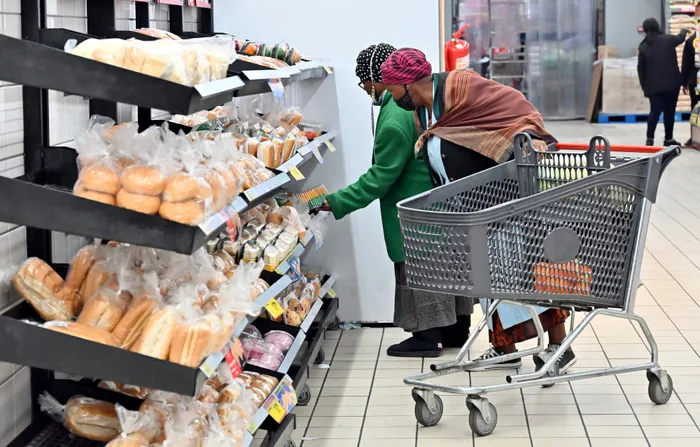
Evashnee Naidu, KwaZulu-Natal regional manager of Black Sash, said the decline in food inflation remained largely invisible to many grant recipients and low-income families.
Image: Ayanda Ndamane/ Independent Newspapers.
South Africa’s food inflation eased to its lowest level in 14 months in April, providing a rare positive development for consumers under pressure from rising living costs, but economists and civil society groups warn that escalating fuel and transport prices could soon reverse the gains.
Statistics South Africa data last week showed food inflation slowed from 3.4% in March to 2.8% in April, even as headline consumer inflation accelerated sharply to 4%.
Wandile Sihlobo, chief economist at Agricultural Business Chamber of South Africa, said the moderation in food inflation reflected improving supply conditions across major agricultural products.
“At the core of moderating consumer food price inflation are lower grain, fruit, and vegetable prices on the back of ample domestic and global supplies, and moderating vegetable oil prices, which underpin the softening of price inflation. We believe meat presents minimal risks to inflation,” Sihlobo said.
“As we stated several times previously, on cereal products price inflation, we are in yet another better production year. South Africa’s 2025-26 summer grains and oilseeds production is forecast at a record 20.8 million tons, up 1% from the 2024-25 season.”
He added that despite recent floods affecting parts of the Eastern and Western Cape, fruit production remained robust, supporting both exports and local supply.
“We are even seeing strong exports of citrus, table grapes, and stone fruits, among others, due to a large domestic harvest. Solid exports also don’t necessarily reduce local supplies; they are key, and the local market remains well supplied. To highlight a few, we also saw strong performance in the various fruit products.”
On the meat sector, Sihlobo said temporary export restrictions linked to foot-and-mouth disease outbreaks were also increasing domestic meat availability.
“Another fact worth keeping in mind is that during foot-and-mouth disease outbreaks, the country is typically temporarily closed to certain export markets, leading to increased domestic supplies, even if the slaughtering has reduced somewhat,” he said.
While agricultural fundamentals remain supportive of lower food inflation, Sihlobo warned that rising fuel prices linked to geopolitical tensions in the Middle East could undermine the trend later this year.
“Fuel accounts for a substantial share of the distribution costs of food products. Fuel also accounts for 13% of grain farmers’ input costs, but farmers are price takers and can’t pass this cost on to consumers except by adjusting their planting decisions in the next season,” he said.
Evashnee Naidu, KwaZulu-Natal regional manager of Black Sash, said the decline in food inflation remained largely invisible to many grant recipients and low-income families.
“The global crisis on fuel is seeing a marked increase in fuel prices which affects both public and private transport and the escalating costs of diesel sees a knock-on effect on food prices,” Naidu said.
“While there has been short-term relief in April, this might not last into further months and provide much-needed relief for poorer households.”
Aliya Chikte, project officer at the Alternative Information and Development Centre (AIDC), said it was concerning that key food categories, particularly nutritious foods, continued to rise faster than overall food inflation.
“When nutritious food becomes unaffordable, the long-term cost is borne in rising rates of non-communicable and preventable disease. Although food inflation is low, headline inflation is high at 4% driven by increases in utility costs and the price of transport.”
She also warned that rising fuel and electricity prices could complicate monetary policy decisions by the South African Reserve Bank.
“South Africa's inflation target was revised in 2025 to a point target of 3%, a tighter anchor that leaves less room to absorb external shocks without a monetary policy response,” she said.
“The tools to control inflation are inappropriate and it will put a further strain on households and economic growth.”
BUSINESS REPORT