

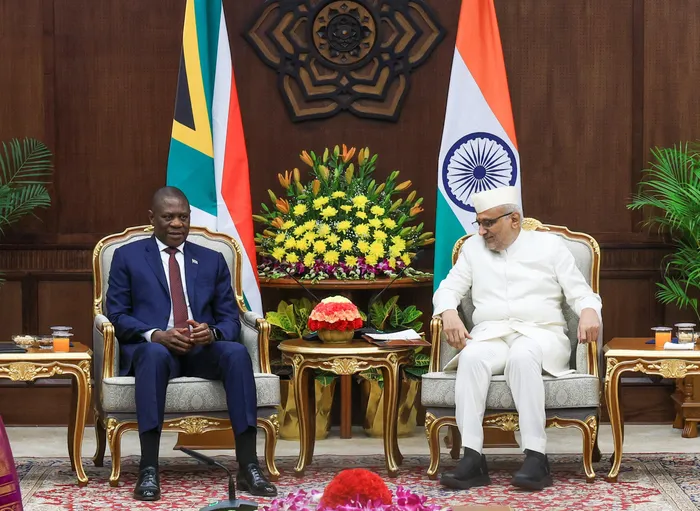
Deputy President of the Republic of South Africa, Paul Mashatile, together with the South African delegation attend a working meeting with His Excellency, the Vice President of India, Shri Chandrapuram Ponnusami (C.P.) Radhakrishnan at the Vice President's Enclave, New Dehli.
Image: GCIS
By Fawzia Moodley
The visit by a high level South African delegation led by Deputy President Paul Mashatile to India, marks the consolidation of relations between the two countries, harking back to the dark days of Apartheid.
The historic ties between India, and the African National Congress, South Africa’s anti-apartheid liberation movement, were based on their mutual desire for freedom from colonialism (for India) and racial oppression in the case of the ANC.
Post apartheid, the relationship between Pretoria and Delhi has morphed into a more substantive alliance encompassing cultural, diplomatic, trade and strategic interests, as well as their shared vision of the world through a principled approach on non-alignment and support for the development of the Global South through South-South partnerships.
Over the years, India and South Africa have sought to strengthen their economies through trade agreements, investment partnerships, skills development and knowledge-sharing initiatives. They have also worked closely within multilateral platforms such as the Non-Aligned Movement (NAM), BRICS, IBSA, the G20 and the Indian Ocean Rim Association (IORA) to promote the economic and political interests of developing nations.
Mashatile, who was met in New Delhi by India’s Joint Secretary (East and Southern Africa) Janesh Kain, made a courtesy call to President Droupadi Murmu and held a bilateral meeting with Vice President C.P. Radhakrishnan to discuss trade and diplomatic ties.
He also met with India’s Minister of External Affairs, S Jaishanker, whose ministry earlier welcomed the South African dignitaries, stating that the “visit will reinforce and impart fresh impetus to India-South Africa strategic ties”.
It comes at a time of global economic upheaval triggered by the US’s war with Iran and the resultant disruption of the global oil trade due to the closure of the Strait of Hormuz. The war, combined with the uncertainty unleashed by US President Donald Trump’s uncertain tariffs, has put unprecedented pressure on both Pretoria and New Delhi, adding impetus to Mashatile’s meetings with India’s captains of Industry to bolster trade between the two countries.
Against this backdrop, Mashatile’s engagements with India’s political and business leaders assume particular significance. South Africa and India already enjoy strong commercial ties, with regular interaction across sectors including information technology, mining, infrastructure, automotive manufacturing, pharmaceuticals, agriculture and heavy machinery. The Deputy President’s visit elevates this engagement to a new level, signalling recognition by both governments of the considerable untapped potential for trade and investment growth.
Indian firms have invested approximately $10 billion in South Africa and more than 150 Indian companies, including multi-nationals such as TATA, Mahindra, Vedanta, Jindal, Cipla, Ranbaxy (Sun Pharma), TCS, WIPRO, Zensar and Tech Mahindra operate in the country.
The strength of Indo-South African economic connection is reflected in the ‘India Business Forum’, which has more than 91 members, with the High Commissioner of India in Pretoria serving as its patron. This is an important platform for commerce between the two countries, with an investment of more than R50bn and its members employing more than 22,000 South Africans.
During the visit Mashatile’s team advocated for “beneficiation led and manufacturing focused investment, particularly in critical minerals such as platinum group metals, manganese and vanadium, as well as pharmaceuticals and renewable energy technologies.”
Recognising the role of small and medium enterprises as engines of job creation, South Africa also proposed the establishment of a South Africa–India SMME Industrial Linkage Programme aimed at promoting supply-chain integration, co-production and joint market access.
The two countries are additionally seeking to leverage South Africa’s position as Africa’s leading digital gateway and India’s globally recognised technology ecosystem. The goal is to move beyond technology transfer towards technology co-creation in areas such as fintech and digital payments, health technology, pharmaceutical manufacturing and agricultural innovation.
An exciting spinoff of the visit is likely to be the establishment of “Africa–Asia Innovation Bridges”, connecting South African innovation hubs, from Cape Town and Johannesburg to Bengaluru and Hyderabad, to support startups, co-investment and global scaling.
In an era of geopolitical and economic uncertainty where old partnerships are being strengthened and new alliances sought and forged, Mashatile’s visit reflects India and South Africa’s determination to harness new opportunities for growth, innovation and prosperity for their people.
* Fawzia Moodley is a freelance writer.
** The views expressed do not necessarily reflect the views of IOL or Independent Media.
BUSINESS REPORT