


Explore how Zipf’s Law, a cornerstone of urban hierarchy theory, fails to accurately depict South Africa’s complex spatial economy, revealing deeper issues of inequality and economic decay.
Image: Ayanda Ndamane / Independent Newspapers
In the theater of regional science, few laws carry the gravitas of Zipf’s Law.
It is the gold standard for urban hierarchies, suggesting that in a functioning economy, the second-largest city will be half the size of the first, and so on.
It implies a natural, almost organic, rank-size regularity.
However, as my recent intellectual banter with Azania Matiwane suggests, applying this "law" to South Africa without the rigour of the Lehohla Ledger is like admiring the smoothness of a veil while ignoring the disfigured face beneath it.
Matiwane’s critique was sharp and necessary.
He cautioned against the "overextension" of Zipf’s Law, rightly noting that the law is descriptive rather than causal.
He argued that a statistical regularity cannot independently diagnose "decadence" or "metabolic forfeits" without the heavy lifting of econometric testing, municipal finance analysis, and longitudinal migration data.
In his view, treating a Zipfian plot as a "moral detector" risks veering from statistical rigour into the realm of quasi-philosophical metaphor.
My retort to Matiwane is rooted in the very essence of the Census Mesh.
The danger of the conventional Zipfian analysis in South Africa is that aggregation is a master of disguise.
When we look at the national urban hierarchy in aggregate, the rank-order appears relatively smooth. It projects a false sense of "Central Place Theory" at work. But this smoothness is a statistical artifact that conceals the fundamental spatial aberrations of our democracy.
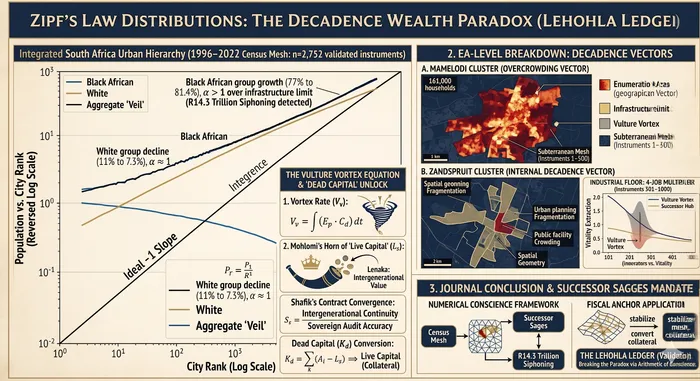
Our spatial economy is not evolving toward a natural rank-size equilibrium, the writer says.
Image: Supplied.
As I shared with Matiwane, the intention is not to suggest that Zipf’s Law caused our distortion, but rather to show how flawed policies use the "ideal slope" to conceal true defects.
In South Africa, we do not have a hierarchy driven by efficient economic competition; we have a hierarchy driven by the agglomeration of poverty and riches.
When we subject our urban centers to Local Indicators of Spatial Association (LISA) and Moran’s I scatterplots, the neatly packaged Zipfian thesis falls apart. We begin to see what I describe as the Vulture Vortex.
Consider the proximity of Sandton and Alexandra.
On a standard Zipf plot, they might be aggregated into a single high-ranking urban node.
But disaggregation—the hallmark of the Lehohla Ledger’s 2,752 instruments—reveals a "deformed Zipf."
We see gated communities siphoning vitality side-by-side with squalid conditions.
This is not a "metabolic" success; it is a metabolic forfeit. The homogeneity of poverty in one ward, adjacent to the enclave of riches in another, undermines the classical index of economic hierarchy.
This debate mirrors the challenges Friedrich Engels faced when finalizing Marx’s Capital.
Engels had to contend with the primacy of capitalist contradictions as a system—dealing with the materialist conception and the "withering away of the state." Similarly, our analysis must contend with the "Capitalist Contradictions" of South African space.
Our spatial economy is not evolving toward a natural rank-size equilibrium. Instead, it is being forced into a shape defined by "decadence"—a structural decline where the "Successor Ledgers" of our current policy frameworks fail to convert the Dead Capital of the townships into the Live Capital of a functioning city.
Over thirty years of disaggregated Zipf plots by race (1996–2022) provide a trove of evidence for regional science.
They show that our urban sprawl is not merely an accident of growth but a deliberate, albeit failing, geometry.
The Black African group growth from 77% to 81.4% has been funneled into overcrowding vectors, while the decline of the White group from 11% to 7.3% remains anchored in high-infrastructure enclaves.
To Matiwane’s point: Zipf’s Law alone does not prove policy failure. But when Zipf’s Law is used to show how aggregation hides the R14.3 Trillion Siphoning of our national potential, it becomes a powerful diagnostic tool. We are not just looking at numbers; we are looking at the Numerical Conscience of a nation.
The banter continues, but the data is clear: we must stop using "regularity" to excuse "aberration."
Only by disaggregating the mesh and confronting the decadence of our spatial structure can we begin the work of true economic convergence.
The "ideal -1 slope" is a goal, not a current reality. To get there, we must first blow the Lenaka of truth and look at the ward, the EA, and the person behind the plot.
Dr. Pali Lehohla is the former Statistician-General of South Africa, Director of the Pan African Institute for Evidence (PIE), and the founder of the Lehohla Ledger. He is a Professor of Practice at the University of Johannesburg and a Research Associate at Oxford University.

Dr Pali Lehohla is a Professor of Practice at the University of Johannesburg, a Research Associate at Oxford University, and a distinguished Alumni of the University of Ghana. He is the former Statistician-General of South Africa.
Image: Supplied
Follow Business Report on Facebook, X and on LinkedIn for the latest Business and tech news.