


Explore how geostatistical analysis of Thabo's life in S’kodi unveils the harsh realities of youth underdevelopment in South Africa and the urgent need for targeted interventions.
Image: Henk Kruger/Independent Newspapers
To understand the journey of Thabo from Skodi through the Lehohla Ledger I have generated a Local Indicator of Spatial Association (LISA) image that visualizes the socio-economic analysis of Skodi in Daveyton.
This graphic maps the geographical dynamics using Global Moran’s I and LISA mapping to define Thabo's environment.
The image illustrates the spatial auto-correlation in Ekurhuleni, showing that Skodi is part of a "High-High cluster" of deprivation and unemployment.
Additionally, it highlights the "neighbor effect" on educational progress and subsequent economic development, showing how localized conditions affect individual trajectories through a "spatial lag" that influences future access to work-seeking opportunities and human capital advancement.
Thabo is a 14-year-old Grade 8 student residing in Sekoti Phola, a neighborhood within the township of Daveyton in South Africa's Gauteng Province.
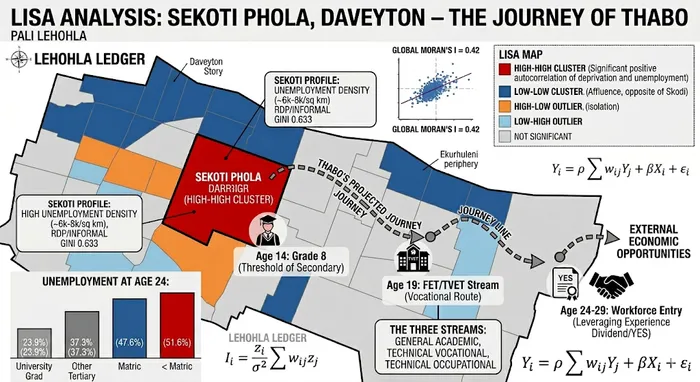
Thabo’s world is defined by stark contrasts and systemic challenges.
Image: Supplied.
To understand Thabo, one must first understand that he is not merely an individual navigating his adolescent years; he is a statistical and social construct defined by his geography.
In the context of the provided analysis, Thabo serves as a powerful case study illustrating how historical spatial planning, economic inequality, and environmental factors converge to shape the developmental trajectory of young South Africans.
Thabo’s world is defined by stark contrasts and systemic challenges. Daveyton is situated peripherally to the economic hubs of Johannesburg and Pretoria, making physical access to job markets difficult and expensive.
The broader municipality of Ekurhuleni suffers from extreme inequality, with a Gini coefficient of 0.633.
Within this region, Sekoti Phola embodies the complexity of South African townships, characterized by a mix of formal RDP housing and burgeoning informal settlements.
For Thabo, this environment translates into a daily reality of "hustling" for survival.
He is growing up surrounded by 6,000 to 8,000 unemployed individuals concentrated per square kilometer, creating intense competition for resources and limiting his exposure to formal economic pathways.
This phenomenon is scientifically captured using the Global Moran’s I and Local Indicators of Spatial Association (LISA) mapping.
These geostatistical tools mathematically "define" Thabo as a resident of a "High-High" cluster.
This means he lives in a geographical hotspot where high levels of socio-economic deprivation are surrounded by other areas experiencing similar deprivation.
This positive spatial autocorrelation creates a powerful "neighbor effect." It dampens Thabo's potential for upward mobility because the economic inactivity is "spatially contagious," reinforcing poverty and limiting his local social capital and job networks.
This environment also forces Thabo to navigate strained infrastructure.
Frequent power outages caused by aging systems and illegal connections, waste management deficiencies, and inadequate water supply impede his educational focus and overall well-being. This creates a precarious backdrop where environmental risk, such as extreme urban heat, compounds his economic vulnerability.
The analysis utilizes a longitudinal lens, drawing on multi-decade census data to project Thabo’s future at key milestones, from age 14 to 29.
His life path is not predetermined, but the probabilities are heavily skewed by his current coordinates.
Ultimately, the analysis of Thabo's life path shows that his future is mathematically tied to the outcomes of his geographical neighbors. While a LISA map defines him as a resident of a "vulnerability hotspot," it also places him within a dense and vibrant community that is central to South Africa's economic future.
Dismantling the "geography of exclusion" that defines Sekoti Phola is essential for Thabo’s success. The 10,000-word study highlights specific intervention pathways: spatially targeted education support, infrastructure to bolster the informal economy, programs expanding workplace experience, and climate adaptation strategies.
Thabo of Sekoti Phola is more than just a name; he is a case study of the broader South African struggle to achieve equality regardless of where a person is born.
His future is not predetermined, but rather depends on whether policymakers can successfully implement place-based strategies to replace the spatial trap with a true "beacon of opportunity."
As we head to the Local Government Elections, we have to reflect on the Century 1976 to 2076 and ask the difficult question of what my generation of 1976 hands down to that of 2026 and what will the generation of 2026 hand down to that of 2076.
Dr Pali Lehohla is a Professor of Practice at the University of Johannesburg, a Research Associate at Oxford University, and a distinguished Alumni of the University of Ghana. He is the former Statistician-General of South Africa.
Follow Business Report on Facebook, X and on LinkedIn for the latest Business and tech news.